

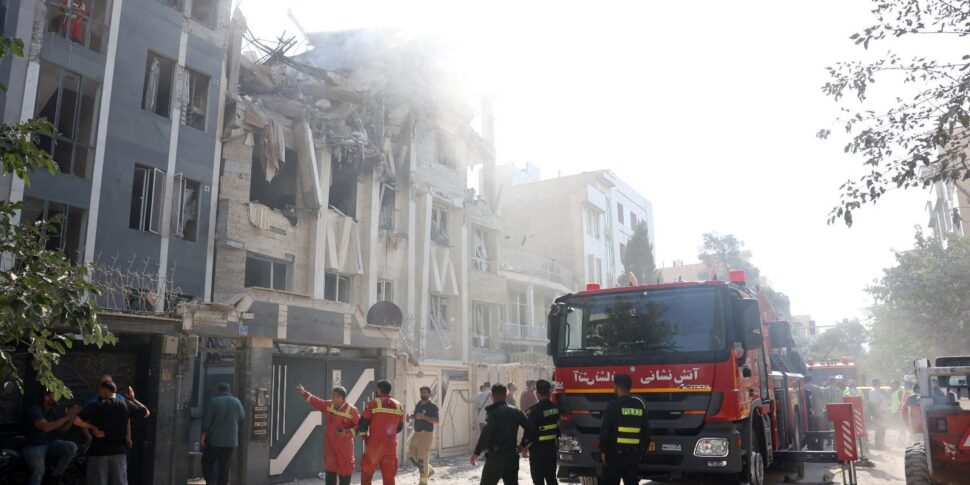
The Iranian armed forces warned that they have no “limits” in their response to Israel after the attacks of the IDF on different cities, including the Tehran capital. “Now that the terrorist regime that occupies AL-SQUDS has exceeded every red line … (there are no limits in response to this crime,” said the General Staff of the Armed Forces of the Islamic Republic in a note. “The Zionist regime and his supporters are responsible for the consequences of the Israeli attack on Iran”, reads the declaration. “The attacks of the Zionist regime could not be conducted without the coordination and authorization of the United States, and the United States, as the main supporters of Israel, are responsible for it”, continues the note. The declaration, cited by Tasnim, invites members of the United Nations, in particular the regional and Islamic states, and other countries to immediately condemn the Israeli attack and to adopt collective action “to end the dangerous adventurism of Israel who has endangered peace and world security”. “The answer is a legal and legitimate right of Iran and the Iranian armed forces will defend the country with all their power and their own way”. This was underlined by the Iranian Foreign Ministry in a declaration.
Where and what the Israeli raid hit
The Israeli attacks last night targeted the Iranian nuclear enrichment, nuclear armament and ballistic missile programs, as well as Iranian nuclear scientists. These are the places where Israeli attacks were reported:
– enrichment complex of Natanz in the province of Esfahan. It is part of the Iranian nuclear program and is an underground enrichment system protected by a concrete shield often almost 8 meters. According to the authorities of the Islamic Republic of Iran, the centrifugation devices of this center were built at a depth between 40 and 50 meters to guarantee “people’s safety” and protection from “possible air attacks”. His existence was denounced for the first time in 2002 by the organization of the Mojhedin of the Iranian people.
– Organization for aerospace industries In Piazza Nobonyad in Tehran. The OIA coordinates Iranian missile production, including the Shahid Hemmat Industrial Group, the Shahid Bagheri Industrial Group and the Fajr Industrial Group.
– Lavizan, Tehran’s northeastern northeastern district is an alleged unresolved nuclear site subject to investigation by the International Agency for Atomic Energy.
– Torre Jahan Koudak, skyscraper in the heart of Tehran. It offers easy access to Haghani, Modarres and Africa motorways and overlooks Abbas Abad hills. It develops on 34 floors, reaching a height of about 153 meters. It houses a restaurant, a swimming pool, sports facilities, courses rooms.
– Farahzad district, in the north of Tehran, is the oldest in the capital and was built 1,500 years ago
– District of Amir Abad, houses an electric power plant in the province of Tehran.
– Sanarzgou district, in Tehran.
– Pars Garna, on via Langari, in Tehran, is a company that provides design and construction services for industrial projects, is controlled by the Defense Industries Organization and is involved in the construction of tunnels and reinforced structures, including PARCHIN, where the research on Uranium’s enrichment through laser has been conducted
– Via Patrice Lumumba in Tehran.
– Residential complex of asid-e sarv in Tehran