

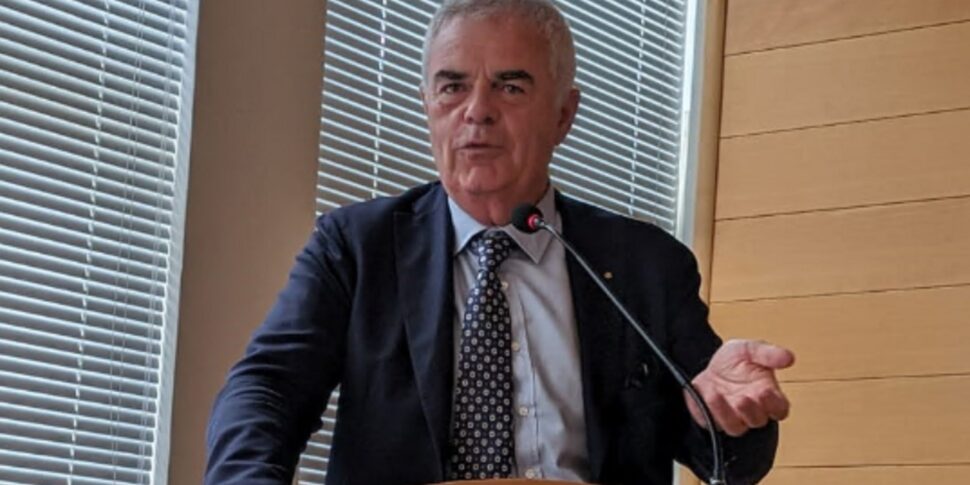
Giovanni Randazzo is a well -known and appreciated professor of the University of Messina. Ordinary of physical geography and geomorphology, it also teaches environmental geology and coastal dynamic, and is among the maximum experts, in Sicily, of geological issues. It is not a “Salvinian”, indeed he had been designated councilor for the sea in the junta of the candidate for mayor of the center -left Franco De Domenico, to the last administrative ones.
After a series of declarations of politicians and technicians on the geo-seismic aspects concerning the construction of the stable connection in the Strait, prof. Randazzo has decided to intervene, especially following the statements of the former president of the Ingv Carlo Doglioni.
“Doglioni – explains Randazzo – is an eminent scientist and says scientifically correct things, but probably did not realize the gravity of what the” Republic “reported, a few days ago, towards us Messina. It is very true, in fact, that there are several other factors to consider beyond magnitude, such as depth, acceleration and oscillation speed that could worsen the effects of the earthquake in the area, with greater shaking. It is also likely that an even more violent earthquake occurs and nobody can foresee the “post-stiff”. The statement is surprising, as, on the one hand it is evident, as the “Strait of Messina” pointed out, which, of course, the bridge was designed by the best scientists in the world, modeling it on the worst predictable conditions, far worse than those of Amatrice and L’Aquila, and this perhaps reverberated on the increase in costs that, considering the reason, are absolutely justifiable. But what seems most unpleasant to me is the political aspect, from the position of the Hon. Bonelli to the one from the senator for the life of Cattaneo. The professor, in fact, makes a shareable scientific reasoning, but the “politicians”, supporting and relaunching his position, forget that between the two banks of the Strait he lives about half a million people who, if what he claimed by the professor should be fulfilled, will have no prospect of the future.
Politicians, scientists and popularies continue to shake the seismic danger for the non -realization of the bridge without thinking about what could happen to the cities of Messina, Reggio and Villa, when an earthquake will occur regardless of the construction or not of the bridge.
For this reason I find shameful – continues the teacher of Unime – who, in order to pursue a confused environmental and/or area ideology, forget that there are people who live around the Strait, who would love that battles were made for active policies in defense of their territory rather than contrasting the only reasonable possibility of development of the area. The bridge will become the world lighthouse of construction technology, safe and anti -seismic, but on the other hand we have the moral obligation to relaunch the seismic prevention of the entire national and local territory. It would not be a success if a tomorrow, as far as possible over time, following a catastrophic earthquake we had to find with an intact bridge between three devastated cities.
For this reason, in parallel with the construction of the bridge, a mandatory anti -seismic activity should be relaunched, which should put the entire public and private heritage of the whole area into reasonable safety. Rather than continuing to look for tricks for the non -realization of a structure that will now be started, the contrary policy (excluding those that pursue ideological environmentalism and almost all local protests who are bearers of a shareable personal interest) should work to relaunch all the possible opportunities for the cities of the Strait.
Furthermore, the movements no Ponte Messina, in an absolutely “nimby” logic, seem to be the territorial devastation that the bridge would bring, forgetting that the realization, in the last fifty years, of a disordered built, exposed to an objective hydraulic-geomorphological danger, has pushed Messina to a very high level of specific risk, among the highest in Italy.
In fact, building without a real overall floor that took into account the cumulation effect, they were struggled, first with a leopard spot and then, continuously, without continuity, the sandy-cyhiaious hills that bordered the historical nucleus of the city; This Dedalo of Palazzi climbs around narrow roads that in their end have an emblematic sign that reads: “Municipal end of the start of the stream”. And would the geomorphological hydraulic danger be the bridge? But it does not end here – the teacher insists -, this same subdivision, with blows of derogations to the PRG, led to the asphyxiation of the Lakes Nature Reserve and the crowding of what is considered one of the most beautiful beaches in Italy, not for what it has behind, but for the magnificent landscape offered by a horizon that is not lost in the sea.
All this constructed coastal has triggered an erosive process of the coast which determined the chase of urgent and decomposed rigid protection interventions that caused the complete stiffening of the coastal system, in fact now completely artificialized. The bridge could not cause new erosion. The construction of the bridge should be linked to an urban regeneration that provides in addition to the impaismic safety, the renaturalization of the system that connects the streams and the coast, promoting the arrangement of the slopes and waterways avoiding further cement flows. The city should be equipped with a new band of beach in defense of the rear coast that should be connected with the hinterland, creating a sustainable and resilient infrastructure, expanding the green spaces and putting them in connection, thus activating ecological corridors without continuity “.