

Google Discover

Preferred Sources
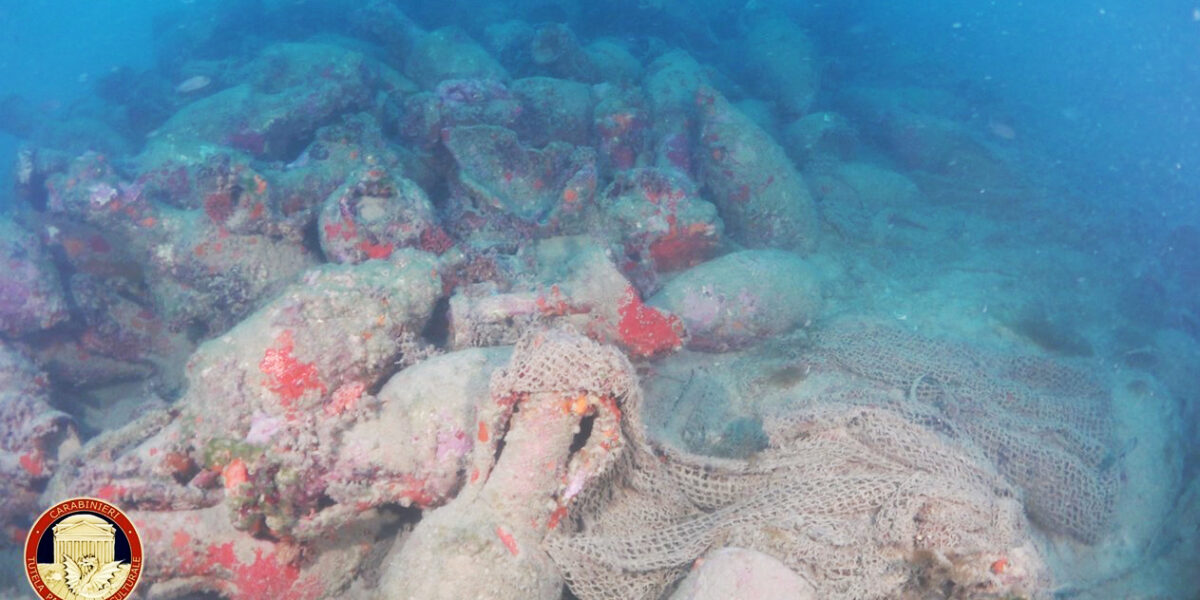
Exceptional archaeological discovery off the coast of Mazara del Vallo. A Roman wreck with hundreds of amphorae identified. The discovery occurred during the seabed reconnaissance activities where the Italian Absolute Men’s Freediving Championship was held. The site has been reported to the Superintendency of the Sea of the Sicilian Region.
During the exploration activities, the athlete Giacomo De Mola and his second/assistant Igor Bisulli identified, off the coast of Mazara del Vallo, a wreck of exceptional archaeological interest, which had remained unexplored on the seabed for over two thousand years.
Giacomo De Mola, world champion in freediving and multiple Italian champion of the discipline, and Igor Bisulli, athlete and federal instructor, are both FIPSAS (Italian Federation of Sport Fishing, Underwater Activities and Finswimming) members. Just as Fabio Portella, an underwater archaeologist and shipwreck expert, is also a FIPSAS member, who subsequently coordinated the documentation activities of the discovery. This demonstrates how the skills developed in the context of underwater sports activities can concretely contribute to the knowledge and protection of submerged cultural heritage.
The identification occurred during a normal seabed exploration activity. An anomaly detected by the echo sounder pushed Giacomo De Mola to carry out a freedive verification dive at a depth of over 45 metres. What initially seemed like a simple rock formation turned out to be a vast accumulation of amphorae belonging to a Roman ship.
The discovery was therefore shared with Fabio Portella, one of the leading Italian experts on wrecks and finds, and the site was reported to the Superintendence of the Sea of the Sicilian Region, which began the study, documentation and protection of the wreck.
The first reconnaissance confirms the exceptional scientific value of the discovery. The wreck preserves an important load consisting of hundreds of amphorae distributed over an accumulation approximately 21 meters long, 6 meters wide and almost 2 meters high. There are also two large lead anchor stumps and a leaden fistula belonging to the vessel’s bilge system on the site.
Preliminary analyzes have allowed us to identify predominantly Dressel 1A type amphorae, together with Lamboglia 2 specimens, amphorae probably of North African origin and a Neo-Punic type amphora. These are finds that testify to the intense commercial network that connected the different shores of the Mediterranean in Roman times.
Fabio Portella and his team carried out a technical dive, creating a three-dimensional (3D) survey of the entire wreck. Digital documentation will allow archaeologists to analyze the site in great detail, while preserving its integrity.
In addition to its extraordinary archaeological value, the wreck today represents a precious natural habitat. In fact, among the amphorae, mostellas, moray eels, brown groupers and lobsters find refuge. In practice, it is as if this place had been transformed into an authentic underwater museum, where history and biodiversity have coexisted for over two millennia.
The activities will continue under the coordination of the Superintendency of the Sea of the Sicilian Region, with the aim of studying the dating of the wreck, reconstructing the commercial route of the ship and better understanding the historical context of the discovery.