

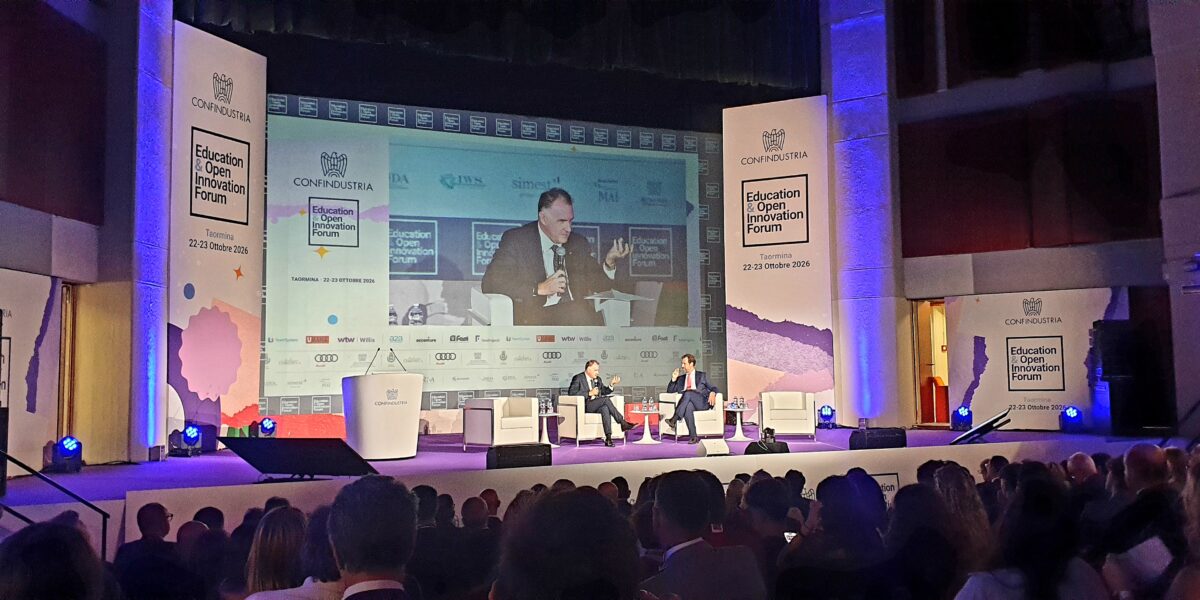
«The accounting is good, but we need to not think about a budget bill, or about tips, the country can no longer afford not to have an industrial policy. The Pnrr is finished, but we need to grow and hope to reach at least 2%. The three things that are fundamental for our country are growth, education and healthcare and to do this we must present a plan that is attractive and concrete and produces trust. A plan of 20-25 billion per year to launch important measures, starting from the maintenance of hyper-depreciation up to the SEZ which has done so much good in the South.”
It is a decisive path traced by the president of Confindustria, Emanuele Orsini, opening the second and final day of the Education & Open Innovation Forum organized in Taormina by the industrialists’ association to reflect on how to guarantee a future for Italian entrepreneurship.
«We must continue to push – he added – to be able to make the country move at the same speed: we cannot think of having a divided country. We must reinvent the strategies, the sovereignties that are needed, Italian and European. Thus, responsibility on the part of all political colors is fundamental.” «We believe in young people and we must ensure that they are attracted to businesses and industry – remarked Orsini – and ensure that for those who go abroad to learn there is a positive return, not a negative one. We need to put merit, wages and housing at a sustainable cost at the centre. This is also why we are pushing as hard as possible to ensure that the house plan is put on the ground quickly.”
Two days of in-depth study on the training-work gap
The analysis defined a clear framework for the in-depth analysis developed during the two days of intense discussion, focused on recovering the profound misalignment between the skills that are learned during the entire training cycle, between school and university, and those actually required by companies, which for almost half of the profiles are unable to find the necessary professionalism, with consequences that impact not only on individual growth horizons, but also on the global dimension of national economic development. Correcting the imbalance must therefore be a shared and priority action for the country system and it was precisely – from the Taormina stage – who represents the Italian industry who clearly recognized the problems but also proposed concrete solutions.
Valditara: yes to school-business dialogue. And there’s no point in smashing it
Among the most awaited was the speech by the Minister of Education Giuseppe Valditara, according to whom the proposal «is very interesting and goes in the same direction as the protocol that we have signed with Confindustria. All trade associations must be ambassadors in business schools and the world of work, that is, they must make our young people and families understand the extraordinary professional opportunities that exist by choosing certain paths.” From the stage of the Palacongressi, Valditara drew up an entirely positive assessment of the results achieved, from those on skills (“for some numbers better than Finland”) to the training of teachers, from the fight against “diploma factories” to school buildings strengthened with the PNRR, highlighting the enrollments in the ITS (“there should have been 11,000 and they are 41,000”) and underlining how the cap on the presence of international minors in the classroom “is not segregation, but integration”. He then recalled the impact of the recent forum on AI at school, which Cernobbio brought together over 7000 male and female students with teachers, companies and institutions. On the sidelines, the minister responded regarding the riots involving many young people, recalling the structured dialogue with the student councils, elected by the school communities: «Concrete examples of how constructive dialogue can contribute to improving Italian schools. It is certainly not by destroying or occupying that the school is improved. The message I want to send is that of valorising representation.”
The detailed debate during the two days
Among the speeches, those of Maria Anghileri, president of Young Entrepreneurs Confindustria, who relaunched the idea of ZES-Ai; Emanuele Levi, CEO of CDP Venture Capital SGR; Patrick Oungre CEO A2A Life Ventures; Renato Dorrucci, managing director Accenture; Niccolò Calabresi Partner Heidrick & Struggles; Euclide Della Vista, president of the ITS Academy Apulia Foundation; Sergio Cavalieri, rector of the University of Bergamo; Francesco De Santis, vice president of Confindustria for research and development; Alessandro Gelain Teacher and podcaster.
Elisa Zscopio, head of the educational programs of Intesa Sanpaolo, launched the idea of training 500 talents abroad with a return pact, while the rector of Luiss Paolo Boccardelli highlighted the need to reform the stage of internships and internships, highlighting the mismatch of skills not only in relation to scholastic training, but also to academic training, recalling how the teacher is no longer the one who transfers knowledge, but the one who accompanies the training. On the first day, among others, the ministers Adolfo Urso and Marina Calderone, the CEO of Il Sole 24 Ore Federico Silvestri and the president of Sicindustria Luigi Rizzolo spoke.
Di Stefano: a 260 million plan for school-business dialogue
Concluding the work of “The Odyssey of Intelligences” was Riccardo di Stefano, Confindustria vice-president for Education and Open Innovation who launched the 2026 edition of ORIENTAGIOVANI in Rome at the Confindustria headquarters on 1 December 2026, reiterating the proposals articulated in two documents, which gave concreteness to the two days: a structured fund of 260 million per year for school training and the strengthening of orientation starting from lower secondary school, with a bridge between businesses, schools, universities and ITS.
“The PNRR leaves us with a wealth of skills, infrastructures and relationships between schools, ITS Academies, universities and businesses. We cannot lose it. – he stated – The Plan concludes, the investments made and the results achieved, however, must have continuity. For this reason we reiterate the request that, starting from the next Budget Law, structural resources be allocated and measurable objectives defined. We must consolidate what has been built and continue to invest in human capital. We present eight concrete proposals. They concern the ITS Academies, the supply chain 4+2, apprenticeships, innovative doctorates, technology transfer and skills for artificial intelligence. We also want to strengthen the relationship between school and business. Our companies must be directly involved in the orientation of children, starting from middle school. For this reason, we will launch OrientaGiovani. We want to help girls and boys to learn more about the opportunities, skills and professional paths of the future. We will start from mechatronics but we will touch on all the most important sectors of Made in Italy. We are not just asking for resources. Businesses are ready to do their part.
The event, moderated by the journalist Concita De Luca and Simone Spetia, of IlSole24Ore – Radio24, was created in synergy with the Municipality of Taormina and the Taormina Foundation, represented by the mayor Cateno De Luca and the president Valeria Brancato, highlighting the consolidation of the ability of the Ionian location to attract large events, including those of a conference nature. Also present were student delegations from ITS Apulia Digital (which created the videos of the event), Volta from Palermo, Aerospazio Sicilia from Vittoria (RG) and Steve Jobs from Catania, the ITS Mechatronics Networks and the National ITS Supply Chain.