

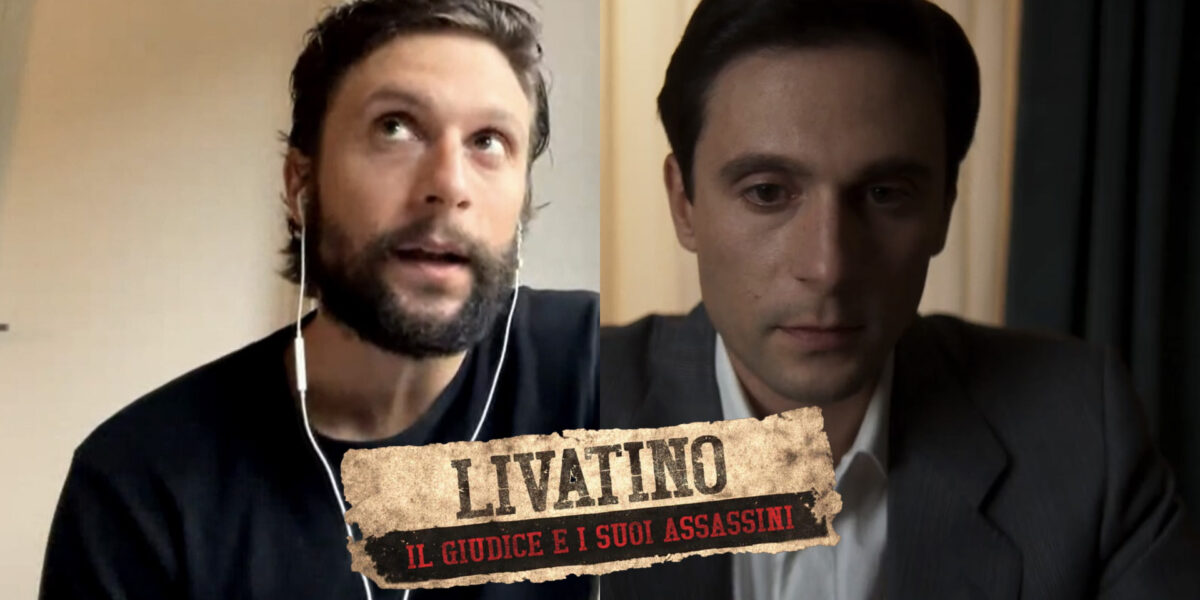
These are the last two years of life. An inflexible life with the toga on. The last two years of the existence of Rosario Livatino, the Canicattì magistrate killed by Stidda on 21 September 1990, are the ones that the miniseries «Livatino – The judge and his assassins» recounts. The first part was broadcast on Rai 1 in prime time yesterday, the second will be broadcast tonight. Michele Placido is directing, while the Messina actor Giuseppe De Domenico plays the protagonist. And in the miniseries there are three other actors from Messina: Ninni Bruschetta and Nino Frassica, respectively the antagonist and Livatino’s father; and Nicola Calì (in the role of boss Di Maggio). A very particular case is that of three protagonists from Messina. To remember a judge of great faith and moral rigor who was proclaimed Blessed and for a month has also been the Patron Saint of Italian magistrates.
So De Domenico, how exciting was it to play Livatino?
«They are different emotions that are all together, this is the beauty of a story that is so complicated and delicate at the same time, I can never find just one, it would be somewhat reductive. It accompanied me for a whole year between studies, filming, post-production, promotion, and now seeing all this attention from people who can’t wait to see the series on Rai obviously makes me very, very happy, that’s for sure.”
Let’s talk a little about before, how did you prepare? I read that you went there to the place, in Canicattì, I was intrigued by a fact you told, namely that Livatino kept a personal register of the films he saw…
«I certainly remember that the impression I had when entering that apartment, I will say perhaps a banality, is as if I was really trying to visualize him and his family moving in those environments, also because they were not reconstructed environments, it was his home in all respects. Entering his room and seeing the notes, his writing, the obsessive order with which he kept the bedside table and all the books and magazines. He actually recorded the films on videocassettes and kept this box set with files inside and in each file for each film he cut out photos and titles from newspapers and pasted them, and commented. These are the things I brought with me, once I even looked through some photo albums, I was allowed to take photos inside the house and family photographs. I left knowing that the mountain of work and preparation was only growing exponentially.”
What does it feel like to play a character killed by the mafia?
«Good question… it’s as if in this case I had a very strange feeling, that of not thinking of having played a character killed by the mafia, that in some way is a consequence that weighs on the history of other men, not on yours. I have the feeling of having played a truly very complex human being, but in reality ultimately extremely simple, because he is moved by love for peace and brotherhood, which is ultimately a very powerful feeling, but in reality very simple, which belongs to the order of nature, where everything in nature seems extremely peaceful, precisely because no one tries to be something different than what it is, so it’s this…”.
Has your way of seeing the mafia organizations in Sicily changed after playing Livatino? What feelings do you have about the before and after, about life and faith above all?
«Well, the exercise of building this character which obviously gave me a very intense life experience, I had the ambition of wanting to give something back to the public rather than interpret, represent something, so I experienced it firsthand and tried to share it with the camera. This means that what has changed in me is that now I am no longer fascinated by power, I can no longer see etiquette and formality, the living room, the media, the press, fame and success, all those that are the constructions of our Western society at least, I can no longer see what they are or what we believe they are, but I constantly see and constantly look for a sincere look in the other, a moment of real empathy, an exchange like you and I are doing now, exchanging words, observations, thoughts. In short, he dismantled the superstructures of judgment and prejudice for me, because the more I delved into his story, the more I realized that at those levels of complexity, having to deal with institutional responsibilities, he managed to find a way to see the human being in front, so once you understand this, any type of relationship changes.”
What was it like acting with two other people from Messina, with those two “old men” Ninni Bruschetta and Nino Frassica, I think it’s a more unique than rare case, three people from Messina who are the protagonists of a fiction, and then what Messina people…
«Eh eh, the icons, our national icons, I didn’t want to believe it at the beginning for this leading role, it’s something that in itself carried a nice emotional load, then on top of that they put the load on me, telling me your antagonist will be Ninni Bruschetta and your father will be Nino Frassica. But I was so happy to have them accompany me in this experience that when I learned from the production plan that they would have a scene together, I wasn’t expected on set that day but I asked the production to go to the set specifically, because I couldn’t miss the moment in which Bruschetta and Frassica, sitting at a table in a club in Canicattì, started talking basically about me. I said: “You understand, as a Messina native I can’t miss this, I have to be there”, and so there was this day in which I was there practically with headphones on listening to them talking about me, just to enjoy this sensation. Now the result is that in any case, both with Ninni and Nino, we spoke today, a beautiful bond has been created, we make good-natured fun of each other for being fellow citizens.”
His relationship with Messina: hate, love, returns, distances?
«I always come back when I can, when I’m away for more than three months I always try to come back… then I need my whole area, Gazzirri, Torre Faro. To stay there, to take my walks, to eat my granitas.”
And when do you happen to be on the ferry?
«In summer or winter I always sit on the bench outside, even if it’s bad, I have to make the crossing there, in the open, feeling like I’m in the middle of the sea, I can’t stay inside. I can even grab an arancino and take it out with me…”.