

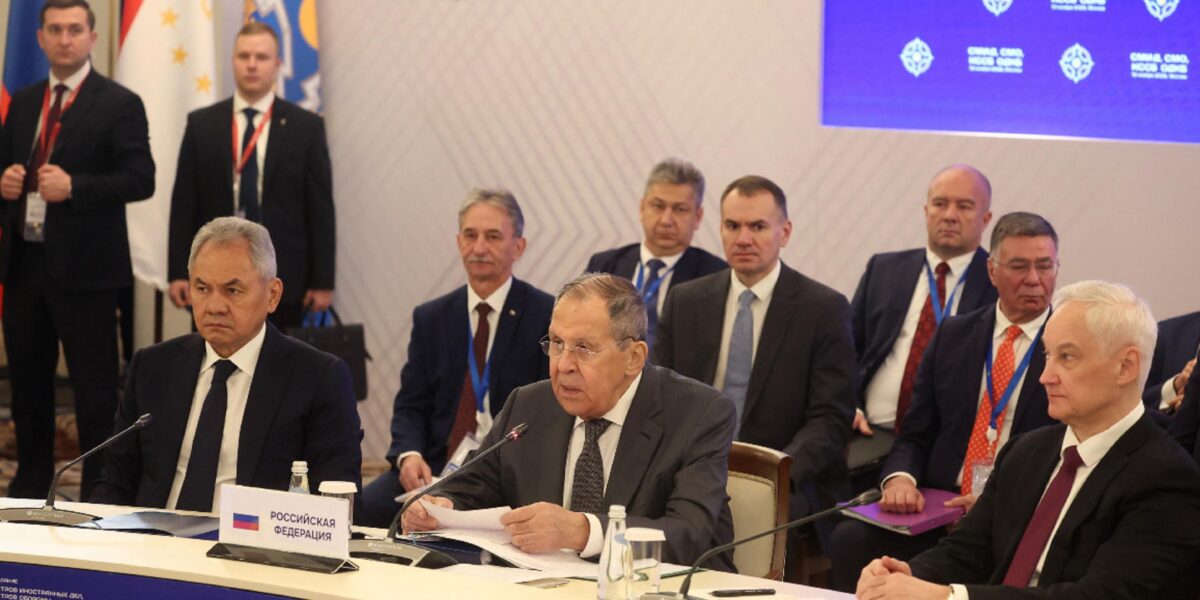
The first day of negotiations in Abu Dhabi ends as many expected. Moscow’s refusal to the main request of Ukraine and its European allies: first the truce and then everything else. «Brussels is simply trying to buy time», cut short Foreign Minister Serghei Lavrov (who was not present in the Emirates). For Russia, therefore, either an agreement is reached upstream on the so-called security architecture in Europe or the war continues. If anything, the novelty can be read, between the lines, in the joint US-Europe-Ukraine statement, which preceded the trilateral, where there is a consensus on the need for “robust security guarantees” in Kiev and on NATO as the “cornerstone” of allied defence.
Negotiations on Ukraine, the positions of Zelensky and Rubio
Then, of course, negotiations are like poker, you don’t lay down the cards at the opening. Volodymyr Zelensky, who flew to Denmark to meet Prime Minister Mette Frederiksen and the Nordic leaders, for example defined the talks as “constructive and in-depth” since “the contents of the security guarantees were discussed in detail” and how to ensure that they “work in the long term”. He then gave instructions to his team “to continue the dialogue” tomorrow and “in the coming days”. US Secretary of State Marco Rubio, for his part, is a realist. “There is still a long way to go”, he commented in the morning, underlining that the United States “never opposed” “direct” negotiations between Europe and Russia, if anything “it was the Russians who didn’t want it”. And in fact on that front we navigate by sight. “The objective is to reach discussions in a multilateral format but we cannot say at this precise moment when this will happen,” highlighted the spokesperson of the European Commission (who is present in Abu Dhabi, alongside the emissaries of France, Germany, the United Kingdom, Italy and NATO, in the person of Ursula von der Leyen’s chief of staff).
Security guarantees and NATO, the confrontation between Europe and Russia
On closer inspection, the primary intention for Europe was to consolidate the common position with the USA, avoiding overly creative interpretations of the concept of security architecture, moreover at a time when the USA is openly talking about disengagement from the Old Continent as part of its military posture (moreover, the review announced by the Pentagon has not yet been delivered to the allies, as it is expected by December). It is no coincidence that Lavrov spoke of his own “programmatic document” on the new security architecture “in Eurasia” and listed, in this context, the other Russian-Chinese acronyms: “the Collective Security Treaty, the Community of Independent States and the Shanghai Cooperation Organization”. EU High Representative Kaja Kallas, in Paris for the G7, spoke bluntly about ambushes by the Kremlin. «These are crucial weeks for Ukraine. We must not fall into the trap of Russian narratives about their alleged security concerns,” he warned. «NATO is a defensive alliance and has never threatened Russia: respect for sovereignty, territorial integrity and the right to freely choose one’s alliances are fundamental principles, not bargaining chips».
The risk, in short, is yet another empty circle. Moscow accuses Europe of only wanting to “buy time for their clients, the Kiev regime”, and does not consider the possibility of direct negotiations “promising” if Brussels does not accept its premises, i.e. the large framework agreement that it wants to extract from the USA. On the other hand, time is running out because the new Congress will take office in January, undoubtedly inclined not to grant discounts to Donald Trump even within his prerogatives. And Zelensky has always said it: the agreement on US security guarantees for Ukraine must be endorsed by the Capitol.