

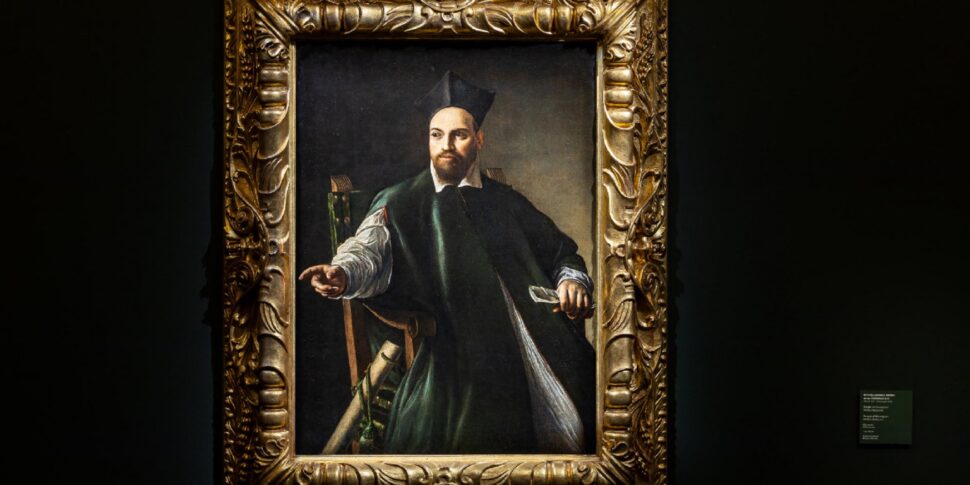
Almost half a million visitors queued in Rome to admire it when it was exhibited, for a few months, at Palazzo Barberini for the Caravaggio 2025 exhibition. Now that painting, a rarity among Michelangelo Merisi’s masterpieces, has been purchased by the Italian state for 30 million euros.
It is the Portrait of Monsignor Maffeo Barberini, an exceptional testimony to the portraiture of the Lombard master: in the limited list of works attributed with certainty to Caravaggio, around sixty-five paintings all over the world, the portraits represent an extremely rare typology, only three are known and certain.
It will now be assigned to the National Galleries of Ancient Art in Rome, permanently entering the collections of Palazzo Barberini, where it was admired at the exhibition which took place during the negotiation phases for the purchase, thanks to an agreement with the owners.
Precisely on that occasion, Italian and international critics unanimously confirmed the attribution to Caravaggio, underlining the exceptional importance of the painting which had been attributed to the master by Roberto Longhi in 1963.
After the recent acquisition of the Ecce Homò by Antonello da Messina, announces the minister Alessandro Giuli, this new operation «is part of a broader project to strengthen the national cultural heritage that the Ministry of Culture will continue to carry out in the coming months, with the aim of making some masterpieces of art history otherwise destined for the private market accessible to scholars and enthusiasts».
In fact, the acquisition represents one of the most significant investments ever supported by the Italian State for the purchase of a work of art. It is “a political and cultural victory of historic importance” rejoices the president of the Chamber’s Culture commission, the FdI deputy Federico Mollicone, according to whom Italy thus reaffirms “its role as a cultural superpower”.
The Portrait of Monsignor Maffeo Barberini depicts the future Pope Urban VIII (1568-1644) around the age of thirty, in the role of cleric of the Apostolic Chamber, in a crucial moment of his rise to power.
When Longhi attributed it to Caravaggio he recognized in the painting one of the founding moments of modern portraiture, with that tendency to underline the psychological intensity and to represent the living presence of the character without resorting to rhetorical elements.
With the way of placing the figure diagonally with respect to the background, the intensity of the gaze, the Portrait reveals the state of mind and personality of the protagonist, an intellectual of the highest social sphere, monumental in his presence, but devoid of rhetoric.
At Palazzo Barberini the painting will dialogue with Caravaggio’s other paintings, with one of the most important Caravaggio collections in the world and, in particular, with another masterpiece by Merisi, “Judith Beheading Holofernes”, also the result of a purchase by the Italian State in 1971.
That operation marked a decisive moment in the modern rediscovery of the painter and contributed to strengthening the presence of Caravaggio’s works in Italian public collections.