

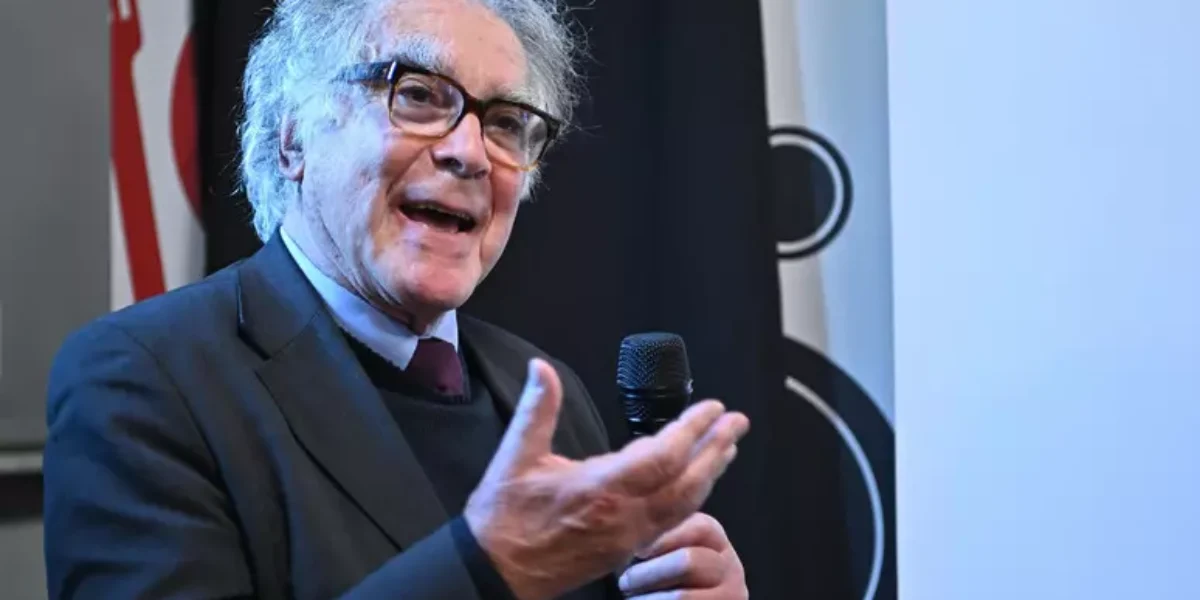
Carlo Ginzburg, Italian historian and essayist, son of the anti-fascist intellectual Leone Ginzburg and the writer Natalia Levi in Ginzburg, has died.
Born in Turin on 15 April 1939, he studied at the University of Pisa and the Scuola Normale, then at the Warburg Institute in London.
He has taught in some of the most prestigious universities in the world: Bologna, Harvard, Yale, University of California at Los Angeles, Princeton. Then he returned to the Normale of Pisa as a professor of History of European cultures. He is considered one of the masters of microhistory, a historiographical movement born in Italy in the 1970s that reconstructs history through the events of ordinary people. Ginzburg’s studies are linked to popular culture, witchcraft, heresies, and religious beliefs of the modern age.
In the mid-1760s, his studies on the trials of the Inquisition led him to reconstruct the story of the ‘benandanti’, the propitiators of a fertility cult in Friuli between the end of the sixteenth century and the mid-seventeenth century. “The benandanti. Research on witchcraft and agrarian cults between the sixteenth and seventeenth centuries” in 1966 was his first publication.
Among other works, “The cheese and the worms. The cosmos of a miller of the 16th century” (1976) where he narrates the events of a miller who lived in Friuli in the sixteenth century through the documents of the Inquisition which condemned him to the stake. With “Investigations on Piero. The Baptism, the Arezzo cycle, the Flagellation of Urbino” (1981) he inaugurated the Microstorie series of the Einaudi publishing house.
He spent his last years in Bologna, where he was often seen in the centre. He had two daughters with Anna Rossi-Doria (later ex-wife): Silvia, art historian, and Lisa, historian of philosophy and writer.