

The war is not only the one being fought with missiles and drones in the skies of the Middle East. The other war, more silent but equally exhausting, is the one that takes place every day in the company warehouses, artisan workshops and shops of this land. It is the battle against the instability of the markets, against energy that changes price in the space of a few hours, against a chain of costs that lengthens and forces the productive fabric to defend itself to stay afloat.
In this grim scenario, small and medium-sized businesses no longer pursue innovation or expansion but simply try to resist the history that passes over their heads.
The new geopolitical crisis and the effect on energy markets
The new geopolitical crisis, which opened after the American and Israeli aggression against Iran, is grafted onto an already fragile economic balance. International tensions have reignited the volatility of energy markets and brought all of Europe back into a spiral of price increases that seemed to be over after the hardest season of the war in Ukraine.
A mechanism which for structurally more fragile regions risks becoming a brake on development. In Calabria, for example, energy hyperinflation threatens to further compress the narrow production margins of small companies and household consumption.
The first alarm signal comes from the CGIA Research Office. The military attack on Iran could cost Italian companies almost 10 billion euros more as early as 2026. The dynamic is linked to the surge in gas and electricity prices recorded in recent days.
If international tensions were to consolidate into a structural increase in prices, Italian companies would find themselves paying around 7.2 billion more for electricity and another 2.6 billion for gas, with an overall increase of 13.5 percent compared to 2025.
Energy prices and the impact on the production system
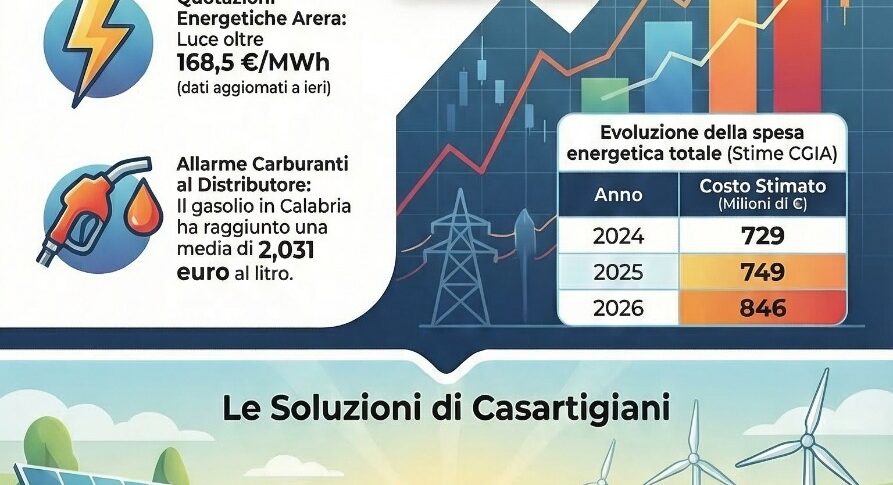
The photograph of the energy markets shows the dimension of the phenomenon. On the eve of the Israeli-American attack on Iran, gas was trading at around 32 euros per megawatt hour and electricity at just over 107 euros. In the space of a few days, prices jumped to 56.1 and over 168.5 euros respectively (these are those updated yesterday by Arera), reflecting the tension affecting one of the most delicate areas for the world’s energy balance.
However, the picture remains far from the peaks reached in 2022, immediately after the entry of Russian tanks into Ukraine, when electricity reached over 300 euros per megawatt hour and gas exceeded 120. But the sign of instability is enough to rekindle the alarm among businesses.
In this scenario, Calabria is also observing the price trajectory with concern. According to CGIA calculations, the energy costs incurred by companies in the region are destined to grow from the 749 million estimated for 2025 to 846 million in 2026, with an increase of 97 million equal to 12.9 percent.
A dynamic that weighs on a production system made up mainly of micro-enterprises, where every change in bills translates into tighter margins and reduced investment capacity.
The alarm of the trade associations
The alarm is also raised by Confartigianato, which in recent weeks has recorded a new surge in energy prices. Added to these increases is the growth of fuel: diesel has reached a regional average of 2.031 euros per litre, with an increase of over 15% in just a few days.
The confederation invites us to maintain high vigilance on the energy markets to avoid speculation and asymmetric price shocks, as happened in 2022. The risk, the artisans explain, is that a persistent increase in oil and gas fuels a new inflationary flare-up.
Energy costs would rise for families and businesses, while any increase in rates to contain inflation could compress investments and consumption, further slowing down already fragile growth.
The proposals for Calabria
It is precisely on this terrain that Calabria appears most exposed. Here the economic system has coexisted for years with insufficient infrastructure, small company sizes and an energy cost differential that is often higher than the national average.
This is also underlined by Giovanni Misitano, regional leader of Casartigiani, who speaks openly about a region already penalized by higher energy prices compared to other areas of the country.
In a context where many companies work with limited margins, further price increases risk having serious effects on employment and development.
According to the association, the combination of the energy crisis and the damage caused by recent climate events could translate into an overall economic loss close to one and a half billion euros.
For this reason, Casartigiani proposes to the Calabria Region a plan based on three axes: a regional fund to support families in energy poverty and micro-enterprises not covered by national bonuses; the strengthening of the Feeri fund with more streamlined procedures to encourage investments in photovoltaics and energy efficiency; and, above all, a long-term strategic plan capable of transforming Calabria into a renewable energy producing area.
It is a perspective that recalls an evident contradiction. In fact, Calabria has extraordinary potential in the field of renewables but continues to depend on an energy system that exposes businesses and families to the fluctuations of international markets.
The challenge for the future does not only concern cost containment but the ability to transform a structural fragility into a new opportunity for development.