

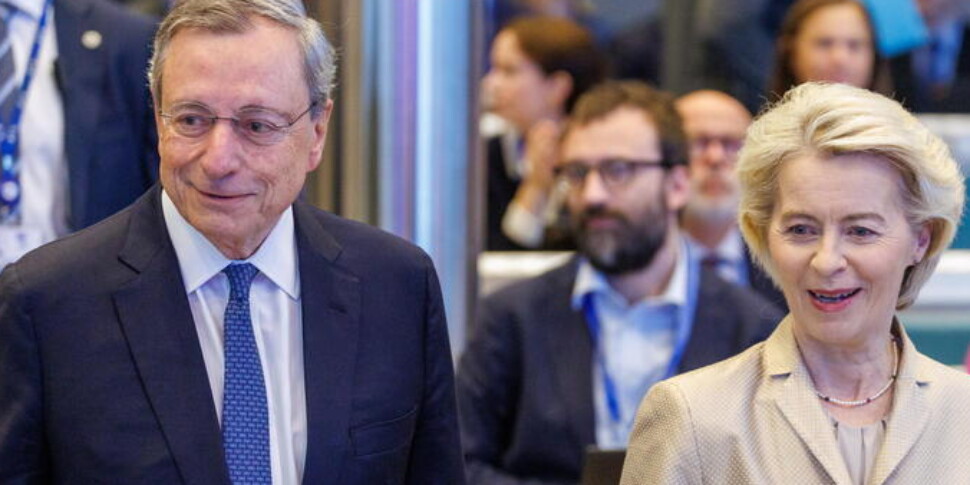
“A year later, Europe is in a more difficult situation. Our growth model is disappearing. Vulnerabilities are increasing. And there is no clear path to finance the investments we need. It has been painfully remembered that the inaction threatens not only our competitiveness, but also our own sovereignty”. Mario Draghi said it at the high -level conference ‘one year after the Draghi relationship’, with Ursula von der Leyen.
“Citizens and European companies appreciate the diagnosis, the clear priorities and the action plans. But they also express a growing frustration. They are disappointed by the slowness of the EU. They see us unable to keep up with the speed of change elsewhere. They are ready to act, but they fear that the governments have not understood the severity of the moment”, added Draghi to the conference in Brussels on the first year of his report on competitiveness. “Too often there are excuses for this slowness” and “this is pleased”, he underlined, exhorting to “new speed” and results “within months, not of years”.
“The United States imposed the highest rates from the Smoot-Hawley era. China has become an even stronger competitor. We have also seen how Europe response is limited by its addictions, even if our economic weight is considerable. The addiction to the United States for the defense has been mentioned as one of the reasons why we had to accept a commercial agreement in large part at the American conditions,” said Draghi.
According to the former president of the ECB, “the EU’s public debt is intended to grow by 10 percentage points in the next decade, reaching 93% of GDP, with more optimistic growth hypotheses of today’s reality. A year later, Europe is therefore found in a more difficult situation. Our growth model is vanishing. The vulnerabilities are increasing and there is no clear path to finance the investments that we need,” underlined.
“In some sectors, such as the automotive one, the” EU “objectives are based on conditions that are no longer valid”. Mario Draghi said it at the EU Commission’s conference on the first year of his report on competitiveness. “The 2035 deadline for zero emissions to the exhaust had been designed to trigger a virtuous circle – he underlined -: clear objectives would have pushed investments in charging infrastructures, made the internal market grow, stimulated innovation and made the cheapest electrical models. It was expected that batteries, microchips developed parallel. But this did not happen”.
It is necessary “to consider a common debt for common projects – both at the EU level and between a coalition of Member States – to amplify the benefits of coordination”, explained Draghi. “The joint emission would not magically expand the tax space. But it would allow Europe to finance larger projects in sectors that increase productivity – innovations, large -scale technologies, research and development for defense or energy – where national expenditure is no longer sufficient,” he added.
Von der leyen: “The routine is no longer enough, the EU must act”
– “I am absolutely convinced that Europe can join around this program. Each single member country has approved the Draghi report. And so the European Parliament did. We all know what it is necessary to do. The ‘Business as Usual’, the ordinary administration, no longer works. This is my final message today. European citizens expect our democracy to decide, act and give results”. This was said by the president of the EU Commission, Ursula von der Leyen, opening the Conference on the first year of the Draghi report. “We have already shown what is possible when we have ambition, unity and urgency. It is our choice,” he added.