

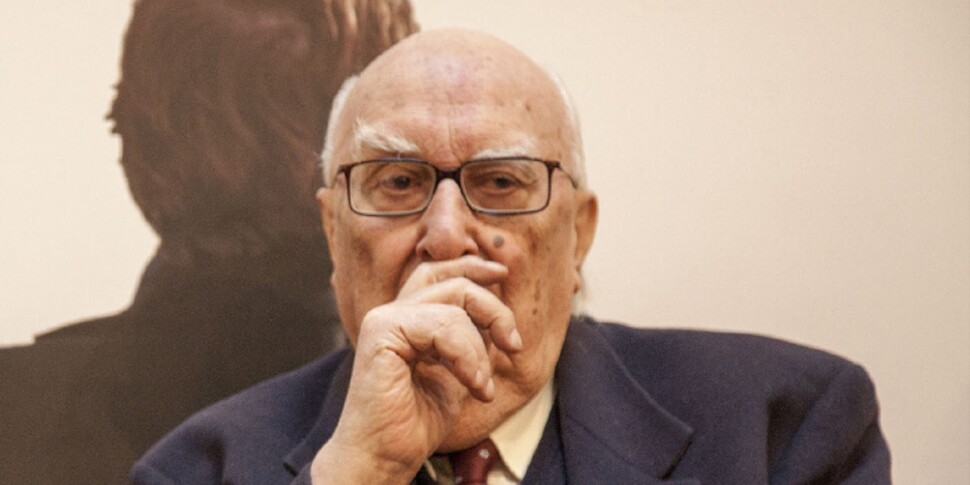
That Camilleri was Camilleri before the literary and popular phenomenon that has become, is a fact. The mitographic “novel” of his youthful family letters attest this, “I will write to you again. Letters to the 1949-1960 family “(Sellerio 2024) edited by the Italianist Salvatore Silvano Nigro, one of the greatest scholars of the master (he known his refined” implications “reviews for the Sellerio editions) and with the collaboration of the daughters of Camilleri, Andreina, Elisabetta and Mariolina, pages that travel the parable of a young man who writes to his parents who would not be able to present what he would not know, We know.
A “such” Camilleri, as stated in the double Pirandellian of “Riccardino”, book-Congendo, from the complex gestation, of the Montalbaniana saga, posthumously by the author’s will, a “great man of man” because he speaks with his character, calling, sending fax, citing the television Montalbano, giving him straight and making them reveal the investigations to then transform them into the investigation. Stories. And whose visionary rope (“a sort of visionaryness that took him more and more frequently” as Camilleri said to Marcello Sorgi in “The head makes us say”) deployed behind the “sinuous course of things” (expression of Merleau-Ponty to which “the course of things” is inspired), to represent the world seen from the Gran Teatro della Sicilia.
Anniversaries are important appointments, and sharing is certain in celebrating his hundredth birthday in the absence of the master (he was born in Porto Empedocle on September 6, 1925), with multiplier initiatives of stories, meetings and memories. But even if Camilleri is an evergreen (we continue to rebuild his novels and his stories with special editorial operations), the celebrations can be insidious when the rites of the memory risk containing too much and the compartment, when it is easy to do it under the Camilleri effect, which, however, grows and lives very well in the many children and aesthetic grandchildren who have learned his lenses. Celebrating the one who at ten years had met Pirandello who had played at the door of the house in uniform as an academician and embraced his grandmother, means asking himself how that curious gaze of the little “nené” since childhood filled the reality, exceptional or dramatic, poor or banal, with fantasy and with the books, those he liked and then will please Montalbano (who reads them after him …). landscape starting from a detail, from a suggestion, by a dream or memories of facts narrated by others.
Had he was still alive, who knows what the teacher would have thought, with the barbarism of the times that run and that sub species of Tiresia he told without ever leaving the end of the narrative invention with which he conquered a vast and loyal audience, who rewarded him with affection. Camilleri knew that literature cannot find an already ready audience, but he struggled to have it, a challenge that is not easy, although the taste of the challenge was for him an exercise of life. The largest was to write in a “” nvintate” language of a “” nvintato” place, and having unveiled “the unit of the place of the Vigatese Arena” (so Salvatore Nigro), the Vigàta who “applisted as the parody of Manhattan on a reduced scale”, as we read in that epiphany of Commissioner Montalbano who is “the shape of the water”. A challenge to have put in that “Vigatese Arena” crimes and deceptions, ignorance and prejudices, crimes and intrallazzi, “stramme” and truculent stories, conscious and unconscious, mafia scenarios and denied human rights, which I miss New York …
That the crime belongs to us but there are those who belong to the crime, and the truth confused to lie assumes the appearances of the truth, as Sciascia said, that the tangle of that matter that life is needed a form and therefore a mask to consist, according to Pirandello (Sciascia and Pirandello, the two Dioscuri di Camilleri with whom he shared the genius loci), but he knew it well, And humor, thanks to the “Camillersmi” made popular by the success of the TV series (even if with the risk that from stylistic figures they became catchphrases), this too was a challenge. Staying up between the paper and television character, without the one devoured the other, while in the meantime he became the most prolific and sold author of the last thirty years, Camilleri was supposed to at his long experience as a theatrical director and delegated Rai production, thanks to which he built his novels, from the first page-scene, just like the curtain of a theater and we are witnessing the stories of the others, who are the stories of each of others. We, what we do not have the courage to say to ourselves.
The Maestro knew with Calvino that multiplying the stories is one of the vocations of the modern novel, and “to bet with the unaware Calvino according to which it was impossible to set a yellow novel in Sicily”, and with himself, author of a “historical” novel as “the beer of Preston”, he had decided to “put black on white” a police whose protagonist, commissioner Montalbano, had “seen” in his visions. The Montalbano cycle would have become a long social novel to explore the ever closer relationship between crime and society, the theme on which Camilleri has made lessons of literature.
Had he was alive, he would have told between wit and paradoxes that we need stories of fiction, to be repeated tirelessly to know the face of humans, changing and always the same organisms. This was his poetics, and the “Camilleri case”, his explosion and fertile proceeding, in front of which he was distanced, after sitting in the meridians, he can certainly be right in the history of Italian literature, without this thinking of replacing Don Lisander, as the master had said, dissociating himself from the initiative, when – Nigro remembers him – in a Sicilian high school Replace “I Promessi Sposi” with “The Beek of Preston”.