

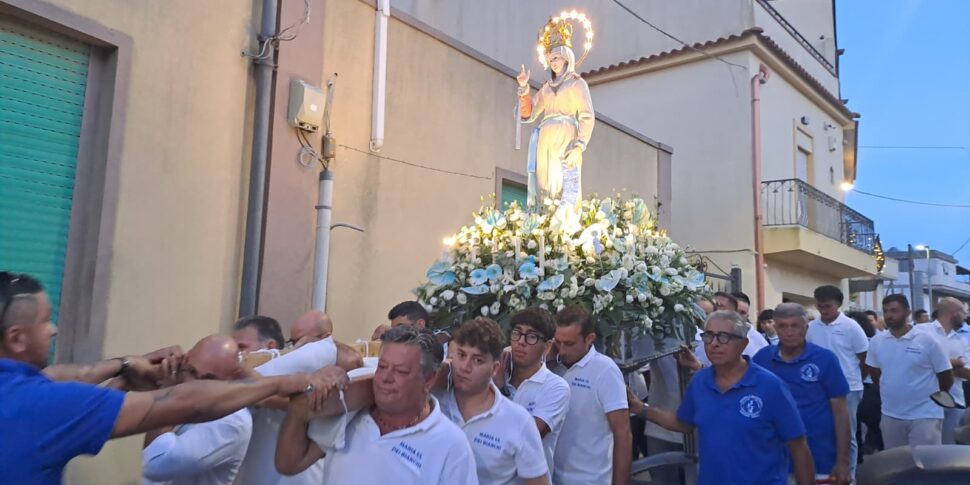
Traditions between history and devotion, which sanction the identity of a people and pass on the “story” from the old people to the new generations. This is what happens in the village of Curcuaci, the small Swiss Messina, who celebrated his patron saint, the Madonna dei Bianchi. A title already known because used for the Virgin of Montalto, known as the white lady. A party with a renewed flavor that lived together with the parish priest Don Gianmarco Restuccia, who since last year wanted to have young people to ideally collect the witness of this ancient tradition, enriching the historical group of bearers of their presence.
A festival lived in the sign of welcome for the entire community: during the new space for prayer but also to the convivial initiatives prepared by the parish priest together with the feast committee and to the support of the sixth municipality represented in procession by the vice president Salvatore Scandurra and the councilor Giovanni Donato, who is spent so much for the success of local religious events. At the end of the mass presided over by the provincial minister of the minor friars Antonino Catalfamo, the simulacrum was brought to the short procession on the shoulder by a large group of bearers, accompanied by the many faithful who renewed their yes to the Virgin. According to what has been handed down by the historian Placido Samperi in the text “iconology of the glorious Mother Virgin of God Mary, protector of Messina”, in 1347 a farmer was burning the land when he presented himself, under the remains of a pilgrim, Jesus, who gave him three loaves, ordering him to throw them in the nearby stream. The man was about to perform the order, when the Madonna “with Candide Vestimento and the Red Cross came to meet him” persuading him not to make that gesture, because those breads to be thrown were the symbol of three great assets that would come M enlarged due to as many very serious punishments that looked into the city of Messina: the plague, the famine and the war, deserved due to the negligence of citizens. The pilgrim, indignant by the disobedience of the farmer, ordered him to throw the loaves into the stream; However, he just had time to launch the first who came the “white lady” by ordering him to go to the archbishop to ask him to ask for a general penance while she would have prayed for the Messina. The penance was performed and of the three punishments, only the first – the plague (probably, precisely that of 1347) – was inflicted. For this reason, to Curcuraci, in the place of the apparition, a church was erected with the statue of the Madonna dressed in white, with the sign of penance in hand, the scourge. Since then devotion has been perpetuated over time culminating on the first Sunday of September.