

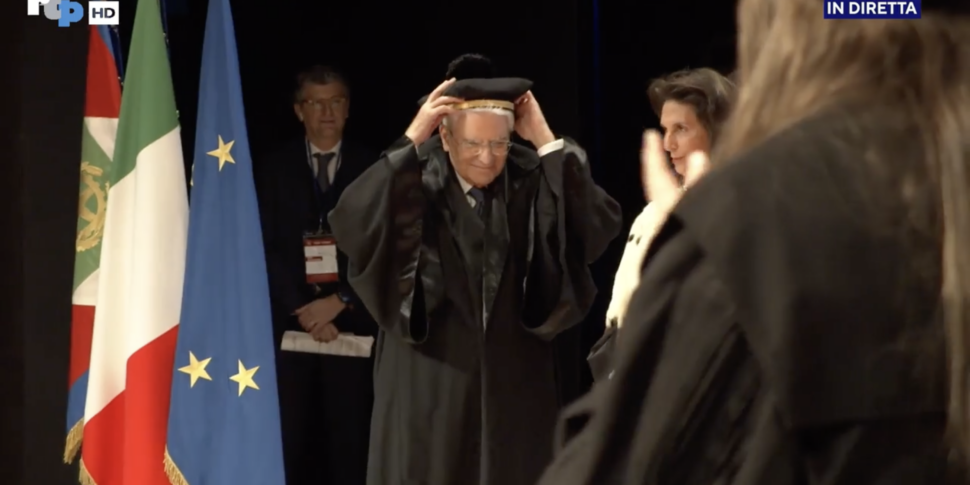
Greeted with warm applause, the President of the Republic Sergio Mattarella received the academic robe, the touch and the honorary research doctorate diploma from the rector Giovanna Spatari.
So, wearing the toga, the head of state began his speech by thanking the rector and the academic communitydefining “students are the raison d’être of this university and of every university. I feel the honor of this recognition and I thank Prof. Silvestri for such generous laudatio”.
The starting point is the process of birth of the European Unionwhose first steps Mattarella recalls, even before the Messina conference of 1955, starting with the Treaty of Paris. “Why coal and steel? An agreement on energy and armaments, the economy was the instrument, but the aim was peace, solid and lasting after the two world wars. Economy and peace continued to be at the center, and after the decisive meeting held here in Messina in June 1955, the six countries signed the Treaties of Rome. The architecture of a common market was thus defined. The project expanded greatly, but the goal remained the same: an era of peace and well-being, based on cooperation and friendship between European states and peoples. One theme has taken on growing importance: the implementation of the rules produced by the Union, at a European and state level. To define the originality of the European model, the term multilevel government has been used. The European community is an apparatus that acts but above all makes people act. In an initial phase, the European Union was based on indirect administration, hence a certain degree of heterogeneity in individual applications. There has been an adaptation of administrative processes, characterized by an increasingly greater level of integration, with the creation of bodies. The evolution of the Committees, which have become places of meeting and exchange of knowledge, is significant and emblematic. The tendency to create common and unitary disciplines is interesting, the integration between national and community levels has become so intense as to make it difficult to identify an effective line of separation. States have taken an active role in applying the rules.” Mattarella makes an excursus on the many manifestations of European integration, the true heart of his speech and mentions the Next Generation complex of reforms and investments, in response to the crisis generated by the pandemic. “Over time the dividing line between direct and indirect administration has become increasingly blurred. It is worth underlining how this means that the implementation of Union law is the result of dialogue and cooperation. The greater efficiency of the administrative machinery and the intensification of controls must be accompanied by mechanisms that defend businesses and citizens”, and the reference is to the strengthening of European administrative law, but also to the principle of loyal collaboration enunciated by Article 4 of the Treaty of Union. “With the Treaty of Lisbon, specific attention was paid to the administrative issue, which becomes of common interest. The provision that the effective implementation of Union law is essential is fundamental.” The principles of the administration of the Union and of European law are at the center of Mattarella’s lectio doctoralis, as are their daily applications: “During the pandemic, the commission negotiated the supply of large quantities of vaccines, obtaining them quickly . Everyone knows the Erasmus project. Over time, alliances and forms of cooperation have developed between the universities of the Union. Union that imposes rigorous food safety standards. We feel confident about drugs and their testing. Intellectual property is protected at European level. Our flights are safe according to the rules established at European level. Crime is fought more effectively. This does not mean ignoring what the limits are, we must work to remove them. Phenomena such as climate change, the energy crisis, the shortage of essential raw materials, migratory movements, security and the digital transition require integration between national and supranational parliaments, a European dimension. Only through close coordination is it possible to ensure effective measures and provide adequate responses to the challenges of globalization.” But there are limits: “There is a lack of effectively integrated political space, in individual contexts the European Union too often continues to be considered a foreign entity. The limited political awareness that the Union has of itself limits its action. Yet what is happening at an international level, with conflicting and even destructive dynamics, brings out the necessary solidarity of EU countries. In recent times the financial crisis and pandemic have been opportunities for courageous choices, however this attitude is no longer sufficient, the turning point in history we are going through requires the awareness that European states individually are not capable of giving effective responses. I recently took the liberty of saying that European states are divided into small states and states that have not realized that they too are small”.