

In the last few hours, the Iranian Revolutionary Guards said they had hit an Israeli F-16 fighter in the skies of central Iran, saying the crash occurred at 3:45 in the morning. According to Tehran, it would be a “hostile aircraft belonging to the Zionist regime”. The Israeli version, however, appears more cautious: the army confirmed the launch of a surface-to-air missile against one of its aircraft engaged in an operation in Iran, but underlined that there would be no damage. It therefore remains uncertain whether the two reconstructions refer to the same episode or to distinct events, while the absence of independent verification contributes to fueling the ambiguity.
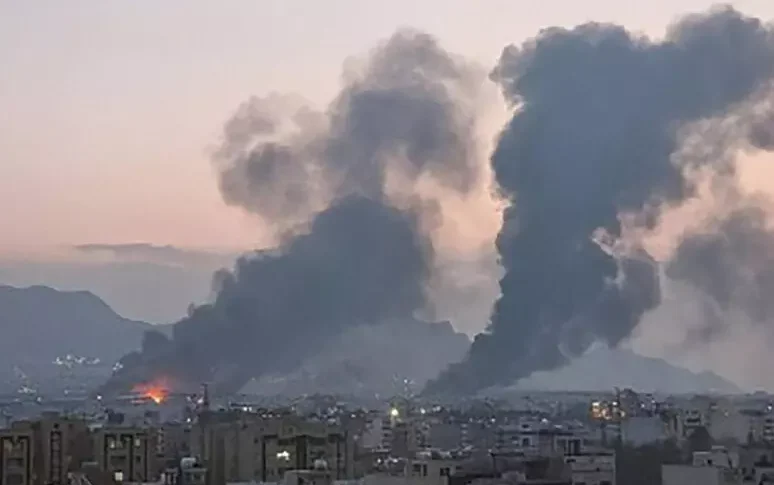
To further complicate the picture, Iranian media released images of smoke in the sky, claiming that a second plane had been targeted, but without providing details on its identity. Again, the information has not been confirmed by independent sources.
Explosions occurred, however, at a US military base in Bahrain, as reported by Iranian state media, while local authorities invited the population to take shelter. According to Iranian news agency Tasnim, several explosions occurred at the US-owned Juffair military base in Bahrain. On its Telegram channel, the Iranian newspaper states that several powerful explosions were heard throughout Bahrain this afternoon. The news came as Bahrain’s Interior Ministry issued a warning to its citizens on social media, inviting them to “go to the nearest safe place” due to the sirens signaling the arrival of attacks.
The most recent developments are part of a sequence of episodes that indicate a progressive increase in military pressure in the region. Only a few days ago, Tehran claimed to have hit a US F-35 fighter, declaring that the aircraft would have been seriously damaged. According to rumors reported by American sources, an F-35 actually made an emergency landing in the Middle East after being hit, although details remain limited.
At the same time, Israel has intensified its offensive operations. The Israel Defense Forces announced that it conducted a large-scale nighttime operation against dozens of targets in Iran, particularly focusing on infrastructure related to the development of ballistic missiles. Targets hit include production plants, component depots and facilities linked to the Iranian Ministry of Defense. According to Tel Aviv, these attacks aim to significantly compromise Iran’s ability to produce strategic weapons and represent a direct response to what it describes as a growing threat to Israeli national security.
Alongside the military dimension, the energy dimension also emerges strongly. Iran is loading about 4 million barrels of crude oil on Kharg Island, with an estimated value of more than $400 million. The operation, monitored by maritime intelligence companies, signals Tehran’s desire to keep its exports active despite the context of instability. Meanwhile, Iraq announced the resumption of imports of Iranian gas after a three-day disruption caused by an attack on an energy facility in Iran. The flow has returned to around 5 million cubic meters per day, a level lower than previous agreements. Iraq’s dependence on Iranian gas – which covers around a third of the country’s energy needs – makes Baghdad particularly vulnerable to regional tensions. Frequent power outages and fragile infrastructure accentuate the impact of any shock on the national energy system