

New storm on the markets, with volatility skyrocketing due to the escalation of the conflict in the Middle East. The US attacks on Israel on Iran’s oil and gas platforms yesterday, to which Tehran responded today by hitting platforms in Qatar, pushed crude oil and gas prices through the roof, generating a perfect storm with a domino effect on stock markets, government bonds and currencies. All this in the aftermath of the Fed’s decision, which left US rates unchanged, as did the ECB today, but announced “determination” in containing inflation to 2% in the medium term.
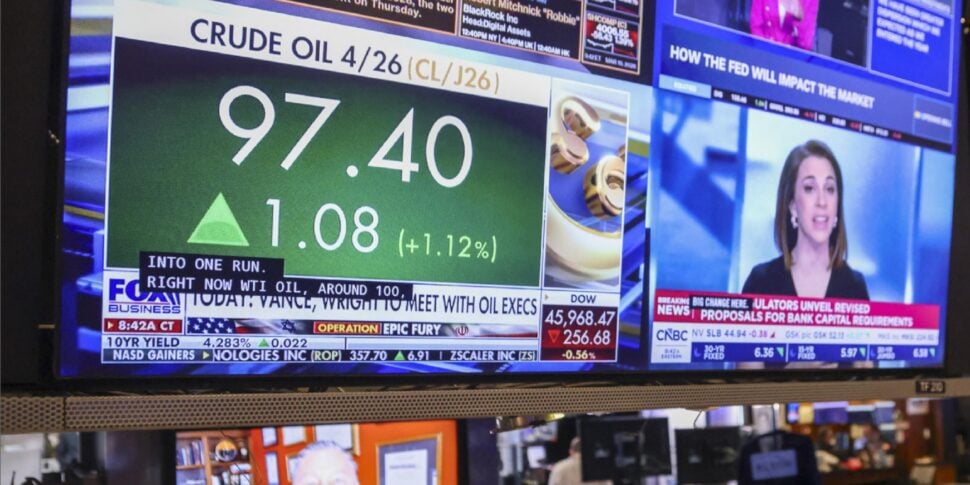
On the crude front, the prices of cargoes departing from Oman closed today at 166.8 dollars a barrel, when until February 26th they were around 70 dollars, marking an increase of over 138% in 3 weeks. US oil remained around 98 dollars, while Brent fluctuated between a high of 119 and a low of 97 dollars after the US Treasury Undersecretary, Scott Bessent, announced that the removal of sanctions against Iranian oil already in transit on ships is being studied.
In Amsterdam, gas closed sharply higher: +13.5% to 61.85 euros per MWh), after reaching the highest since August 2022 at 64.6 euros. The repercussions were inevitable on government bonds. German Bunds jumped to 3% for the first time since 30 June 2011. The situation then stabilized with the spread between BTPs and Bunds moving little at 82.1 points, the Italian annual yield rising by 5 points to 3.77% and the German one by 1.7 points to 2.95%.
Stock markets are already heavy in Asia and the Pacific. Tokyo lost 3.38%, Mumbai 3.26%, Hong Kong 2.02% and Shanghai 1.39%. In Europe, Milan lost 2.32%, better than Frankfurt (-2.82%) and London (-2.35%), but worse than Paris (-2.03%), while in the USA Dow Jones and Nasdaq lost around 0.8%. A rather bleak picture according to Ricardo Evangelista, senior analyst at ActivTrades. “These developments – he explains, referring to the cross-attacks on oil and gas infrastructures – have triggered a reaction from the markets, which have discounted an increase in risks linked to a prolonged interruption of oil supplies from the Persian Gulf”.
According to him, “the situation is now more worrying for oil operators, because the disruption to global energy markets could extend beyond the limitation of oil tanker traffic through the Strait of Hormuz, to the point of compromising the production capacity of one of the most important oil and gas extraction centers in the world.” All of this, according to MPS Strategy analysts, “is part of a macro scenario already complicated by signs of rising inflation in the United States”.
However, it is “almost impossible” to quantify the impact of the war according to Paolo Zanghieri of Generali Investments. This was partly done by the European stock markets, which burned over 420 billion in a single day, after having sent 1,162 up in smoke in the first two weeks of the conflict.