

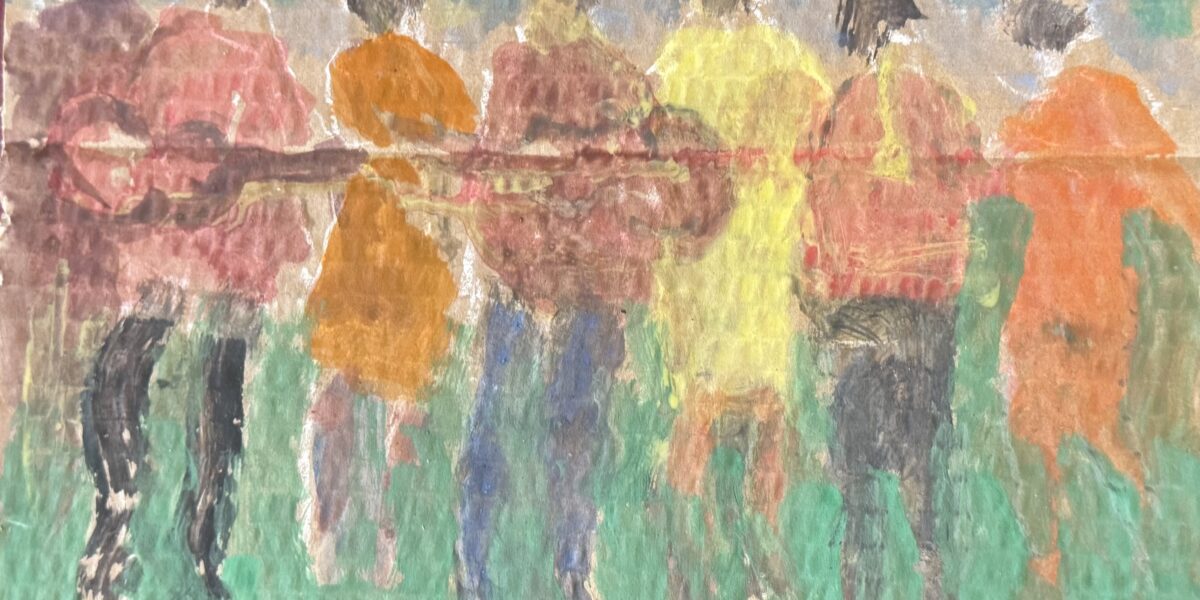
The last exhibition of Nino Rigano, doyen of Messina painting – who passed away on August 25th at the age of 91 – dates back to November 2025 (at the Camiciotti 73 gallery), but his relationship with art accompanied him until his last days, constituting, like all great passions, that invisible thread that linked him to life and at the same time a way to communicate to the world that life was abandoning him. In fact, the artist created his latest works on the hospital bed, using his material of choice, cardboard, and as always following an inspiration that came from within, but which we imagine to be different, more ethereal, like the paintings he created, in which the figures appear blurred: “So blurry – observes his daughter Antonella – that it gives the impression that he too was about to leave, that he too was disintegrating”.
Figures on a neutral background that seem like shadows, but always close to each other, in relation to each other, engaged in that relationship of mutual communication that has always been primary for Rigano, becoming a characterizing element of the places depicted, which, according to the artist, receive their particular connotation from those who live there. The last tables, created holding them on the legs, are many, some even unusual compared to his themes (in one you can distinguish two guitarists), but even in these the line appears almost evanescent. “There is nothing left – continues Antonella Rigano – there are no eyes, they are almost ghosts. And just as usual there are so many, an infinity. Some are barely outlined figures, in others the background is very little soiled. Small canvases all signed”.
Among his latest paintings is also the theme of Flowers, taken up several times during his artistic activity, without however becoming a key element, used to give a message of authority or preciousness (we remember the canvas depicting Pope Francis with a bouquet of roses in his hand). Among the “testament drawings” there is also the figure of a warrior on horseback, who could be a contemporary Don Quixote or a typical knight of the Sicilian Puppet Opera; the only certainty is that it is a character who fights against injustice, in defense of the weakest. Because Nino Rigano has always declared himself on the side of the humble, profoundly against any form of racial or gender injustice and discrimination.
In this regard, we remember his exhibition “L’Eterno Femminino” in 2014, which glorified women in every aspect and in their different roles, even in the beauty of their physical features, as an indispensable figure for society and necessary for man. Like his Franca, his beloved wife who survives him, but whom Alzheimer’s disease had made distant in recent years, to his immense pain.