

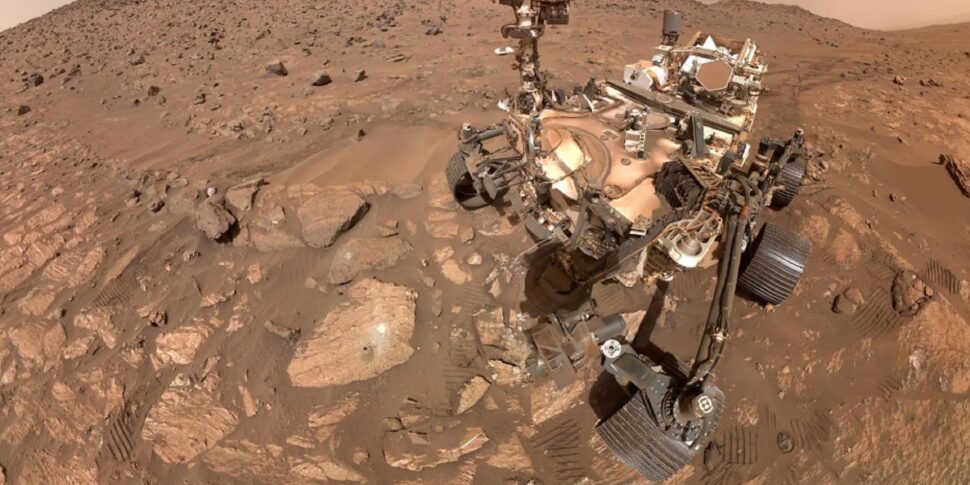
“Today is an exciting day: are we a closer step to answer the question ‘Are we alone in the universe?'”. In times of budget cuts, Nasa does not spare itself on enthusiasm to announce the discovery of a new potential indication of the presence of microbial life in the past of Mars.
“Perhaps the clearest sign of life that we have found so far”, underlines the administrator at Interim Sean Duffy, presenting the data collected by the NASA Rover Persencerance in the summer of 2024
The results make extraterrestrial life hunters dream, but are not yet definitive: in fact, further investigations will be needed to completely exclude the hypothesis of a non -biological but purely geochemical origin. It remains to be understood how these insights will be conducted, given that NASA is still evaluating how to bring the Martian champions back to earth “in a cheaper and fast way” after the cuts imposed by the White House. The potential signature of the Martian life under the researchers’ lens was found during the sampling of clay rocks that Perseverances conducted in July 2024 in the so -called ‘Bright Angel’ formation, a rocky outcrop located at the base of the northern side of the ancient ‘Neretva Vallis’ river valley that converges in the Jezero crater.
The analyzes on the sample called ‘Sapphire Canyon’ revealed the presence of tiny nodules and granules enriched with iron phosphate and iron sulphide. These characteristics are associated with organic carbon and seem to have formed after the deposition of the sediments, in low temperature conditions. Further analyzes have revealed that these minerals are concentrated in specific areas and are not distributed evenly.
Their presence in such a context could support their classification as potential biofrar. This kind of traces could also be generated in the absence of life forms, due to the effect of prolonged high temperatures, acid conditions and interaction with organic compounds. However, the rocks of Bright Angel do not seem to have experienced high temperatures or acid conditions, and it is not known whether the organic compounds present would have been able to catalyze the reaction at low temperatures.
The discovery was particularly surprising because it concerns some of the younger sedimentary rocks ever studied by the mission, therefore Mars may have been habitable for a longer period than expected. Or perhaps the oldest rocks could contain signs of life simply more difficult to detect. At this point there are many open questions that do not yet allow to draw definitive conclusions about the presence or absence of life on Mars, admit the researchers, but the NASA administrator still takes the opportunity to highlight the political scope of the discovery.
The Rover Perseverance, “sent to Mars during the first presidency of Trump” made it, and is the result of decades of studies that “underline the leadership of the US spaceship”. “We are engaged in a second race to space and China wants to get to the moon before us, but this will not happen”, reiterates Duffy. “We will continue to be a leader in space and bring the imprint of American boots also on Mars”.