

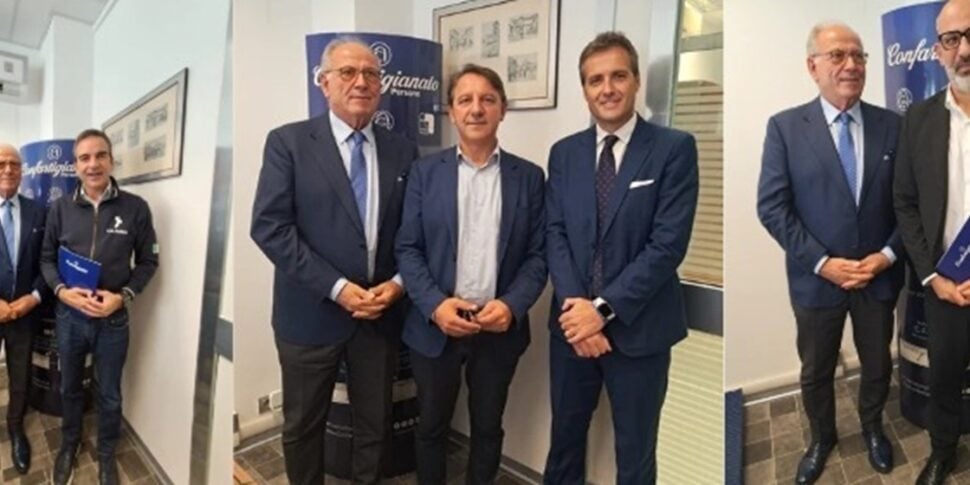
Confartigianato Imprese Calabria presented its programmatic document in view of the next regional elections, illustrated by President Salvatore Ascioti and the regional secretary Silvano Barbalace.
Also present was the regional vice president Francesco Pellegrini, the presidents of the categories, the members of the executive junta.
The Calabrian crafts, with over 31,700 active companies and over 53,000 employees, represents 18.7% of the regional workforce and 17.3% of the overall entrepreneurial fabric. A sector that, according to the latest Censis investigation carried out with Confartigianato, is confirmed as a silent but essential engine of economic and social development, capable of combining tradition and innovation, territorial roots and opening to international markets.
Among the central themes underlined by Confartigianato there are:
- Constant comparison with regional policy, to transform dialogue with companies into a permanent programming tool;
- Streamlining of the bureaucracy and digitization of the public administration, to make the start and growth of activities easier and rapid;
- Support for investments, innovation and aggregation between companies, with subsidized access to credit and simple and certain tools;
- Redevelopment of production areas and greater attention to the participation of micro and small Calabrian companies in public tenders;
- Implementation of the regional law 5/2018 and refinancing of the Craft Fund, including the creation of the regional brand of quality and the development of experiential tourism linked to crafts;
- Legality and loyal competition, with more incisive checks against black work and abusiveness and prizes for regular companies;
- Training and generational change, with the establishment of a “Grande Academy of Artisan Crafts” to form the craftsmen of the future;
- A plan for exports, capable of enhancing Calabrian products on foreign markets, with a unique direction and shared with trade associations.
“The craftsmanship does not ask for welfare, but simple tools to work, grow and innovate. He does not demand shortcuts, but clear rules, certain times and equal dignity compared to the other productive sectors” – underlined Ascioti and Barbalace.
Confartigianato Calabria asked the future president of the Region for a concrete commitment: in the first 100 days of mandate sign with the organization an agenda of the interventions, capable of defining the needs of the micro and small Calabrian companies in a clear and operational way
The comparison promoted by Confartigianato Calabria with the candidates for the presidency of the Region has offered the opportunity to measure political approaches and priorities on crucial issues for the world of artisan enterprises: credit, innovation, training, European policies and enhancement of the territories.
TRIDICO’s intervention – The first to intervene was the candidate of the center -left Pasquale Tridico, who claimed a direct link with the crafts already gained at the helm of the INPS. “I collaborated with Confartigianato and with Inail – he recalled – reporting the disproportion of insurance premiums compared to minors in the sector. We have built useful agreements to strengthen representation and operation ». Hence his vision: do not force dimensional growth processes, but enhance the productive fabric made of micro and small businesses capable of competing in the districts, when they know how to network on innovation, training and credit.
A central chapter for Tridico is that of innovation. The proposal is the creation of four technological and training public hubs: one specific for crafts, one for agriculture and two for industry. A thousand young people, 250 per pole, should develop ideas and processes calibrated on local supply chains: agro -industry, food and wine, quality crafts. “There is no aerospace where there is no aerospace,” he pointed out, clarifying the desire to anchor the projects to the territorial vocations. The hubs should be born in close synergy with the three Calabrian universities, without multiplying locations but placing themselves in the districts-Corigliano-Rossano, Vibonese, central area, Reggio-to build supply chains that bind school, professional training and research.
The theme of the transfer of knowledge to companies through the regional funding of the industrial doctorate, which would allow researchers to operate three years in companies before completing the academic path, also at the center. Next to this, support for credit and international marketing, considered indispensable public goods for small businesses. “The Region – he added – must guide the promotion abroad with a task force for internationalization. And when we plan the poles, the first thing will be to ask the associations for training needs: the choice of sectors and places will be participatory ».
The intervention of Occhiuto- On the opposite front, the outgoing president Roberto Occhiuto, candidate of the center-right, has set his intervention as a sort of final balance. «I am doing an election campaign by telling the Calabrians that I do the final balance of what I did. I don’t have a magic wand, but I put a region back in motion that was motionless, “he underlined.
Among the most relevant points, the use of European resources: Occhiuto has indicated the reprogramming of the ERDF as a lever to cover activities now financed with the FSC and integrate the fund for craftsmanship. In parallel, the push to internationalization and fairs, indispensable tools for micro -enterprises often without capitals adequate to face distant markets. “When present the Calabrian excellence in a fair – he said – shows that there is a Calabria who has great resources”, remembering the commitment of many young people who have innovated family businesses.
The knot of access to credit remains central: «We need confidoes that they work and operational tools. We can use EU resources for rotation funds with leverage 1: 4 or 1: 5, but someone
must manage them ». Hence the reference to the transformation of Fincalabra into a true financial and to the possibility that trade associations play a role in the management of practices.
On the internal areas, Occhiuto has emphasized the new European flexibility, which will allow to allocate resources to water and social housing. The idea is to finance up to 80% of the purchase and renovation of the houses in the villages, to contrast their depopulation.
Great space also to human capital. After investing on universities and increased scholarships, the president launched the proposal of a “merit income” from 500 euros per month for graduates who choose a Calabrian university and maintain an average of at least 27. A measure that, according to Occhiuto, would be sustainable and with a strong impact for families. In addition, he recalled the urgency of new technical-professional academy, in collaboration with universities, citing Lamezia’s experience for the maintenance of aircraft.
In the mandate balance he claimed concrete results: the end of the season of emergencies on waste, the reform of the remediation consortia reduced from 11 to one, the historical record of tourist arrivals, in particular foreigners, and the relaunch of airports with new infrastructures.
Finally, the political and communicative line: «I speak well of Calabria because the government and because I love this land. If you tell you as without a future, investments do not arrive ». And an appeal to the associations: «From October 7th I will have a thousand problems on the desk: bring me concrete ideas on credit and professional training and make them together. Governing is not to talk about the maximum systems: it is to direct European resources to the development of the territory and the support of companies ».
The intervention of Tuscan. The candidate for the presidency for democracy Sovana Popolare, Francesco Toscano denounces a “medically crushed media between two systems” campaign and explains the approach of his list: “We aimed to put the political reasoning back to the center, not the patches: enough calls for rain and turmoil promises”. The diagnosis is structural: “For thirty years the system has been carrying out with the automatic pilot: the color of the governments changes but do not change economic desertification and demographic hemorrhage”.
To get out of the logic of the “sorted bands”, proposes to transform Fincalabra: “From a wheelchair that distributes funds to small regional IRI: inside trade associations and system banks, facilitated credit lines guaranteed by the region and regional tax credits circulating to enter immediate liquidity”. Objective: “to overcome bank prudence when paralyzing deserving investments and putting the creation of wealth back to the center”.
On the internal areas he contest the renunciation setting: “I do not accept the idea that they must be” accompanied in the end “: it is a political choice, not a necessity”. The battle is linked to the risks of global homologation: “Each craftsman is a world, an identity. If everything uniforms, whoever is different becomes a problem to punish ».
It invokes an alliance between businesses, work and politics “to stop going to Brussels or Rome with a saucer in hand” and claims project autonomy: “Nobody prohibits us from using our resources for autonomous development processes; If needed, conflicts are also faced: political struggle is not bad when the system is wrong ».
On the economic framework, he disputes austerity and wage compression: «Poverty generates poverty. With growing duties and massacred internal demand, exports alone is not enough: without income and liquidity the craftsmen, even the best, do not sell ». Hence the idea of ”reverse the paradigm” using “the regional financial as a direction of development” for credit, supply chains and new chains of value.
There is also a cultural passage: “We must get out of the individualism that makes us prefer the neighbor in difficulty to shared well -being. Better to accept that someone earns a little more in a common project than to stay still still: better to stay behind a Ferrari than on foot ». It offers coordinated artisan chains, “also with a common brand, sovereign Calabria”.
The closure is a call to three floors – political, economic, cultural: «Enough resignation. We do not want to be saved by anyone: we can get back in motion alone. Maybe we will lose, I think not; But it is the only sensible and dignified choice for a local policy that really wants to change ».