

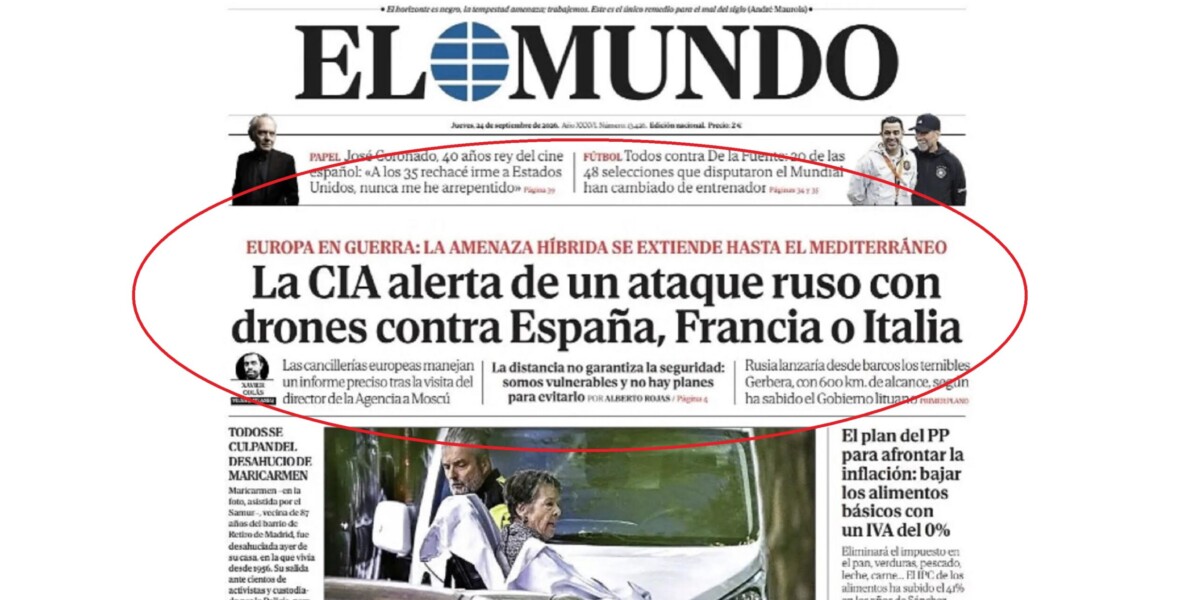
Merchant ships used as launch pads, drones hidden in containers, Italy within range. The scenario of the Spanish newspaper El Mundo made the rounds of the editorial offices in a few hours. According to the newspaper, US intelligence warned Italy, France and Spain of a possible Russian attack with Gerbera drones launched from the Mediterranean. Looking at it closely, however, the alarm leaves many questions open. The technique of launching drones from the sea is plausible and already has precedents. What is currently missing is any confirmation of the alleged plan against the three countries.
Crosetto: «No confirmation»
The first slowdown came from Defense Minister Guido Crosetto. On Qualified sources interviewed by ANSA had already previously reported that the alert would not reach any operational level: neither to intelligence, nor to diplomacy, nor to the military. From the opposition, PD deputy Lia Quartapelle asked the government to clarify whether there are concrete elements behind the alarm.
Brussels: «No specific alert»
The position of the European Commission also arrived in the afternoon. Spokesman Thomas Regnier explained that Brussels is not aware of the specific alert described by El Mundo, but that the news “is not a surprise”. “Our airspace is being tested and has been violated several times,” he said, recalling that “several hybrid attacks are underway” against many member states. The matter, he specified, falls within the competence of the national authorities.
Anonymous sources and no verifiable details
El Mundo’s story is based on an anonymous source close to the Lithuanian Ministry of Defense. It also relies on some analysts who say they know of a CIA report circulated among European chancelleries. The report has not been made public and, at present, there is no independent official confirmation of its existence and content. Indeed, in Italy, qualified sources have ruled out that the alert arrived through operational, diplomatic or intelligence channels. Furthermore, the elements that would transform a hypothesis into a concrete threat are missing: objectives, dates, suspicious ships.
A plausible technique, an unproven plan
The Gerbera is small and lightweight, constructed of plywood and polystyrene. According to El Mundo, several specimens could be transported hidden on a freighter and launched with a catapult. The newspaper hypothesizes launches 200-300 kilometers from the coast. Identifying and above all attributing such an operation with certainty would not necessarily be simple. On February 27, 2026, the Swedish Armed Forces confirmed that, in the previous days, a drone had taken off from the Russian intelligence ship Zhigulevsk, in the Øresund Strait, during the visit of the French aircraft carrier Charles de Gaulle to Malmö.
The aircraft was neutralized with electronic jamming by the Swedish patrol vessel Rapp. The Swedish authorities have not disclosed the model of the drone. Last July, a report from the IISS, the International Institute for Strategic Studies in London, judged it likely that ships linked to the so-called Russian “shadow fleet” were used as launch or recovery platforms for drone overflights in Europe. However, the IISS expresses a probabilistic assessment. Not all individual incidents have been directly attributed to Russia. Many overflights lack public forensic evidence linking a specific drone to a specific vessel.
Strategy under the threshold of war
According to Western analysts and services, many of the operations attributed to Russia were conducted under the so-called “war threshold”: sabotage, trespassing and overflights which make attribution and a coordinated NATO response more complex. An armed attack against targets in Italy, France or Spain would represent a qualitative leap from this scheme.
The Danish precedent
The case that comes closest to the scenario described is that of the Boracay oil tanker, of the so-called Russian “shadow fleet”. Between 22 and 25 September 2025 the ship was off the coast of Denmark, in the days in which drone sightings also forced the temporary closure of Copenhagen airport. The French Navy then boarded it, and the commander and first officer were detained. On March 30, 2026, the commander, Chinese citizen Chen Zhangjie, was sentenced in absentia by the Brest court to one year in prison and a fine of 150,000 euros for refusing to obey orders during the interception. The condemnation does not concern the drones: the connection with the Danish overflights has never been proven, and at the time the French president Emmanuel Macron avoided confirming it.
What remains of the alarm
None of this excludes the threat. The technical capacity exists and is cheap, and suspicions of a hybrid Russian pressure campaign against countries supporting Ukraine have multiplied in recent months. El Mundo links the alert with the convening of the Defense Council by Macron on September 16, and with the meeting at the Elysée with the leaders of the parties two days later.
The Elysée linked those meetings to the intensification of Russian hybrid threats, including the risk of drone strikes and cyberattacks against critical infrastructure. However, he did not mention the alleged CIA dossier. According to El Mundo, sources and analysts consulted maintain that the French authorities would have attributed great credibility to the report. At present, the plan described by the Spanish newspaper remains a hypothesis attributed to confidential sources, without official confirmation and without confirmation both according to the Italian government and according to Brussels.