

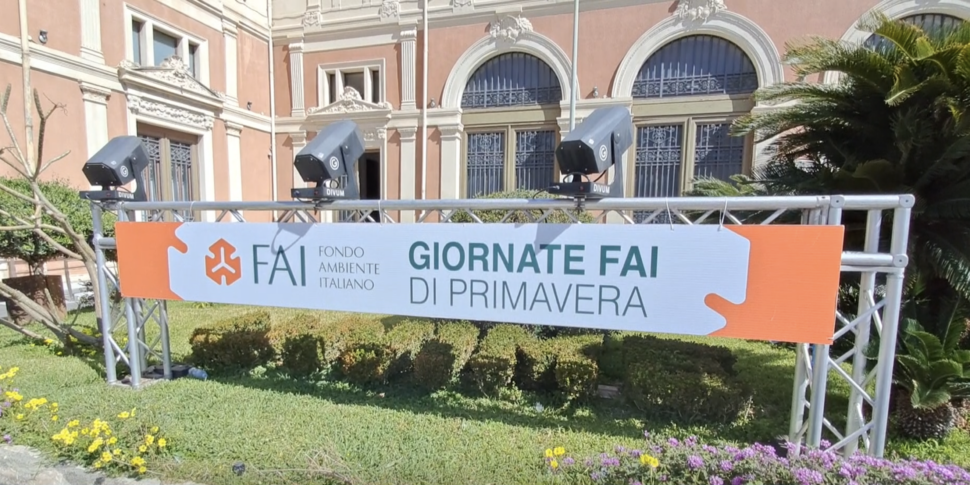
As many as 780 places are open and can be visited, with a free contribution, in 400 Italian cities: on Saturday 21 and Sunday 22 March the FAI Spring Days are back, now in their 34th edition. An event, now known to citizens, dedicated to the rediscovery of Italy’s immense cultural and landscape heritage, which was presented this morning to the Ministry of Culture.
Extraordinary openings
Among the extraordinary openings of goods and environments not normally accessible to the public, in Rome there will be that of the Palace of the Ministry of Education and Merit, designed by Cesare Bazzani in 1912; or the Supreme Court of Cassation, based in the Palace of Justice, built to a design by the architect Guglielmo Calderini between 1888 and 1910. While in Naples, the Maradona Stadium will be opened, inaugurated in 1959, where visitors will be able to observe the pitch from the sidelines and walk the so-called ‘Blue Mile’, just like the athletes do.
Or again, in Liguria, the Lantern of Genoa, the most famous monument of the city, the first written testimonies of which date back to 1128; in Turin the Palazzo di Città, seat of the Town Hall, will be opened, with richly decorated rooms, such as the Mayor’s Hall – exceptionally accessible – the Marble Hall and the Council Hall, with velvets and red damasks on the walls; while in Sicily, in Palermo Porta Nuova will be open to visitors, one of the most representative examples of the city’s triumphal architecture, where a new inclusive visit accessible to all will be proposed, in collaboration with the Army Military Command ‘Sicilia’, owner of the property, and the University of Palermo, which includes supports created specifically for the FAI Days, such as tactile visits with models and virtual visits with videos for people with reduced mobility and a cartoon for children. This is just to give a few examples. But the complete list of open places and how to participate can be found on www.giornatefai.it.
What’s new in this edition
Among the novelties of this edition, an unprecedented itinerary to commemorate the 800 years since the death of Saint Francis of Assisi, with a selection of openings in 8 regions that will enhance the figure and the spiritual and cultural heritage of the patron saint of Italy, such as that of the Sanctuary of San Donato with the adjacent historic Garden of San Francesco in Ripacandida (PZ) – the ‘little Lucanian Assisi’ – decorated with frescoes of ‘500 and recognized in 2010 by UNESCO as a ‘monument messenger of the culture of peace’, and of the Franciscan complex of San Bernardino in Caravaggio (BG), with a precious cycle of frescoes depicting the Passion of Christ. In Umbria, visits to the Convent of San Fortunato in Montefalco (PG), a Franciscan convent which houses Renaissance frescoes by Benozzo Gozzoli and, in the surrounding woods, evocative caves, an underground oratory from the early Christian era, later used for the cult of Christianity, and also to the Bosco di San Francesco, a FAI asset in Assisi, a place of harmony and silence at the foot of the Basilica of San Francesco, where you can admire the Third Paradise by Michelangelo Pistoletto.
Here is the list of openings planned in Calabria:
in MONGRASSANO (CS)
GIAS will be opened, a company known in the frozen food sector for having patented the first cold peeling method of
tomatoes, to visit the museum and interactive space that is part of Museimpresa, the Italian Archives Association and
Corporate Museums. Furthermore, FAI members are exceptionally reserved a special informative visit to the supply chain
production and transformation of agri-food products by the owner Gloria Tenuta;
in MONTALTO UFFUGO (CS)
it will be possible to visit Molino Bruno, one of the major industrial companies in the province of Cosenza, following the
manufacturing process from the grain of wheat to the transformation into flours of various kinds and witnessing the
preparation and cooking of flour-based products;
to SANT’ANDREA APOSTLE OF THE IONIAN (CZ)
the Palazzo della Baroness Scoppa offers a journey through time among ancient living rooms, family paintings, precious memories and
a loggia with one of the most beautiful sea views in the region. And also noble palaces, the Clock Tower, the majestic buildings
churches, the humble house of the Blessed Monachella of San Bruno, the workshops of the crockery makers and the Museum of Memory, with
tools of peasant civilization. In the Marina, the Regional Nature Reserve, formerly a FAI Heart Place, which protects stretches
uncontaminated areas of the Ionian coast with dunes, spontaneous vegetation and wildlife;
in SANT’ILARIO DELLO IONIO (RC)
the route is divided among the plots of the center of Sant’Ilario, passing by its noble palaces, to then open up to the current
fraction of Condojanni. Against the backdrop of uncontaminated nature the route continues with the valuable Casino Speziali,
private residence which also has a peasant museum inside, open to members only;
in SPEZZANO DELLA SILA (CS)
visits to the I Giganti della Sila Nature Reserve and to the Casino Mollo, a FAI property. This majestic centuries-old forest in
heart of the Sila National Park, it has survived intact since the seventeenth century; next to it stands the hunting lodge donated to
FAI by Giovanna, Beatrice and Maria Silvia Mollo in 2016 and today at the center of an important restoration and
valorisation;
in STRONGOLI (KR)
a rich itinerary that starting from the Cathedral, dedicated to SS. Pietro e Paolo, continuing with the church of Santa
Maria delle Grazie, passing through Palazzo Amantea and Palazzo Giunti, culminates at the Castle, full of history, and finally ends
of route to the church of Santa Maria della Sanità and the municipal clock tower, will trace the lines of a past
still legible in its centuries-old stratification;
in VIBO VALENTIA (VV)
opening of the majestic Palazzo Di Francia, a private residence still inhabited today by the descendants of the noble Di family
France and normally closed to the public. It will be a unique opportunity – reserved for FAI members – to visit,
in addition to the valuable garden, some lounges kindly opened by the owners. During the visit it will be possible to admire
the historic furnishings, the fine wallpapers and the important picture gallery;
There will also be a walk – open to all – to discover the most significant buildings in the historic center of Vibo
Valentia, the ancient Monteleone: Palazzo Murmura, Palazzo Gagliardi De Riso, Palazzo Cordopatri, Palazzo Marzano,
whose history will relive through the stories of the illustrious characters who lived there.
Thousands of volunteers for a widespread heritage of art, nature and culture
Thanks to 7,500 volunteers from the delegations and FA groups active in all the regions, guided by the desire to always propose new places, and thanks to 17 thousand Ciceroni apprentices, young secondary school students specially trained by their teachers to talk about the beauties that surround them, hundreds of special places will therefore open their doors, from the North to the South of the Peninsula, often little known or little appreciated, and many of which are usually inaccessible: from villas to castles, from churches to places of education and research, from artisan workshops to naturalistic areas, passing through institutional headquarters, theatres, art collections and production sites and even a water pump and a football stadium, because in Italy the heritage of art, nature and culture is everywhere.
At each visit it will be possible to support the Foundation’s mission with a donation and, among the many openings proposed, some will be dedicated to FAI members and to those who register during the event.
From 1993 – the year of the pioneering first edition of the event – to 2025, almost 13 and a half million Italians have been able to discover and rediscover over 17,000 special places in the cities and territories in which they live.
«It is essential – the Minister of Culture, Alessandro Giuli, argued at the opening of the press conference – to rediscover our beauties to be aware of an immense heritage that we have the duty to safeguard, protect and enhance. The most beautiful aspect is that we do it together with the FAI but above all with many young people, 17 thousand Ciceroni apprentices, who will lead many Italians to discover and rediscover our beauties in the beautiful season of spring”.
«The spring FAI Days – added Marco Magnifico, FAI president – are increasingly a large and powerful megaphone to tell what FAI is and what it does every day; not a spectacular isolated event but the testimony of a daily and widespread commitment throughout the country, of a courage, a curiosity, a spirit of service and a concrete attention to the issues of protection which relies on the support of an ever-increasing number of citizens to continue, alongside and with the institutions of the State, to do good for the most beautiful country in the world: ours. For this reason, the FAI registrations and the donations we collect during the event are fundamental to supporting the complex daily reality of a Foundation that acquires, restores and enhances cultural and landscape assets of every type, size and variety forever and for all, capable of telling their story, with theirs, that of Italy 365 days a year – and not just two”.
Fundraising
The FAI Days in spring, like those in autumn, are an opportunity offered to Italians to get to know and appreciate the wonders of our country, but also an important initiative to raise awareness and raise funds by the Foundation, in support of its public utility mission of care and protection of cultural heritage, in the spirit of article 9 of the Constitution and according to the principle of subsidiarity (article 118): what is collected from registrations and donations received during the event, in fact, concretely supports its institutional activities and allows the Make sure you continue the restoration and enhancement projects, some of which are very expensive, on the 75 assets it cares for, manages and conserves, of which 60 are regularly open to the public so that all citizens can enjoy them, forever.