

Technology and economics: these are the fronts – new but not too much – on which the war between civil society and organized crime is combated. But there is also another level of contrast, much deeper, early, preventive and probably even more complex: the cultural one, the one that activates within the social fabric, before judicial. In the family, at school, in places where individual consciousness is formed and oriented it, teaching in small daily life to distinguish between good and evil. To understand the scope of values and disvalue, which spread above all in digital environments.
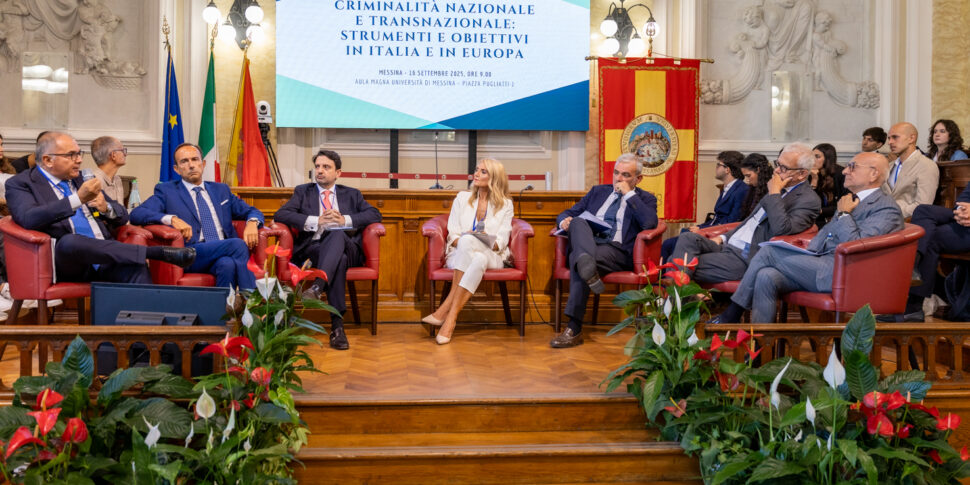
The deepening in the context of the thematic panels of the conference “National crime and transnatational crime: tools and objectives in Italy and Europe”, held at the University of Messina and promoted by the Eurodepiete Giuseppe Antoci together with the Procurator of Messina Antonio D’Amato and to the Uniime GIOVANNA SPARITORI, with the presence of the President of the European Parliament Roberta Metsola and a parterre of illustrious guests.
On the themes of the event they discussed – focusing on the change of mafias from European funds to PNRR to the virtual space – for the first time all together, the district anti -mafia prosecutors of Messina, Antonio D’Amato; of Catania, Francesco Curcio; of Palermo, Maurizio De Lucia; by Caltanissetta, Salvatore De Luca; of Reggio Calabria, Giuseppe Borrelli with the moderation of Alessio Ribaudo (Corriere della Sera) and Elvira Terranova (Adnkronos).
On a deviated digital generation he pointed the attention of Amato, warning – also addressing the many young people present – on the “model” propagated via social media by criminal organizations, to the point of making it preparation especially in contexts burdened by cultural desertification. “The volume of drug trafficking is equal to twice the Greece GDP”, Borrelli then observed, highlighting the incidence of the reinvestment of such a amount of illicit capital on the global economy, with tools of concealment of the origin and in countries other than “production”. And to emerge immediately is the failure to harmonize the control systems, for example among the customs databases, failing to contrast the illegal entry of goods offered then under the subscription.
The picture outlined by Curcio alarming: due to a rule of freedom, such as art. 49 of the EU Treaty – which allows you to choose where to reside or locate a company – the interception of suspicious IT flows is more difficult, if generated by companies with legal offices in countries (such as Ireland) with non -homogeneous regulations. Therefore, forcing the investigators to resort to Trojan, instead of getting upstream from the provider access to data.
But if, as De Luca observed, it is often difficult to “pierce” conversation networks, the criminal relationships circuit can be reconstructed with other tools such as environmental interceptions, collaborators of justice and, in particular, the analysis of spending capacity and standard of living: the money that falls within the circle is seized and confiscable.
“We do not look for” ghosts “, but authors of crimes” said De Lucia by tracing the guidelines of action: capturing the “leaders”; Improve the prison system, which despite criticality and signs of malaise, guarantees an indispensable means such as the isolation regime; impoverish crime by acting on economic activities. And, above all “continue to” cut the grass “, to act in the area, to make people understand that making the mafia is not convenient”.
Present the young people of the schools and the university
A symbolic presence, a precise message: the fight against illegality starts from afar, and you do not win without them. In the front row, as pointed out by the Spatari rector, the prosecutor D’Amato and the Hon. Antoci, there was a delegation of students and students (of the Maurolico high schools and the Farina di Messina and the Unime of Law Departments and Political Sciences): not “recipients” of words to the future, but true protagonists of the “present” cultural change.
The challenges of the AI, between cryptocurrencies, tax fraud and “hostage” data
According to Alessandro Chiocchetti, secretary general of the European Parliament, “the development of artificial intelligence and its possible criminal use represent an unprecedented challenge”. And this is the starting point on which the leaders of European agencies and law enforcement agencies discuss, with the moderation of Gaspare Borsellino (director of Italpress) and Giuseppe Pipitone (Il Fatto Quotidiano). For Bruna Szego, president of Amla, European anti -money laundering agency, “the starting point is a very fragmented European framework, with very different rules. Getting to uniformity will not be simple ». With an alarm: “Technology is changing the recycling methods”. European tools have been equipped, as confirmed by the executive director operations Jean Philippe Lecouffe, but, highlights Federica Curtol, head of the Eurojust operations, “a common regulatory framework is not enough if there are 27 different judicial systems within the union. It is even more difficult to collaborate with the countries outside the Union “.
There are new “weapons” against which to fight: “Critpovalute – warns Calogero Ferrara (European delegated prosecutor) – are not abstract, new platforms develop daily, whose tracking requires difficult investments to be supported”. Certainly it is underway, explains Vincenzo Nicolì, director of the police of the police, “a very rapid evolution of technological tools that support the traditional activities of criminal organizations. We are concerned with the phenomenon of taking out private data but also of state entities. They are criminal activities not only virtual, but with important reverberations on real life ». The commander of the Scico of the Guardia di Finanza, Nicola Quintavalle, underlines how a lot has changed, over the years: “Today we face corporate and financial schemes that are difficult to penetrate, tax frauds are deadly tools to circulate illegal money all over the world”. “The problem – adds the commander of the Carabinieri Ros, Vincenzo Molinese – who is also an opportunity, is the enormous amount of information to be tried”. Points on which “artificial intelligence comes to the rescue. It is unthinkable, for example, that a single operator can also process all the data of a single mobile phone, and here too we experience artificial intelligence ». (Seb.Casp.)
The academic panel on European legislation on organized crime
The international struggle to organized crime requires a sufficient degree of autonomy of individual countries, but also shared tools, whose effectiveness is based on the harmonization of criminal systems: university teachers Stefano Ruggeri (ordinary of Unime Criminal Procedure), Costantino Visconti (ordinary of Unipa Criminal Law) and Giuseppina Panebianco (ordinary of criminal law Unime) with the moderation of journalists Maurizio spoke of it. Scaglione (Sicily) and Nuccio Anselmo (South Gazzetta).
The frame is that outlined by the 2008/841/Gai del Council decision, relating to the fight against organized crime and criminalization of crimes related to participation in a criminal organization. The decision aims to harmonize the rules of the EU and its Member States. Furthermore, if the crime falls within the jurisdiction of several Member States, they must collaborate, for example through the European Union Agency for criminal judicial cooperation, to establish which Member State will pursue the crime and to centralize the criminal action.
Panebianco clarified how the decision does not give a tax definition of criminal organization, highlighting the importance of shared rules for example in terms of collaboration of witnesses to prevent a diversified treatment from hindering the emergence of “karst” corrupt phenomena. Visconti observed how important it is that each country can build its case of crime, remarking the importance of the aggression of the heritage of criminal groups that make use of platforms and legal “networks” for their traffic. Finally, Ruggeri has warned on the need to also guarantee the protection of fundamental rights to the right trial on the transnational level, recovering participatory logic and the values inspired by the European Court of Human Rights.