

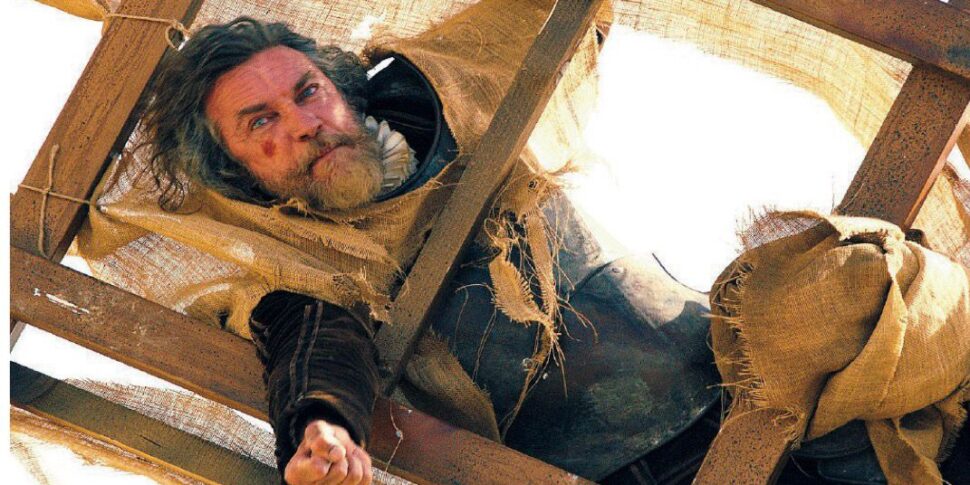
«Don Quixote», which brings Cervantes’ masterpiece to the big screen, will be released in Italian theaters on March 26; a rereading that is both faithful and very current. The new film by Fabio Segatori, in competition at the 17th BIF&ST of Bari International Film&Tv Festival, begins with the sequences set in 1571, made in Messina with the collaboration of the Messina producer Gigi Spedale and with the patronage of the Municipality of Messina.
Alessio Boni plays “the knight with a sad figure” with extraordinary verisimilitude and sincerity alongside Fiorenzo Mattu, who gives his Sancho Panza a touching charge of humanity. The cast is completed by Angela Molina, Melito Marcello Fonte from Reggio, Galatea Ranzi and Carlo De Ruggieri, together with debutants Gabriella Bagnasco in the role of Dulcinea and Martina Molinaro in that of Altisidora. The Messina cast sees among others Ettore Ianniello, who plays the young Cervantes wounded in the battle of Lepanto, and Mauro Failla in the role of the doctor who treated him and Davide Colnaghi, the porter who looks after him. The sets are by Cinzia Muscolino (from Messina, nominated for a David for «Grazia» by Paola Columba).
«Who has never felt like a foolish idealist in a world governed by greed and oppression?» observes director Fabio Segatori, who adds: «Around Don Quixote there is the desert, a Middle Ages that never ends. The knight urges men to be free, but in the end he realizes that “freedom is a new experiment, we are not used to it yet”.
Made outside the dominant industrial logic, the film focuses on the power of the classic text, on the work of the actors and on the amazement of places never seen in the cinema. The landscapes are a true co-protagonist of the film. Southern Italy is a mythical and real place, a harsh land suspended in time. Filmed in the Upper Ionian Sea, between Basilicata and Calabria, the film passes through gullies dug by the wind, medieval castles overlooking the sea, rivers, pristine beaches and sun-baked expanses. It is a physical, material film. In the age of Artificial Intelligence, of fake images, a 12 meter high working windmill was built, on which Alessio Boni flew upside down in the sky. A true “melee” against the wizard Freston, the enemy of Justice and Freedom.
The story begins in 1571, with Miguel de Cervantes, wounded in the battle of Lepanto, lying in a hospital in Messina: sequence shot in Messina in the rooms of the sixteenth-century Fort Gonzaga, reopened after years for filming, and in Fort S. Salvatore, made available by the Navy. Between fever and hallucinations, Cervantes sees books set on fire: they are by Don Alonso Chichano, a man obsessed with chivalric novels who decides to become a knight errant. Thus was born Don Quixote della Mancha, who elects the peasant Dulcinea as the ideal lady and drags Sancho Panza with him. The knight tries to defend the weakest, even at the cost of appearing ridiculous and crazy. Mocked, humiliated and finally defeated, Don Quixote is brought home in a cage, but cannot be reduced to a life without ideals. And so he dies. In the Sicilian night, Cervantes reopens his eyes: from pain, war and madness, Don Quixote was born, the stubborn dream of a freer humanity. The work, produced and distributed by Baby Films with the support of MIC – Directorate General for Cinema and Audiovisual, Calabria Film Commission and Lucana Film Commission and in collaboration with Rai Cinema, will be presented today at the Multicinema Galleria. In theaters from the 26th.

Find out more in the digital edition
To read everything, buy the newspaper
or download the digital version.