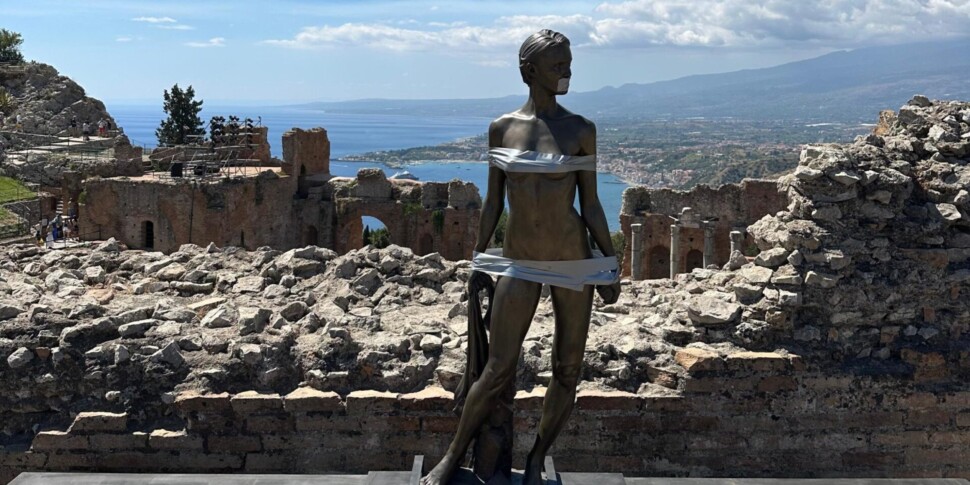
Only four works, all in connection with the place that will host them. “Sculpted gestures”, an exhibition of the sculptor Jago (pseudonym of Jacopo Cardillo, born in Frosinone 38 years ago), presented by the Archaeological Park of Naxos Taormina, was inaugurated yesterday in the Antico Theater of Taormina. “Animal imprint”, “memory” and “prison”, in marble, rotate on the theme of the hand; “David” (golden bronze, 1.81 tall) takes up the theme of the biblical hero, transformed into a woman. We talked about this and more with the author who already has successes that have brought his works all over the world, but who is loved more by the public than by critics (at least a part).
Are you an artist of sculpture or, as the Malevoos say, also of marketing? Also with the help of destination that blocks the image of the “naked” David on social networks, ensuring them newspaper titles?
«I think art is the ability to do on multiple floors. If a work has value generates marketing automatically because it intercepts the interest of the public ».
Do you feel, how someone says, a perfect consent machine?
«If it were true, there would be no those who don’t like my works. I appreciate constructive criticisms, those that become a push to improve. I don’t think everyone should give me reason ».
I would try to define it “a protester inserted in the system”. Do you recognize?
«I like it, but I don’t think there is a single art system, rather many systems, each with their own rules. From some they are automatically excluded, even if people come from me, collectors come ».
What is your goal? Destroy the system from inside or modify it for the better?
«I am a sculptor, I work to remove the superfluous and get to the essence. This way of being can be applied in life, not only to the artistic gesture. But I operate from the outside of the systems ».
There is talk of “easy sculptures”, banality and effect search. Meanwhile, people follow her and appreciate it.
“Are they trivial works? Possible, but I am serious in the work. Despite this “banality”, many come to see my works, maybe then they are the same people who pay the ticket in museums. Here, they need the system. Does art have to be for a few or for many? And, if there are many, are they automatically ignorant? And, when they go to the museum and serve the annual statistics, are they no longer? What is true art? Who establishes it? ».
Really talent, his talent, becomes irrelevant if, as someone says, is it at the service of the most obvious simplification? Should we be afraid of simplicity?
«We must be afraid of the inability to read deeper levels. Maybe he criticizes himself by zapping as on social media. Someone says that my works are populist, but does not go all the way on the topic because it does not have time. I continue to do what I have to do ».
What are his relations with the Vatican, given that after receiving the pontifical medal for his sculpture (a bust) of Pope Ratzinger, did you replicate her in a version without clothes, after giving up the pontificate?
«There are no more relationships. At the time they had invited me to the meeting of the artists with the Pope, then they made me know that they retired the invitation. Never felt. We can define it a silence without complications ».
She loves to resume great classic themes: the pity or the David who remember Michelangelo’s sculptures, or also “the veiled son” inspired by the “Veiled Christ” of the Sammartino. Why?
«Some themes have always been addressed and the artistic language I use is what I understand. I don’t think Bernini thought he didn’t do his David because Michelangelo had already done another one, or that Michelangelo himself posed the problem of Donatello’s previous one. Making certain works does not mean wanting to compare. I use my topics and the work becomes contemporary, it comes from what I feel. It also applies to critics: a scholar renounces writing on Caravaggio because they have already done so many others before him? ».
What kind of stage is Taormina in her career?
«The goal is to interact with the wonderful ancient context, create almost invisible installations in the midst of archaeological finds, integrated as if they had always been there. With the “hands” I think I have succeeded. The “David” who now has a glossy bronze, has been exchanged by some visitors with an ancient statue. It means that the operation works ».
“Look down” and “Italian marble” are two of his works that have brought the world of the last to the foreground. The fact that, left on the street, are “touched” seem to give it reason about their need.
“I confirm. The statue in a square or in any case on the street releases the viewer from the behavior he has to keep to the museum and leads him to interact in various ways. We know that a caress already contributes to creating a patina. Then the work changes as a human being ».
You created a museum in Naples, in the Sanità district: does the artist have to be independent?
“What is a museum? The attempt to protect an idea of beauty. This wants to be my place, capable of participating in city dynamics, welcome and social issues, contributing to the redevelopment of the neighborhood ».