

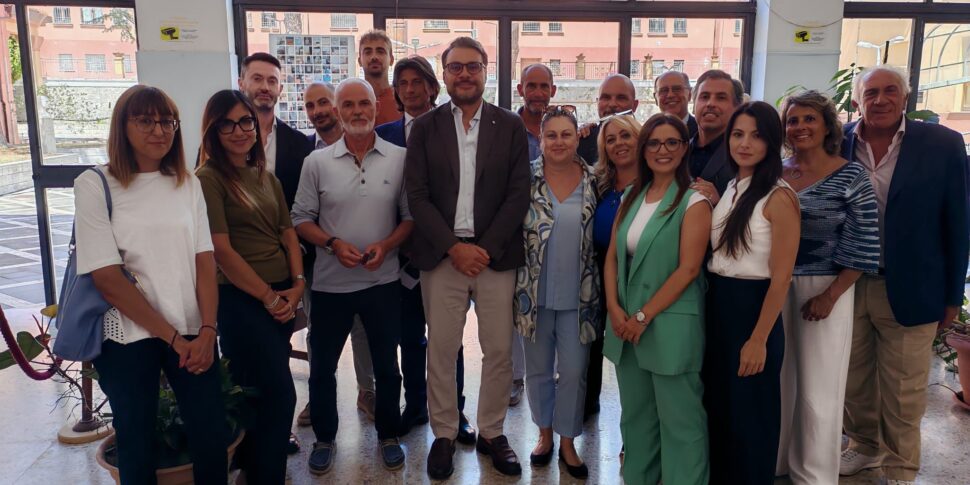
After the visit to the prison “Ugo Caridi” in Catanzaro, today – August 25 – The Board of Directors and the prison observatory of the Criminal Chamber of Catanzaro had the opportunity to go to the city criminal institution of the city, to meet the boys and share, even for a few hours, their daily life of restricted. A particularly significant moment, especially if we think that, at the same time, in the imagination of each of us our children are still immersed in the summer holidays.
The visit was led by the president of the Criminal Chamber of Catanzaro Francesco Iacopino, together with the junta component of the Union of the Criminal Chambers Valerio Murgano, saw the participation of the president of the Criminal Chamber of Cosenza Roberto Le Pera and the President of the Council of the Bar Association of Catanzaro Enza Matacera. The vice president of the Criminal Chamber of Catanzaro Orlando Sapia, the secretary Antonella Canino, the councilors Stefania Mantelli and Vincenzo Galeota, the probiviri Vincenzo Ranieri and Piero Mancuso, the members Antonio Mungo, Alessandra Coppolino, Adriana Anello, Francesca De Fine, Danila Scicchitano and Federico Sapia, as well as the councilor of the Bari Order Gianpaolo Stanizzi also took part.
They were welcomed by the deputy director, dr. Gennarino del King, by the manager of the educators and the penitentiary staff, led by the commander Daniela Caputo, and had the opportunity to dialogue with a group of eight young prisoners, all in execution of a final penalty. The Institute hosts a total of 31 children: some of them do not have a family in Italy and therefore live in total solitude, without any emotional reference outside of the operators and agents who assist them. Others have distant families, whose distance does not allow them to benefit from prize permits, despite being worthy, with consequent compromise also of the re -educational paths.
The boys they spoke with did not expressed complaints about the prison condition; Rather, they showed the desire to be able to take advantage of greater recreational spaces and training opportunities. Some have repeated their middle school studies, despite having already concluded them, and would now aspire to attend a higher institute, which however is not present within the IPM; Others would like to learn a job. Nobody has mentioned the obsolete state and the need for renovation of the cells, also evident to our visit, nor the limited hours of sociality and permanence in the open air (just you are a day). What emerges, rather, is the fear for the future, however combined with a strong desire to grow, to improve, to redeem itself.
These guys have made mistakes, but ask – and deserve – hope, trust, affection and humanity. It is up to us to take charge of them, to demonstrate that we believe in the possibility of their change, offering concrete tools for reintegration. In fact, the possibility of finding the pleasure of the study, the dignity of work and the warmth of family ties must be accompanied to the regained freedom.
This is a commitment that only the lawyer cannot take charge – which is responsible for being bridge between the penitentiary world and that of civil society – but the entire community. In fact, the Constitution assigns to each of us the task of removing the obstacles that prevent the full development of the human person: all men and women of good will can and must cooperate so that the work of re -education and re -socialization can find fulfillment.
In this sense, “as a criminal chamber we want to be a voice of those who have no voice, but also stimulus so that civil society does not remain extraneous to the life of these young people. On this path we intend to commit ourselves concretely:
• On the one hand, promoting with the diocese the project of “adoption” of small foreign minors who have no family ties in Italy (in this regard we have already activated ourselves and we hope, shortly, to be able to sign with the competent institutions a protocol of understanding to start its implementation on an experimental basis, so that voluntary families can become a point of territorial reference for these children and an arms of affection);
• On the other hand, favoring the entry of companies into prison, to offer young professional training opportunities and prepare them, once free, for a real and dignified insertion in the world of work.
We are sure that these tools can represent a real yeast for their future, so that the penitentiary experience remains behind them and the pages of their life can return to being written looking at horizons of hope “.