

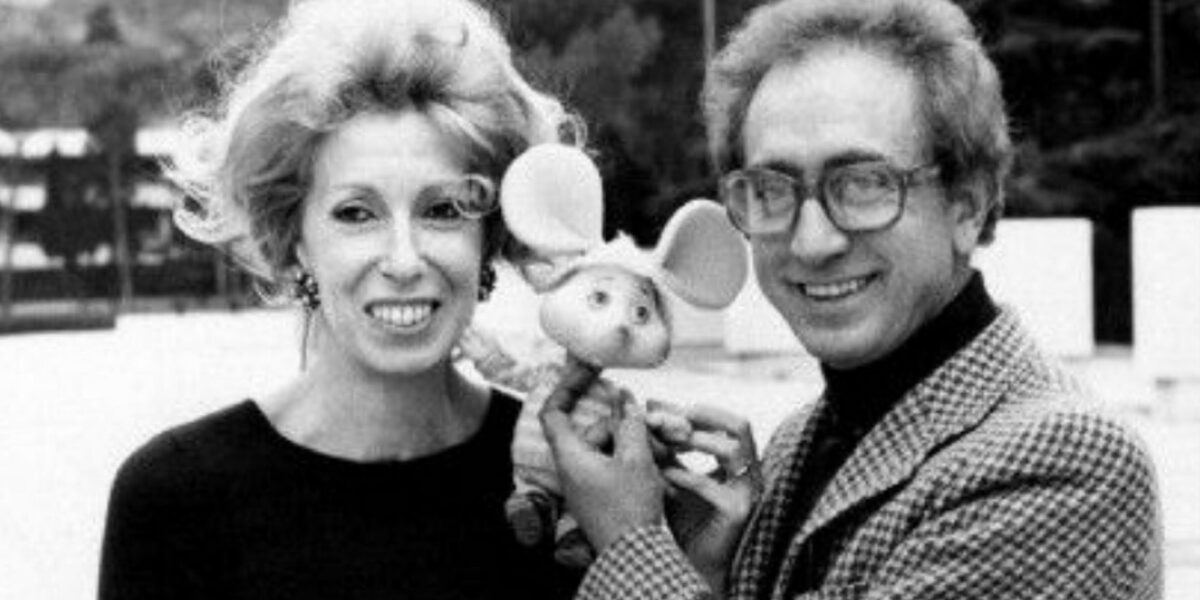
Peppino Mazzullo, the historical voice of Topo Gigio, died on 30 September in Messina, three months after turning one hundred. We remember him by re-proposing the interview he gave us for Paginatrè of the Gazzetta del Sud in February 1998, when the character was turning forty and the actor was preparing to return to live in his Santo Stefano Briga.
Who would believe in a great love story between a puppet and a human? Yet it was love at first sight that gave birth to Topo Gigio forty years ago, when the Messina actor Peppino Mazzullo, born in Santo Stefano Briga, saw for the first time the little character to whom he would lend his voice and… his soul. Since then together they have traveled the length and breadth of the world from Finland to South America, translating into the most disparate languages (English, Portuguese, Spanish, French, Arabic and, recently, also Croatian and Albanian) those proverbial “scramble me with cuddles” and “what are you telling me”. There are even “Topo Gigio’s”, some of the most renowned Italian restaurants in cities such as Chicago and Atlanta, and a very successful cartoon was produced in Japan.
But the greatest gratification for Mazzullo-Gigio is to excel, ahead of people of the caliber of Frank Sinatra, in the special ranking of appearances on the “Ed Sullivan Show”, a true institution of American television (it was there, for example, that 73 million Americans saw the Beatles for the first time).
«I started acting in Santo Stefano Briga – says Peppino Mazzullo – in the church of San Gaetano. I had formed a theater company together with Professor Placido Andriolo, named after Vittorio Alfieri, and immediately after the war we staged various tragedies, from Vincenzo Monti’s Aristodemo to Shakespeare’s Romeo and Juliet. Then I attended two dramatic art academies and a lot of theater school until I arrived at the Rai prose company in Milan in 1950. At the same time I was the lead actor at the Angelicum theater where I took part in the entire series of “Signor Bonaventura” and I remember that Sergio Tofano was delighted with my interpretation. Then countless comedies, from “The Flying Doctor” by Molière to “The Adventures of Lazarillo de Tormes”; all the harlequins as Brighella, Truffaldino… in short, a lot of characters. It was the only company in Italy to make shows and programs for children. And I stayed in Milan for a long time working with most of the great actors of the moment… from Ruggero Ruggeri to Renzo Ricci, from Peppino De Filippo to Nino Besozzi. Then they all went through RAI.”
From the Rai of Milan to Richetto
– And Totò?
“No. I have never had the joy of working with Totò… but with Taranto and Rascel yes, and for several years. As well as with Tognazzi and Vianello. Precisely then the years in which the magazine was created began. I spent three years at Rai making “The Garden of Wonders” with the unforgettable Giovannino Mosca, who was a friend of that series of great actors such as Vittorio Metz and Marcello Marchesi.”
– And at Rai he also met Maria Perego and Cino Tortorella…
«In fact… In fact, I already knew Tortorella because we attended the Academy of Dramatic Arts together. It was he who, even before the “Zecchino d’Oro”, when he started doing “Zurlì mago del Thursday”, called me to play Bonaventura in his broadcast. And from there Richetto was born. In reality I should have only appeared in one episode, in the role of a schoolboy who the magician Zurlì, with a marzipan letter, would have cured of the limp R. Instead, between one improvisation and another, Richetto worked for several years. This was in ’57, while ’58 was the year of Topo Gigio.”
The birth of Topo Gigio
– How was Topo Gigio born?
«He was born… with a shirt. Because he had a wonderful mother like Maria Perego, who had already created him to do a musical number. One day she pointed out this puppet to me, who had never yet “spoken”, and said to me: “Try to find a voice for him, who knows, a good character might emerge”… and, thank God, that was the case.”
As in all “myths”, there are conflicting versions about the birth of the tender puppet. Its creation is mostly attributed to Maria Perego, but some television historians maintain that the real “inventor” was Guido Stagnaro (the two then, with Federico Caldura, formed a lucky trio on the small screen).
– Forty years together is not a few. But what is your… “relationship”?
«What can I say… it’s part of my life. Through this puppet I have the fortune and joy of also playing an educational role for children. A noble task.”
– Is Topo Gigio also a pedagogue?
«Well, involuntarily. At a certain point you understand that a character who has been so loved for so many years cannot be interpreted lightly. So I’m very careful about the words I say and how I say them. Even when Gigio shouts he must be endearing, he must never bother the public’s ears.”
– Are the lyrics always improvised?
«No, there are also some very beautiful texts written by Maria Perego, to which I, as every actor should do, add something of my own at the last moment… many things cannot be written. Regardless of who he writes to, Gigio has a life of his own, with or without the lyrics. He can even close his eyes and carry on on his own… you give him a chance and he talks.”
– And the Commedia dell’Arte was very useful for this.
“Naturally. This is how I started in a cinema theater in Messina. First we did Romeo and Juliet but then there was the farce which was all improvised. There was a canvas to play on. It could last half an hour or an hour, depending on how long the audience wanted it to last… the more they laughed, the further we went.”
The elf of Saint Stephen Brig
– Do you ever dream of yourself as Topo Gigio?
«Once I dreamed of him speaking to me with my voice and I woke up, I won’t say scared, but very excited. But there is a particular episode in my childhood memories. At the age of three or four, in Santo Stefano Briga, opening my eyes one morning I remained motionless because at the foot of the bed I saw… do you know what we called it? u fuddittu (the elf, the woodland sprite widespread in Sicily as well as throughout European fairy tales, ed.), a very short man. I saw this figurine and I wanted to scream to call my mother, but I couldn’t… at least that’s what I remember now. Thirty years later, in ’58 when I saw Topo Gigio for the first time, I had shivers… it was that character I had seen when I was three years old.”
– Was it a premonition or a coincidence that made your fortune?
“I do not know. The human being can still be known thirty-forty percent. We get caught up in everyday life. Perhaps we have recorded many things in our memory, and from time to time they can come out. For me life is a wonderful dream… I don’t think it can end with death.”
Peppino Mazzullo’s most recent commitment is to save the precious works of art of his native village, Santo Stefano Briga, to which he has decided to return. He has already purchased and had a house renovated right next to the church of San Gaetano, the one where he made his debut as an actor as a boy.
The return to Sicily
– Now you are also working hard for the land where you were born and where you will soon return to live…
«Yes, I have a great opportunity to do something for my area, for our Sicily. Why not do it? There are splendid things, we have many masterpieces that are being destroyed… I believe that this too is a task that I must carry out.”
– He hasn’t forgotten Sicily or even its dialect. In one of the last broadcasts of “SOS, opera d’arte chiara” he played Antonello da Messina in Sicilian…
“Yes. I also remember a long radio series on Rai of “Sala stampa Sport”, before “Sports Sunday”, when Giovannino Brera was there. I, who played Calogero, a Sicilian, represented all the southern teams, and Febo Conti in Milanese those of the north.”
– Is the aesthetic similarity between Richetto and Topo Gigio a coincidence?
«No, it’s not a coincidence… I’m glad you noticed it too. I remember that when Maria Perego understood that I could almost feel the character inside me, as she modified it, from the eyes to the lower lip, she always added some features that resembled me. Initially this was not the case. He was uglier, more of a field mouse, with a beard made from pieces of straw stuck to his cheeks.”
– Do you always have the puppet with you?
“No, I’ve never had it, and I don’t want to have it.”
– Why?
«Because he becomes a puppet. I love the character… and I have instructed my collaborators to never let me see Topo Gigio thrown to the ground or hanging from a nail like a marionette. We only meet when it’s time to go on air. I don’t even try… because I can’t repeat the intonations I give the first time. I really live them, I put my soul into them.”