

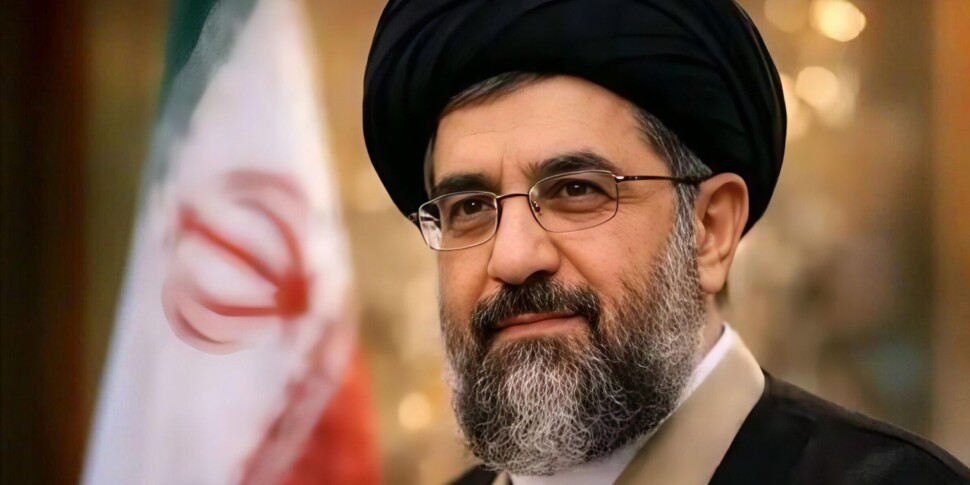
From the secret rooms of power to the throne of Tehran: for Mojtaba Khamenei, second son of Ayatollah Ali Khamenei, all that seems missing is the official status to become the Supreme Leader of Iran in a bloody legacy that challenges history and the people.
Born in Mashhad on September 8, 1969, for decades he did not seek the spotlight, preferring to control it. And now, after the death of his father, the favorite son is preparing to be the third supreme leader in the history of the Islamic Republic after having built his power in the silence of the corridors of the Beit-e Rahbari, the office of the Supreme Leader, weaving a web while the presidents passed by and the squares burned. He was his father’s gatekeeper, deciding who could speak to the Ayatollah and what information should come to his table, amassing informal but immense power in the shadows.
The link with the Pasdaran and the repression
Mojtaba’s true strength lies in his indissoluble bond with the Pasdaran. Unlike his more ideological father Ali, Mojtaba has always been the generals’ ally. Various intelligence sources reported that he coordinated the repression of the Green Wave in 2009 and the “Woman, Life, Freedom” protests of 2022. For the Revolutionary Guards, he represents a guarantee that the Iranian military-industrial complex will remain intact.
An uncompromising power and hereditary dogma
His election breaks a fundamental dogma, that of hereditary monarchy, risking creating deep discontent even within the Shiite clergy of Qom. Those who have met him describe him as an even more intransigent and vindictive figure than his father, with a personal fortune estimated at hundreds of millions of dollars and a network of influence that extends from militias in Iraq to bank accounts in London. Observers note that Mojtaba Khamenei did not come to power to reform Iran, but to lock it down.
Theological training and military militancy
He attended the prestigious Alavi school in Tehran and then theology in Qom under the guidance of ultra-conservative clerics and his father himself. Between 1987 and 1988 he served in the Habib ibn Mazahir battalion of the Revolutionary Guards, forging bonds with soldiers who now occupy key positions in the security apparatus. He never held elective public office, acting as an eminence grise in his father’s office. He supported Ahmadinejad in the controversial presidential elections of 2005 and 2009, orchestrating, according to media reports, his electoral victory.
The secret designation and international sanctions
He had been earmarked early as his father’s successor and Iran International reported about a year and a half ago that he had been secretly chosen by Khamenei, who had long feared for his fate.
Sanctioned by the US Treasury Department in 2019 for his links to the activities of the Quds Force and the management of an alleged occult financial empire with luxury properties in London and Dubai, in 2004 he married Zahra Haddad-Adel, the daughter of Gholam-Ali Haddad-Adel, the former speaker of the Iranian parliament. However, he had no children and reports have often circulated of his trips to London, under anonymity, for infertility treatments, a condition considered by the regime to be a sign of weakness.