

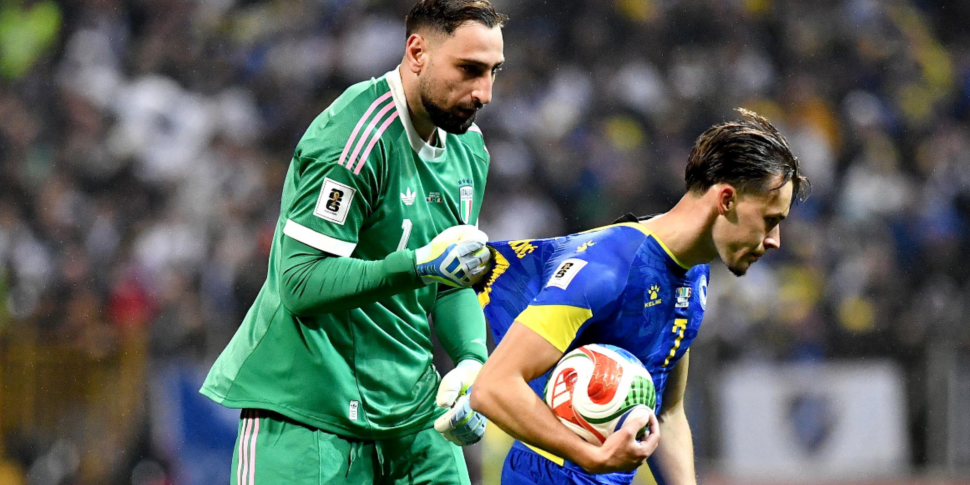
For the third time in a row, Italy will not participate in the Football World Cup. If anyone has been distracted from this thought in recent days, there is a high possibility that regret will return forcefully on Thursday 11 June at 9pm (Italian time). That is the kick-off time of the inaugural match between Mexico and South Africa, a match that will be preceded by what promises to be an evocative opening ceremony. For some it will be the beginning of dreams and hopes, for many others it will be the time of regrets. Especially for many stars who, for one reason or another, will not be there at this World Cup.
Italy out of the World Cup: Donnarumma leads the list of absent Azzurri
Not even the increase in participants to 48 allowed Italy to find a place in what was once its natural sporting home, the World Cup. The non-participation of the Azzurri also keeps out of the competition those few international level footballers that the Azzurri can boast in their football pool. The most important name is that of Gigio Donnarumma. The very fact that the question arises as to whether or not he is the best goalkeeper in the world offers a measure of how high his level is as a professional. The Manchester City goalkeeper is joined by other Premier League protagonists such as Tonali and Calafiori or the Inter players Barella and Dimarco.
Lewandowski, Kvaratskhelia, Osimhen and Dybala: all the big names who will miss the World Cup
Among the European national teams that will not take part in the next World Cup, the absence of Denmark stands out, which will force leading players such as Rasmus Hojlund, Morten Hjulmand and Christian Eriksen to stay at home. Poland is also out and will not be able to count on Piotr Zielinski and above all on Robert Lewandowski, once again unlucky on the way to a great world championship.
The failure of some European selections to qualify will also deprive the tournament of high-level defenders such as the Hungarian Milos Kerkez and the Ukrainian Illia Zabarnyi, as well as the talent and imagination of the Hungarian Dominik Szoboszlai and the Georgian Khvicha Kvaratskhelia. In attack, however, the goals of the Slovenian Benjamin Sesko and the Serbian Dusan Vlahovic will be missing.
Africa also leaves many protagonists at home. Nigeria will not be represented by two true champions like Victor Osimhen and Ademola Lookman. Cameroon’s elimination excludes Bryan Mbeumo and André-Frank Zambo Anguissa from the tournament, while Gabon will not be able to count on goals from Pierre-Emerick Aubameyang. In South America, however, Chile’s absence will deprive Alexis Sanchez of the World Cup experience.
There is also no shortage of defections due to injuries. The absences of the Brazilians Eder Militao and Rodrygo, the Argentine Panichelli, the Frenchman Hugo Ekitike, the Germans Serge Gnabry and Marc-André ter Stegen, the Englishman Jack Grealish, the Dutchman Xavi Simons and the Ghanaian Mohammed Kudus are particularly significant.
Furthermore, some large national teams can afford the luxury of leaving extremely valuable players at home. This is the case of France, which will not bring Khephren Thuram and Randal Kolo Muani, and Brazil, which will have to give up Joao Pedro, Gabriel Jesus, Carlos Augusto and Ederson. In the Argentina led by Lionel Messi, however, Paulo Dybala found no space.
The lineup of the absentees and the great excluded in the history of the World Cup
If we wanted to imagine a lineup of absentees, the result would be a team capable of performing well in the competition: Donnarumma; Kerkez, Militao, Zabarnyi, Calafiori; Ederson, Tonali, Szoboszlai; Kvaratskhelia, Osimhen, Rodrygo. The history of the World Cup, moreover, is full of great exclusions. Absolute champions such as Northern Ireland’s George Best, Welshman Ryan Giggs and George Weah, AC Milan’s great striker and later president of Liberia, have never had the opportunity to compete in the World Cup.
However, the most famous absentee of all time remains Alfredo Di Stefano. The Real Madrid legend never managed to play in a World Cup due to a series of unfavorable circumstances: in 1950 Argentina chose not to participate in the competition; in 1954 the process that would have allowed him to represent Spain had not yet been completed; in 1958 the Iberian national team failed to qualify and in 1962 an injury definitively prevented them from fulfilling that dream.