

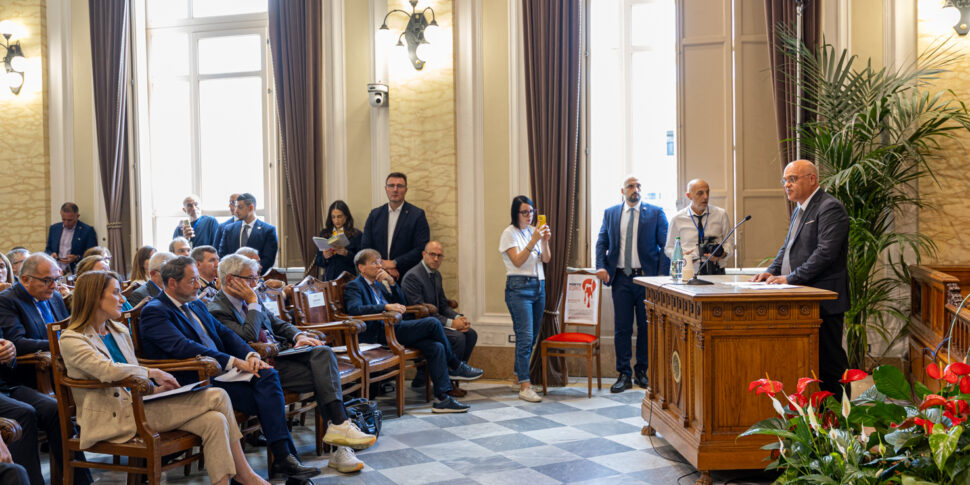
“The European Parliament is ready to strengthen the collaboration with all the actors engaged to ensure that the mafia never finds refuge again in any corner of our continent”. And to say it, snatching the applause of the prestigious audience of the Aula Magna of the University of Messina, is precisely the president of that European Parliament called to legislate on the topic, Roberta Metsola. His intervention, full of meanings and ideas, arrives in the middle of a day that, in the intentions of those who strongly wanted it (the MEMPTUATE OF THE M5S Giuseppe Antoci, together with the Prosecutor of Messina, Antonio D’Amato, and the rector of the Peloritano University, Giovanna Spatari), must be a starting point for the next moves which, in the European field, will have to lead to creating the “tools” to face ” Transnational », as the conference title states.
A conference from which, Antoci himself underlines a final document, “the publication of the documents, which can be a source of inspiration, also in view of the European rule on transnational organized crime” will come out. And who knows that really, to put it with Andrea Apollonio, magistrate and writer, yesterday in Messina he was not written “a page of history”, as had happened – Antocice and the Spatari Ritrice remember – 70 years ago, with the Messina Conference. Moreover, the parterre of guests and speakers is of absolute level: from the Minister of the Interior Matteo planted (and in the audience there is also the chief of the State Police Vittorio Pisani) to the national anti -mafia and anti -terrorism prosecutor Giovanni Melillo, up to the prosecutors of the four Sicilian anti -mafia district directions and of Reggio Calabria, at the top of the European and national police officers and forces, as well as experts and scholars of criminal law.
According to President Metsola, “Sicily embodies the most authentic meaning of our union. When this city was devastated by the 1908 earthquake, Malta, the smallest island, gave its help and this is precisely the meaning of Europe ». And today that Europe has a challenge in front: “The fight against criminal networks can only be fought through cross -border cooperation”. Some steps have been taken, by the European Prosecutor’s Office and the confiscation directive and the recovery of goods, “but we must and more do, the directive on the fight against corruption will be decisive. Organized crime fits quickly to the changes of our time and it is essential that we react with the same promptness ». What the scenario is, moreover, Alessandro Chiocchetti, secretary general of the European Parliament summarizes it: “Only the computer -organized IT crime could cost the international community 10,500 billion dollars by the end of the year”.
But, highlights the prosecutor of Messina, D’Amato, “a new European legal framework is needed that allows you to identify and punish criminal profiles capable of exercising new persuasive control forms. Where should we start from? From the resolution of the European Parliament of 2011. And from the key notion of organization ».
The minister planted is said to be optimistic: «With Europe we have already shared some contrast systems, we can reach more and more shared systems. But focusing on the great themes of transnational crime must not make us lose sight that all this is based on actions from below, of the so -called crime manovalanza ». According to the national anti -mafia prosecutor, Melillo, “gigantic steps have been made, but there is still a lot to do. There is an Italian, but also European responsibility, in understanding how a weakening of the Italian anti -mafia system is unthinkable “.
The emotion of Antoci, “father” of this day, is sincere, in remembering “the many sacrifices of servants of the state, magistrates, journalists, law enforcement men, innocent victims, sacrifices, that my family and I know well, and who have contributed to building a system of rules and institutions that today represents a model”. But a decisive aspect should not be forgotten: «The fight against mafias is not only repression, it is not only a criminal trial, it is also a culture of legality, civic education, social commitment. And precisely from this city, from where seventy years ago the spark of Europe started, we want to think that today Europe can start again in the fight against transnational organized crime “.
The satisfaction of the rector and institutional presences
Pride and emotion. The rector Giovanna Spatari highlights how an honor was, for the university, “hosting a conference that catapults, once again, our city at the center of the European debate, 70 years after the Messina Conference”. The confirmation of the Academy “as a place of the formation of a civil conscience, as well as scientific”. And a red thread with the inauguration of the academic year, with the Head of State Sergio Mattarella: “The president – says the rector – recalled how united Europe is a bulwark against autocracies and in the same way the world needs Europe to counter criminal action”.
Present the emeritus president of the Constitutional Court Gaetano Silvestri and the president of the Court of Auditors Guido Carlino. Institutional greetings entrusted to the Prefect Cosima di Stani (“we feel the need for sharing and objective homogeneity”), to the mayor Federico Basile (which I cite Sciascia highlights how “a good industrious city must do its part to help governments”), to the president of the court of appeal Luigi Lombardo (“Europe is under attack, if it presents itself in scattered order is not able to confront the continental giants”) And to Archbishop Giovanni Accolla (which warns against “too many individual and collective behaviors deviated and deviant”).
The bridge and the balance to be found: the plated-melillo dialogue
The place and the moment make the Ponte on the Strait chapter inevitable. And the dangers to defend himself from. “It is a work of great strategic value – the Minister Matteo planted – reiterates the government line -. We do not escape the risk of infiltrations, and not because it is achieved in Sicily and in Calabria, but because it is a great public work. However, we must go on, indeed, it will be a great opportunity to make it clear that Italy is able to achieve these works without giving in to the danger of contamination of criminal interests. We are organizing ourselves by trying to enhance both a central structure, as for the Cortina Olympic Games, and the role of the prefectures. I am confident about the ability of our system to intercept any attempt at intrusion. And there is the great theme of making all this compatible with judicial investigations, the challenge is to find balance between prevention and contrasting action at the judicial level “. Theme on which – in the final panel conducted by journalists Paola Cervelli (Tg1 Rai) and Paolo Borrometi – says his the national anti -mafia prosecutor, Giovanni Melillo: «The roles are distinct: we do not make preventive investigations, our offices have not opened windows on the bridge, work on the size of the mafia system projected to the control of contracts. It is a job that has a greater need to feed on the results of the prevention actions, which need adequate resources and means ». «The prevention system has lights and shadows – warns – does not feed on the financial monitoring of the great works. There is a need for a strong political mandate to implement this tool ». And he warns: «In the nineties I saw how the season of the delinquent exploitation of the money flows related to the post -earthquake reconstruction changed the Camorra, which became a galaxy of companies. Then the investigations were late and incomplete. Today we have a duty to make them timely and effective. We will support the district prosecutors, because after this story Cosa Nostra and the ‘Ndrangheta will no longer be the same ». «I would not like to point the finger at the public prosecutor as an opponent of the country’s development strategies, as too many times it has happened. The balance point is fundamental, but presupposes the abandonment of a controversy towards the judiciary, of which the need is not felt ».
Seb.Casp.