

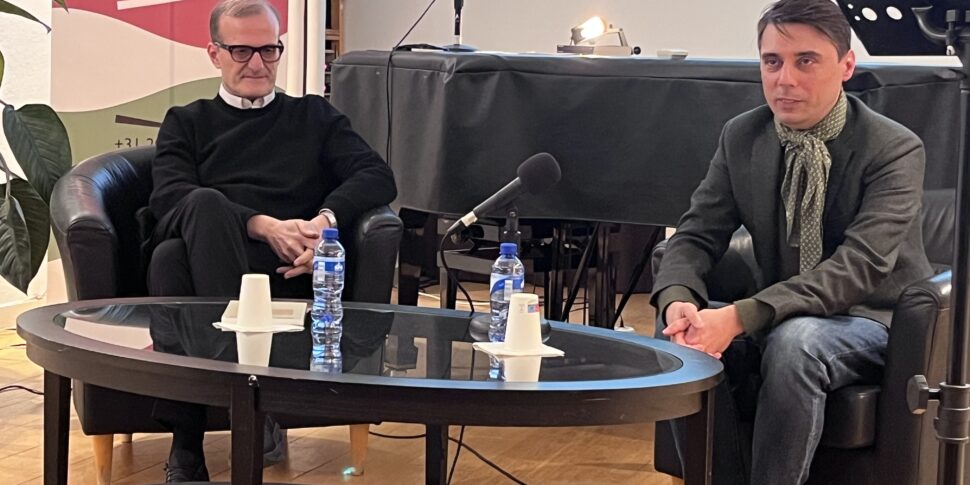
The room is full, alive, crossed by a restrained energy. The attention of young people is vibrant, intense, almost feverish. For them, Dante is not a distant monument but a restless companion: it is the restlessness, the anxiety that grips, the frustration that seeks words and at the same time the stubborn attempt to overcome it. In this tense and participatory climate, his voice appears necessary. As if the word of the Supreme Poet, in his eternal return, asks today more than ever to be listened to again in the light of a crisis that is not only cultural, but environmental, sensitive, almost ontological. The audience is international at the Italian Cultural Institute in Amsterdam of the Italian Embassy in the Netherlands. The occasion is significant: an “ecocritical” rereading of Dante, an Italian heritage but also a global voice, in a time in which reflection on the relationship between man and nature is becoming increasingly urgent.
At the center, the Earthly Paradise of Purgatory: not just a symbolic or theological space, but a living, concrete, sensorial environment. An Eden that breathes, that vibrates with pleasure, that involves the body even before the spirit. It is here that the ecological dimension becomes revealed: Dante not only describes a place of moral perfection, but an intact ecosystem, in which the human is immersed and participates, not dominator. To introduce this compelling interpretation of the Divine Comedy is the Dante scholar Gandolfo Cascio, trained in Palermo and now a professor at the University of Utrecht, committed to the promotion of Italian culture in Europe. And it is developed with passionate dialectic by Manuele Gragnolati, professor at the Sorbonne Université and previously at the University of Oxford with which he maintains a research link.
In a context of innovative textual exploration and of strong civil value, Gragnolati builds a path capable of crossing the centuries with lightness and precision, like a tightrope walker suspended between the language of Dante and that of the contemporary poet Andrea Zanzotto. “Reading Dante with Andrea Zanzotto: for an ecological reading of the Earthly Paradise” is the thematic perimeter outlined by the director of the Institute, Veronica Manson, for this immersion in a critical perspective that is both rigorous and innovative. The juxtaposition between semantic and creative universes centuries apart also becomes, by contrast, the most lacerating point of a bold analysis yet fully adhering to the text of the Comedy. Because if Dante’s Garden of Eden is primordial harmony and antechamber to Paradise, our present appears like its reverse: a modern hell, devastated and corrupt. It is through this awareness that the comparison with Zanzotto’s Conglomerati (2010) becomes meaningful.
In Zanzotto’s extreme and visionary poetry, the landscape is no longer innocent: it is broken, contaminated, yet still capable of minimal and very powerful epiphanies. The meow or yawn of a cat in a pristine context is transformed into a symbolic figure, evoking forms and semantic short circuits that recall, in a surprising way, Dante’s imagery. A dizzying game of references, where even decay retains traces of beauty.
The voice of Elsa Morante also ideally fits into this fabric of resonances, who in her Earthly Paradise recalls how, after the expulsion from Eden, man was left with at least the company of animals, “looks without judgement” capable of attenuating the bitterness of exile. An image that ideally dialogues with Dante’s story and reinforces the ecological reading proposed in the meeting.
And then there’s Matelda. A luminous and elusive figure, placed by Dante to guard Eden, she emerges as a woodland nymph, a corporeal and mythical presence, closer to Ovid’s metamorphoses than to an abstract allegory. Grace, naturalness and gesture coexist in her: she is the one who introduces Dante to the experience of the Earthly Paradise not through dogma, but through contact, movement, perception. It is no coincidence that the reference to the Metamorphoses and the Ars amandi – understood as “techné”, the art of living and transforming – opens a further level of depth: nature is not static, but fluid, changeable and the human is an integral part of it. To close the circle, Professor Cascio’s intervention brings attention to an essential point: the priority of literal adherence to Dante’s text. In a time prone to arbitrary interpretations, the return to the word, to its concreteness and precision, becomes not only a philological but also an ethical act.
A dense and current reflection emerges, capable of showing how Dante does not belong to the past, but is a powerful lens for questioning the present. And perhaps, in the ineffable silence of his Earthly Paradise, an urgent question continues to resonate: are we still capable of inhabiting the world like a garden?