

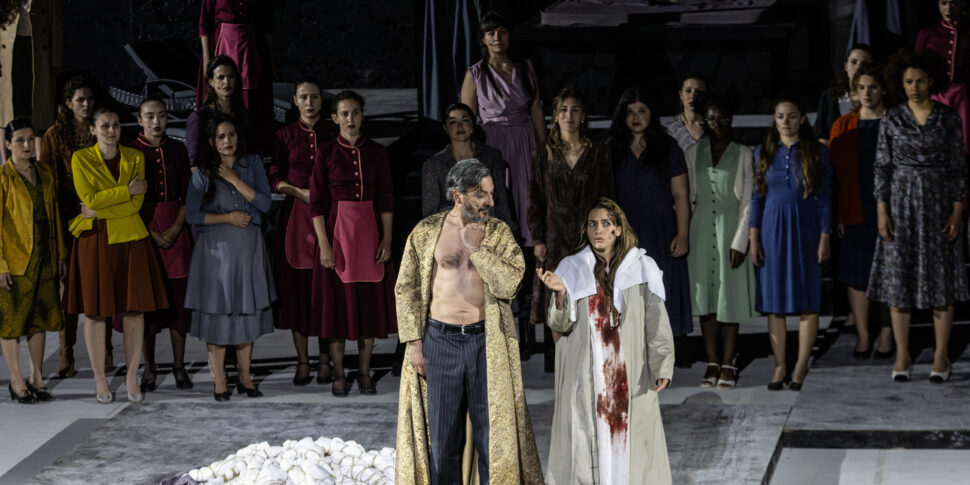
Alcestis is a woman of the border: the one between life and death, between love and sacrifice. And Alcestis is a spectacle of the border: between the tragic and the comic, of which it possesses both natures and registers, between the sacred and the everyday. Between yesterday and today. It has a happy ending, but perhaps we can also ask ourselves about that happiness: Alcestis is a space of questions, of mystery. The very well-known story told by Euripides (year of grace 438 BC) – that is, the sacrifice of Alcestis who, alone, agreed to die in place of her husband Admetus, the Thessalian king of Pherae, who had obtained, thanks to Apollo, the singular privilege of escaping death if someone had offered to die in his place – does not end with the pacifying kiss and the resumption of existence, but with the return of the bride kidnapped by Hades and who became a veiled and silent presence, a bearer of another sense. Nothing will be as before, in Admeto’s glam villa, with spa and design objects (the sets are by Gregorio Zurla, the lights by Pasquale Mari), and even beautiful girls by the pool, a bright pink counterpoint to the severe waitresses in burgundy (the costumes by Alessio Rosati evoke the modern imagination to standardize roles and hierarchies) who polish every surface of that perfect and glossy place, where it seems that no drama can happen.
Furthermore, a choice much criticized on the Internet, in the cloying debate on the “distortion” of ancient tragedy, which is reignited every time a staging is judged excessively “modern” (that is, always): it would be interesting to understand what some people mean by “classicism” and “respect”, and one might think that they have more in mind Ben Hur or peplums than the reality of the texts or the philology of the shows… For this reason we do not stop being grateful to Inda for its inexhaustible work of re-proposing the classics in their universal value and within the most cultured languages of modernity: «tradition is not worshiping the ashes but guarding the fire», a mission perfectly summarized in the phrase attributed to Mahler and often cited by the managing director Marina Valensise.
Thus the director Filippo Dini in the show – co-produced by Inda and the Fondazione Teatro Stabile del Veneto – which successfully inaugurated the 61st season of classical performances at the Greek theater of Syracuse, follows all the folds and implications of the text, in a proliferation of ideas and finds, some even extreme and unsettling. At the center is Alcestis, the dying woman dressed in white, already inside the death that inhabits her panting voice, her broken gestures: Deniz Ozdogan returns to the stage in Syracuse, where in «Prometheus Bound» in 2023 she had embodied, alone among gods and demigods, a pure and entirely human female power. Her Alcestis – «who is alive and who is dead» at the same time (the intense handmaid of Sandra Toffolatti tells the choir, in the beautiful translation by Elena Fabbro) – is a frenetic presence within the syntax of bourgeois decorum, where the body is an object among others, to be modeled with physical culture (the spa tools so appreciated by Admetus and his guests) or to be entrusted to the nursing staff with their paraphernalia of drips and oxygen cylinders.
Instead the body of Alcestis is rupture and sacrifice and tragic questioning. The lucid Alcestis who knows very well the implications of her gesture, far beyond the understanding of Admetus, whose confused mediocrity Aldo Ottobrino embodies, sometimes with excess of vehemence. So perhaps it is not a romantic story of love and self-sacrifice, but a contrast between feminine and masculine in which we can read centuries, millennia of abuse and “training for sacrifice”.
After the first intervention of Apollo – a rock star shining and unattainable like a golden statue (Alessio Del Mastro) – it is death, the body of Alcestis, that invades and disrupts the scene. The death that really comes: Luigi Brignone’s Thanatos is a very interesting character, a disturbed bureaucrat, with raincoat and document folder and careful parting, but with a dark nature that manifests itself in devastating tics and raven screeches, surrounded by three disturbing infernal beasts, a bit Walking Dead and a bit punkabbestia (Riccardo Gamba and the two students of the Inda Academy Samuel Cannoni and Eddye Di Meo). They will seize Alcestis, who is both the composed figure in the bed – the bed where death is celebrated instead of love – and the fragile prey figure (in the gestures of the “beasts” there is an echo of the eternal violence against women): it is she who continues to invade the scene, alive and dead, now the beginning of chaos and disorder and dismay in the model house of Admeto the host, Admeto the bon vivant.
And here is the caesura that we, lucky spectators of the premiere, were able to fully experience: the empty stage and Paolo Fresu (author of the music), alone, who descends and crosses, barefoot, the entire space suddenly filled only by the sound of his flugelhorn. In that insistent, solitary brass voice, a melody of silence and mourning, but also of ineffable hope, of things lost and yet returned, of conclusions and beginnings again. A moment, yes, of “border”, suspended and unrepeatable (and certainly without this the form of the show will have to change).
From there the other half of Alcestis comes to life, the one with comic or grotesque ideas – as is the nature of the text, and as it is tremendously difficult to govern on stage – embodied by Denis Fasolo’s amusing Heracles, the generous and drunken braggart who arrives on a bicycle, dressed in an extravagant yellow sheepskin (the syntax of the colors is bold and significant: to mark the two “sacred” guests, the Olympic gold of Apollo and the shameless yellow of Heracles): his Venetian accent is the strongest thing in the comic characterization, especially in the dialogue-contrast with the Bari servant-valet Bruno Ricci (what a resource, for comedy, our dialect tradition…).
And then there is a palace of the guest, unaware and enjoying himself, and a palace immersed in mourning: the double nature of the Alcestis, his continuous “trespassing” which even the public has shown to appreciate. How he applauded the very harsh contrast between Admeto and his father Pheretes (the director Filippo Dini himself), which overturns and contradicts the entire ethic of fathers’ self-denial towards their children, even if, in fact, only two opposing egoisms face each other, given that the only victim, in fact, is not there and is a woman…
The choral sequences are very evocative, a living “body” and a reflection of the multifaceted community (and Syracusan excellence, always): the movements are by Alessio Maria Romano, the choir leader is Carlo Orlando, the choir members are Simonetta Cartia, Gennaro Di Biase, Riccardo Gamba, Lucia Limonta, Margherita Mannino, Carolina Rapillo, Ottavia Sanfilippo, Roberto Serpi, Chiarastella Sorrentino, Dalila Toscanelli. As always, the students of the Inda Academy, a precious art nursery, were excellent. The cast also includes the children of the royal couple, Maria Sole Gennuso, Giorgio Signorelli and Riccardo Scalia.
It continues, alternating with Antigone, until June 6th.