

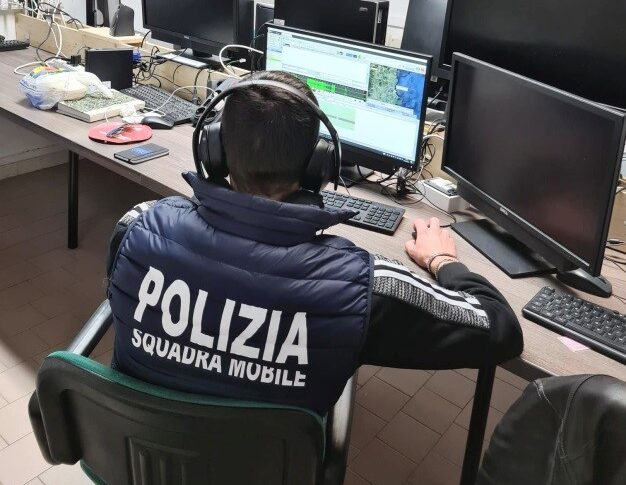
There are 41 suspects, Italian citizens but also Chinese and Albanians, at the center of an investigation by the Florence prosecutor’s office, delegated to the investigators of the Central Operational Service of the State Police and the Flying Squad of Prato into three criminal organizations that dealt with drugs and migrant trafficking.
In addition to precautionary measures, both of a personal and real nature, personal, local and IT search decrees were carried out in Italy and also abroad, with the collaboration of foreign authorities, facilitated by the intermediation of Eurojust.
The alleged crimes and precautionary measures
The 41 suspects are recipients of precautionary measures issued by the Florentine investigating judge, for crimes contested in various capacities for criminal association aggravated by facilitating a gang and by transnationality, and aimed at money laundering, the reuse of capital from illicit proceeds from drug trading activities, and illegal banking activity; of criminal conspiracy aimed at international drug trafficking; and criminal conspiracy aimed at encouraging the illegal entry into our country of Chinese citizens.
17 suspects have been sent to prison, 16 have been placed under house arrest, and 8 are required to report to the judicial police. The precautionary measures were notified mainly in Tuscany, in the provinces of Prato, Pistoia and Pisa, but also in various foreign countries, in particular in Spain. The seizures concern assets with a total value of more than 60 million euros, against 27 suspects.
The international narcotics payment network
The investigation made it possible to discover the existence of an organized group, headed by a Chinese citizen rooted in Prato for some years, which since at least 2021, according to serial schemes and with organizational locations in various locations, located both on the national territory and in various European countries, including Spain, Portugal, France, Germany, Belgium and Holland, to ensure multiple criminal organizations, in particular Albanians, operating in Central and Northern Italy, dedicated to the illicit trade of narcotic substances, as well as organizations qualified mafia-type companies, operating in Campania, Calabria and Puglia dedicated to drug trafficking on a supranational scale, to make international payments for the lots of the narcotic marketed without the need to resort to any physical movement of the money.
The illegal bank and the “Chop-Shop” system
According to the investigators, in fact, there was an illegal bank, with a logistical base in Prato, also serving the three groups, through which payments for the narcotic substance were made abroad on behalf of the “customers” with a payment system similar to the traditional Islamic one called *hawala*, also known in China with the chop-shop variant; the man at the head of the “bank” had a vast array of collaborators in various European countries and is for investigators the link between Italian crime, foreign Albanian crime operating in Italy and some representatives of the illicit interests of the Chinese business community operating in Prato.
During the investigations, the movement of sums of money connected to international drug trafficking and tax crimes perpetrated by Chinese citizens was estimated at approximately 80/100 million euros per year, for at least three years. The “bank” ensured a service, on the one hand, of payments for narcotic consignments and, on the other, of black market transactions of goods between Chinese companies.
The money laundering mechanism between Italy and Spain
The sums for the purchase of drugs were collected “at home”, by sending courier collaborators, and the money was taken to Prato in a car with a double bottom and delivered to a Chinese fast fashion entrepreneur through Chinese “collectors”, apparently as payment for a supply of clothing. In Spain (but also France and Portugal) the money was collected by the couriers of the Spanish cell of the organization from Chinese-run fast fashion shops located in commercial centers in various Spanish cities (Madrid, Seville, Malaga, Valencia).
In this way, the criminal group based in Prato has guaranteed for years the payment of large quantities of narcotics coming from Spain and Holland, reducing the risk that the cash could be intercepted by the police en route from Italy to the countries supplying the narcotic. The abusive “bank” also worked for both Italian and Albanian drug traffickers, facilitating relations with Albanian and Italian criminal organizations, including mafia-type ones: the Briganti clan, from Lecce, fringe of the Sacra Corona Unita, the ‘ndrina Fiarè/Razionale/Gasparro, local to San Gregorio d’Ippona (VV) and the Aquino-Annunziata clan from Campania.
Illegal trafficking of migrants from China
A part of the group of Chinese citizens, already in the context of the illegal “bank”, also managed in parallel a distinct illicit activity of organizing the entry into Italian territory of Chinese people, after having made them arrive for the first time in Serbia, a European country not belonging to the Schengen area.
Once they arrived in Belgrade, the Chinese immigrants were welcomed in Chinese-run accommodation facilities, and were then transported by the group by car to Hungary, also forced to cross some mountain sections on foot, and from there to Italy through Slovenia, with final destinations in Prato, Turin and Somma Campagna (VR). Every single migrant paid 9500 euros.