

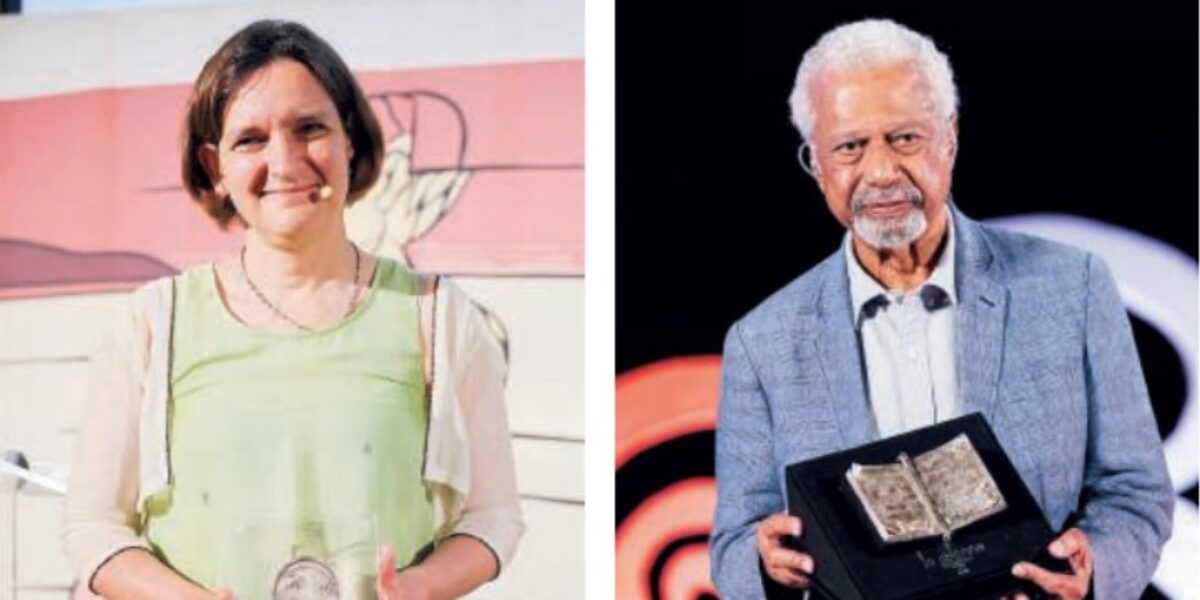
Listening to them one after the other, the feeling is that Esther Duflo and Abdulrazak Gurnah spoke about the same theme without ever mentioning it in the same way. She through numbers, experiments and institutions. Him through memories, crossings and stories. But the meeting point has remained the same: trust is not born when everything works. It was born much earlier. The moment someone decides that a person, a story or a possibility still deserves to be taken seriously.
First it was the turn of Esther Duflo, a French economist awarded yesterday with the Taobuk Award by the creator of the festival Antonella Ferrara. Those who expected a lesson on economics as a language of graphs and forecasts found themselves faced with something else: a reflection built through simple questions and stubborn tests. “We really need to make an effort to look social justice issues in the face,” he said. “The risk of recent years is twofold: on the one hand considering some inequalities as inevitable, on the other thinking that slogans or abstract principles are enough to correct them.” The point from which Duflo has been starting for years is this: not to trust intuitions, even when they seem morally right. Put them to the test. It is the method of randomized experiments that has made her one of the most influential economists of her generation: observing similar groups, introducing a limited difference, following over time what really changes. To tell it, she returned to one of the studies that most marked her work, conducted in Ghana: «We took students who had passed the exam to enter high school but didn’t have the money to enroll. We gave fifty percent a scholarship and then followed them for years.” The results have broadened the field. Better scholastic outcomes, greater civic participation, greater familiarity with the functioning of institutions. And above all a very strong impact on girls, capable of passing on to their children over time. Then the transition to economic inequalities, which Duflo reads not only as a moral problem but as an element of democratic erosion: “If an absolutely limited number of the super rich continue to accumulate the world’s resources, those of the rest of humanity progressively diminish.” Hence also a proposal: «An international taxation of the super rich – even limited – could improve general conditions». And again: «When I talk about gender equality I talk about gender equality which concerns both women and men to the same extent because society needs everyone’s talent».
Shortly thereafter, completely changing camp but not really topic, Abdulrazak Gurnah moved the conversation elsewhere: not to the rules that distribute opportunities, but to what people try to salvage when the ground beneath their feet breaks. For a long time its literature was told through words such as migration, colonialism, exile. «I don’t think my characters are condemned to be foreigners. I believe that very often they are people looking for security.” The distinction is not small. For Gurnah, movement almost never arises from the desire for elsewhere: it arises from the attempt to continue living. «After decolonization there was an enormous dispersion of human beings. Some fled conflicts, others simply sought a better life. I’m interested in understanding what resources a person can find when their life is in danger.” «We need to think about colonization again. Not because we have to live in the past, but because too often the story that has been told has been a non-story.” Even when he talks about Zanzibar he avoids any simplified nostalgia: «It wasn’t a choice to be born there: I was deposited by nature and events». «That piece of the Indian Ocean had already belonged for centuries to a network of languages, trades, crossings, contaminations». And when the discussion comes to the female figures of his novels, the response changes tone, touching on the private: «I had a mother, four sisters, two daughters. Writing means trying to understand others. With patience.”