

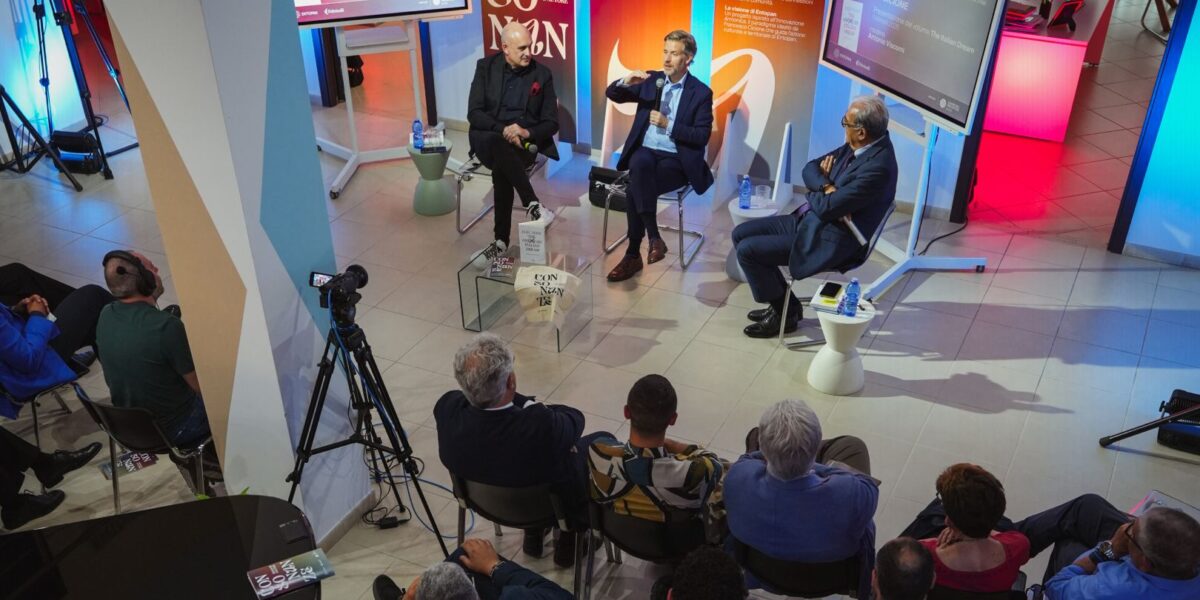
The “Italian dream”? It doesn’t exist, actually, yes! Alec Ross explains it clearly in his latest book “The Italian Dream. Taking back the future”, at the center of a national presentation tour that started from the South in synergy with Entopan, the Calabrian open innovation hub, and with Harmonic Innovation Group. Together with the president of Entopan Francesco Cicione, the American economist, former consultant to the Obama Government for technological innovation and now an entrepreneur and professor at the Bologna Business School of the University, visited Catanzaro (in the company headquarters in Caraffa, with the moderation of vice-president Antonio Viscomi) and then Reggio Calabria, (in the «Pietro Battaglia» council room of Palazzo San Giorgio, with the moderation of Demetrio Naccari Carlizzi). The tour – as part of the Consonanze – Dialoghi d’Autore route, a traveling cultural exhibition promoted by Entopan and Feltrinelli with HIG – ended in Catania, where in the great hall of the University Ross spoke together with Cicione with the moderation of the head of strategic relations Raffaele del Monaco and the journalist Santina Giannone. Also speaking was Emanuele Spampinato, CEO of Harmonic Innovation Group, the ecosystem – chaired by Pasquale Scaramuzzino, with Francesco Profumo as president of the Strategic Steering Committee – which between Sicily and Calabria focuses on the development of the south through “harmonious” technology and innovation.
At the center of the three stages, the reasoning – intellectual, but also very concrete – which, starting from the essay, unfolded on the destiny of Italy, on the role of the new generations, on trust and on the need to return to building long-term visions.
The tour that starts from the South: “Here I feel at home”
But why start from the South? “I feel at home in the South – Ross replies – and I see talents from southern Italy everywhere in the world. I want to be here, there is a thirst for information and inspiration. And the authors often stop in Rome”. A South to which we need to “restore trust” and the courage of a dream that is based on craftsmanship, beauty, creativity, quality of life. Creating the conditions to train and retain young people, without simply telling them that “patience is needed” and without betraying their expectations for the future.
The familiarity with the lands of the South – as the author himself explains – is linked to the family roots of Ross, whose great-grandfather from Abruzzo left Italy, starting a story that perfectly reflects the theorem of the “American dream”, the American dream of immigrants looking for opportunities and a future in the new world. And the South of Italy is the one that should most treasure Ross’ words, regaining confidence and above all giving it to its young people, boys and girls whose condition often recurs in the pages of the essay. Young people discouraged by endless apprenticeships, who at thirty years of age are still considered “boys” and who instead should be given the management responsibilities they deserve, so as not to choose to move away, from the south to the north or from Italy to abroad. Furthermore, the profound social gap between the Italian regions is also highlighted by Ross in the volume, articulated in the development of eight dichotomies: Young and Old, Innovation and Tradition, Form and Substance, Learning and Superficial Stimuli, Unity and Division, Short and Long Term, Trust and Distrust, Optimism and Pessimism
Italy must set an example: its own
“Now is not the time for Italy to follow the American example or that of any other people of any other country. It is the time for Italy to establish its own model and offer its own example”, hopes the author.
During the Catania event, as already emerged during the two Calabrian stages, Ross expanded the reflection, starting from the ideas offered by the book and outlining a concrete horizon of growth, of “recovery” of a possible future, but above all trying to “awaken” an identity pride that too often seems clouded. And he does it in his own way, despite knowing that “it would be impossible for the reader to agree with me on everything” but – he adds – “I believe that when two people agree on everything only one of the two is really thinking”.
Ross’s starting point is in fact as simple as it is provocative. For decades the so-called “American Dream” was based on a clear promise: work hard, respect the rules and guarantee each generation a better life than the last. Today, he argues, that promise seems to have broken down, especially in Italy, where economic growth has been among the lowest among industrialized countries.
A country that “is” a dream, but doesn’t have one
Italy “is” a dream, explains the author, but it does not “have” a dream. In particular, a medium and long-term project is missing, producing economic stagnation, discouragement and above all a growing generational divide. The issue is particularly felt in the South, from which a significant hemorrhage of talent continues. Young people trained in excellent universities often find professional opportunities, responsibilities and growth paths abroad or in Northern Italy that they struggle to find in their territories of origin.
Cicione: the South is a laboratory of global challenges
Francesco Cicione has transformed the reflection on the Italian dream into a reflection on the role of the South. According to the founder of Harmonic Innovation Group, the South must not be considered a periphery but the center of a new development perspective. The dialogue with Ross showed the strength of a friendship and a deep affinity: Ross’s vision, attentive to the individual, merit and innovation, met Harmonic Innovation, which intertwines that drive “with the values of community, culture and ethical anthropocentrism. It is the Italian and Mediterranean way to development that Entopan has been cultivating for twenty-five years, recognizing in the South and the Mediterranean a laboratory for the global challenges of the future”.
And the essay grasps precisely this invitation addressed to Italy: to return to looking at itself truthfully, to recover the taste for vision and the ambition to build one’s own future. For Cicione, the real Italian problem is not the lack of resources, but the loss of the ability to dream, a condition which – also due to regulatory hypertrophy – risks transforming the legacy of previous generations into a brake rather than a source of development.
Beauty and innovation on which to base competitiveness
In the book, beauty emerges as a distinctive trait of Italian identity, not however as a simple aesthetic question, but as a value capable of translating into innovation, quality and competitiveness. Ross developed the theme by connecting it to contemporary technological transformations. In a world increasingly dominated by algorithms and the standardization of information, he explained, creativity, originality and craftsmanship become strategic factors. Not only in art and fashion, but also in industry, manufacturing and technology.
Trust, the intangible infrastructure of development
The theme of trust is therefore central, as an intangible infrastructure of development. Ross observed that in the world’s major innovation ecosystems – from Silicon Valley to the Gulf countries, from India to China – competition does not exclude the ability to team up. In Italy, however, too often individualism, suspicion, distrust and a sort of satisfaction with the failures of others prevail.
A reflection that is directly connected to the flight of young talents: those who find contexts that are more open and willing to welcome new ideas inevitably tend to develop them elsewhere. The first of the in-depth analyzes on the eight dichotomies is dedicated precisely to young people, aimed at undermining the “Bourbon” generational approach which produces increasingly serious damage. The invitation is instead to a call to collective responsibility, aimed above all at those who today are twenty or thirty years old and risk thinking that their future can only be realized far from Italy.
Precisely from here comes the final appeal addressed above all to the South. Not an invitation to naive optimism, but to what Ross defines as “realistic optimism”: the ability to face problems without denying their complexity, but without even giving in to resignation. Cicione also insisted on the need to recover a long-term culture, recalling how the great works that built the identity were born from visions designed for future generations.
The future is therefore not something to wait for, but something to build. And the South, often told only through its fragility, can once again become one of the places from which this construction starts again, to rediscover a historical vocation that belongs to its deepest identity: transforming culture, creativity and developing communities. Without easy recipes or shortcuts, but replacing resignation with responsibility, fear with trust, regret with the project. Only in this way can we take back that future.