

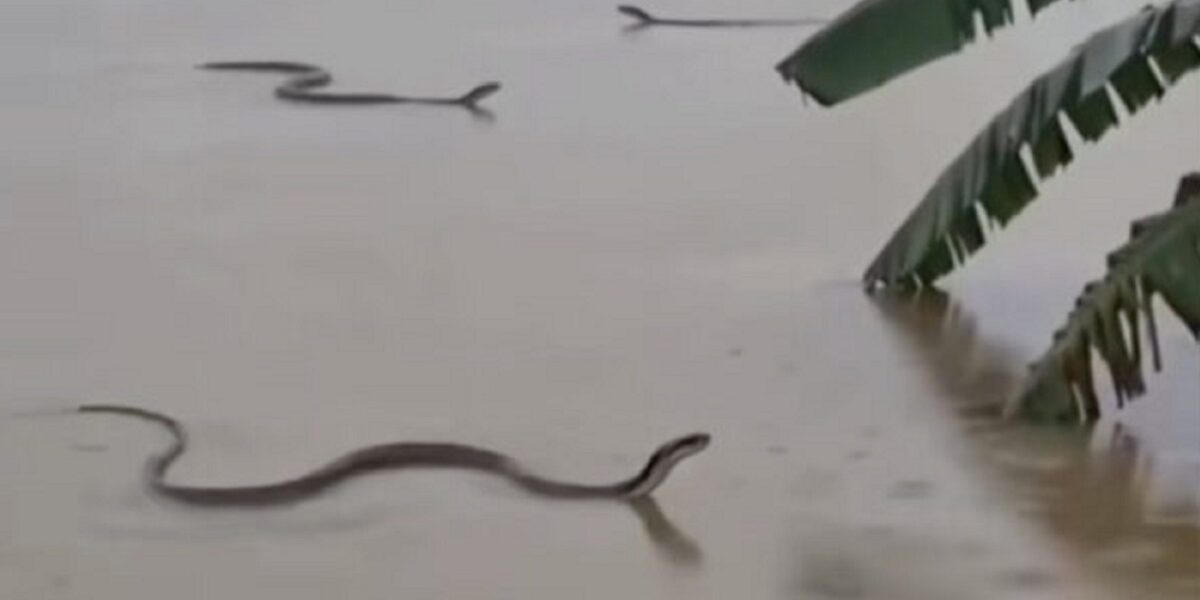
About 900 had escaped from a farm overwhelmed by the flood. A team of volunteers says they caught up to 3,000 in two days. It is the paradox of snake hunting in Hengzhou, in the Chinese region of Guangxi, where cobras and rat snakes have flocked to the submerged streets and images of specimens swimming in muddy water have gone around the world. Behind the viral videos, however, there is a much more serious disaster: 39 people have died in Guangxi, 26 of them in Hengzhou, where the embankment of the Liulan basin collapsed.
The house-to-house hunt
The snakes escaped from the farm in Dengwei village, Yunbiao township on Monday, July 6, when water destroyed the facility. Estimates speak of 800-900 specimens, mostly Indochinese rat snakes – a non-venomous species, bred throughout the area – but there would also be cobras in the group.
It was not the official rescue team that cleaned up the village, but civilian teams made up of residents of nearby villages. A member of one of these groups, seven to eight people in all, told the state-run newspaper Beijing News of having worked tirelessly for two days recovering between 2,000 and 3,000 animals, mostly rat snakes: many more than had escaped from the farm. “We pretty much cleaned them all up,” he said. After a flood, snakes seek shelter in the corners of houses: the inhabitants reported the sightings, the teams intervened, the captured specimens were handed over to professionals to be released into the wild.
The head of the Dengwei village committee, Wu Zhi, explained to the Chinese media that most of the snakes had already been swept away by the current and that those recovered on site were mainly non-poisonous water snakes.
The bites and the anti-venom serum
According to CNN, a woman died after being bitten by a snake – perhaps a cobra – which is suspected to have come from one of the farms overwhelmed by the water; Chinese state media reports more people bitten. The local authorities had confirmed, in the first hours of the emergency, the emergency hospitalization of a resident.
Area hospitals have beefed up their supplies of anti-venom serum. Residents have been asked not to attempt improvised captures: in case of sighting, do not approach, do not hit the animal, report it to the village committee.
Twenty million snakes
That a snake farm ends up underwater in Guangxi is not an eccentricity. The region, which borders Vietnam, is the heart of reptile farming in China: in 2020 it was home to nearly 20 million snakes on more than 14,000 farms, according to the Guangxi Dailya newspaper linked to the regional government. Over 100 species have been recorded in the area and snake meat is considered a nutritious food, with a long hunting tradition. Today, however, most farms work for the pharmaceutical and biomedical industries.
Hengzhou, one million inhabitants, stands on a plain surrounded by mountains and crossed by over 660 waterways. It is known as the jasmine capital of China: the flower from which tea is made has been grown here for 500 years.
The failure of the Liulan basin
But the news, beneath the viral videos, is different. The record rainfall brought by tropical storm Maysak caused the embankment of the Liulan basin to partially collapse, pouring a mass of water onto the villages downstream. The toll released on Thursday by the deputy mayor of Nanning, Ding Wei, speaks of 39 deaths throughout Guangxi, 26 of which in Hengzhou, and nine missing. There were approximately 130,000 evacuees and 5,700 boats used in the rescue effort.
In Guigang, about sixty kilometers to the north-east, the military completed the evacuation of over 10,000 students and teachers who were stranded in a school complex: images from state TV show boys in orange life jackets climbing onto boats while the buildings emerge from a lake of mud. Also in Guigang, a zoo reported the disappearance of over 100 animals, including two zebras, four porcupines and dozens of tropical birds. Three lions drowned: the staff chose to keep the predators’ cages closed so as not to add one risk to another, said Yin Feifei, head of the facility.
The water is receding, but more rain is expected. Teams are removing mud and debris and disinfecting several centers in Hengzhou; electricity was restored to over 60,000 homes.
Now comes Bavi
While Guangxi counts the damage, China prepares for the next blow. Typhoon Bavi, which hit the Northern Mariana Islands with catastrophic force in recent days before weakening, is now targeting the eastern coast. The authorities have evacuated over 600,000 people: more than half a million in Zhejiang province, another 100,000 in Fujian. Landfall is expected in the Wenzhou area between Saturday night and the early hours of Sunday. An orange alert has been issued, the second out of four levels; hundreds of flights have been cancelled, schools and maritime connections suspended.