

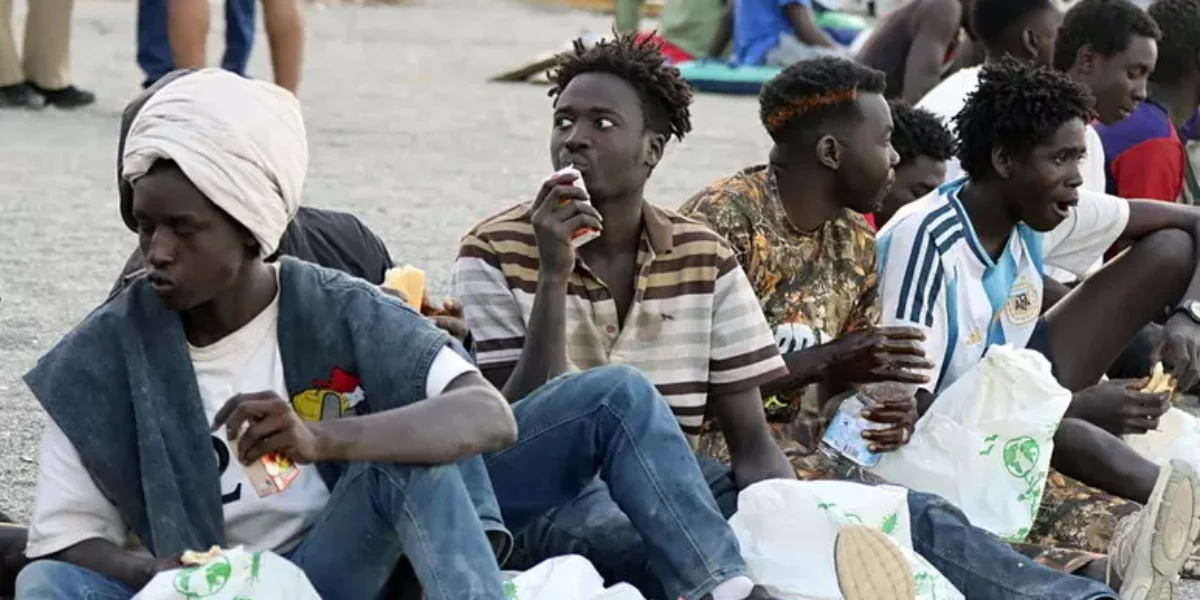
A retaliation dictated only by “partisan and electoral needs”. Spanish Foreign Minister José Manuel Albares, for the first time in Ceuta, returns to attack the Italian government which, after the mass entry of over 70,000 people from Morocco on 30 and 31 July, sealed the borders with controls on ships and planes arriving from Spain, provoking a similar counter-decision from Madrid. The European Commission hopes for a “temporary” suspension of Schengen, convinced that if the alarms about a new invasion from Morocco prove unfounded, “the general situation will return to normal”. Rome is maintaining a hard line for now, determined not to change its decision at least until mid-August.
On Thursday the Schengen committee summoned Interior Minister Matteo Piantedosi to a hearing in San Macuto, who will reiterate the concern that pushed the government to ‘close the borders with Spain and open the very tough diplomatic clash with Madrid. A decision which, however, the Interior Ministry reiterates, can be revoked when the threat returns. It is Matteo Salvini himself who makes it clear, albeit with polemical tones, that after 15 August everything could return to normal also to encourage the flow of tourists to and from Spain: «Various secret services, not politicians, say that the alarm in Ceuta is not over. Let’s see if it will be an alarm that will occur, but I hope not. So let’s get to mid-August and see if Sanchez will be able to defend his borders, but not with buoys, because it’s a joke.”
But even if the suspension of Schengen is lifted, it will take much longer to mend the tension between Rome and Madrid, marked by the profound ideological distance between the two opposite governments also on migration policies. Sanchez is convinced that Giorgia Meloni will exploit the Ceuta crisis to counter internal cracks and stem Vannacci’s rise. And today Albares accuses bluntly: «Italy’s attitude was not one of solidarity and support, like the vast majority of European Union countries», but of a «probable response to partisan interests» and «internal electoral needs». Other than an invasion of migrants in Spain, he insists, Italy “records a greater number of irregular entries compared to Spain” while the secondary movements of irregular migrants from Spain to Italy are “minimal”, “below 1%”, claims Albares.
n a week after the meeting of EU Interior Ministers, in which Spain asked for solidarity from its European partners, the Spanish minister sends a reassuring message: “No one has left the city for the peninsula, nor will they be able to do so.” And precisely to discourage new mass arrivals from Morocco, he launches a heartfelt appeal which is also a warning: “Do not risk your life, your money and your future in a hopeless adventure. Anyone who enters Ceuta or Melilla irregularly will be repatriated.” Just as they will return in Morocco the North Africans who are still in the exclave, ten thousand according to an estimate by the president of Ceuta, Juan Jesús Vivas, around two thousand people, however, according to the Spanish authorities. «Ceuta has suffered and continues to suffer an invasion», Vivas complained in the meeting with the foreign minister, while admitting that «Morocco is willing to facilitate the return of these people, both adults and minors». started immediately without following a procedure that guarantees due process. Among those who have entered illegally, some come from countries at war or victims of other forms of violence and could request asylum, and this right must be guaranteed: that there are, for example, situations of extreme poverty or abuse.