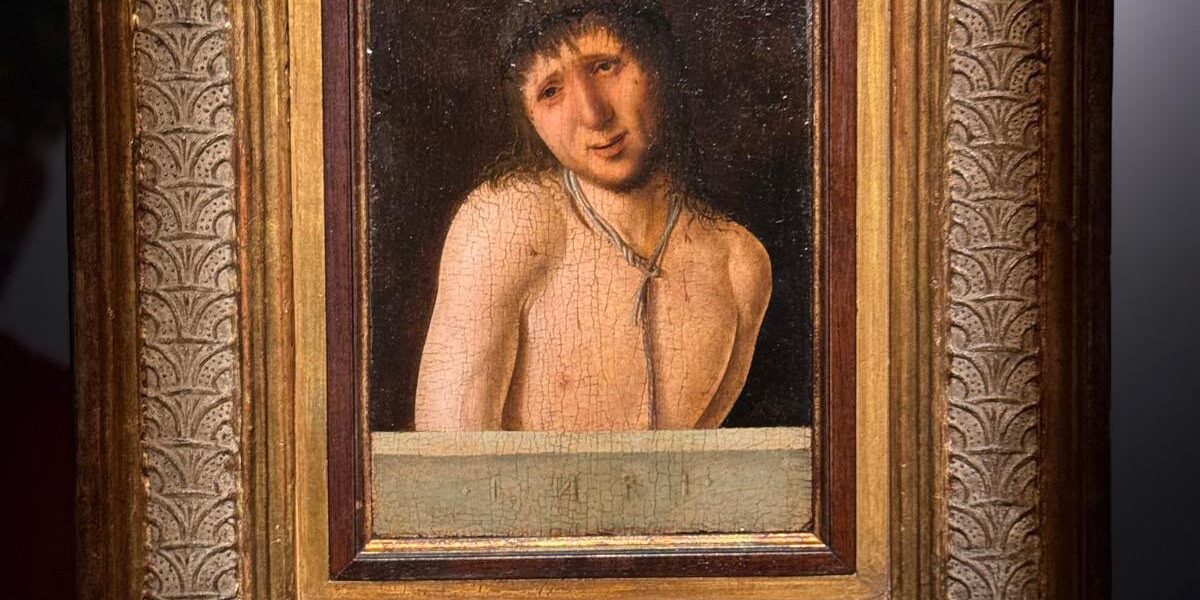
The Ecce Homo by Antonello da Messin, the two-faced tablet recently purchased by the Ministry of Culture, has been on display since 20 August at the Meeting in Rimini in a special space where it is possible to admire this large work of minute dimensions and also follow the exhibition dedicated to the work of the Messina artist. A precious opportunity seized by many who have contemplated the masterpiece, dating back to between 1450 and 1465, which shines from the two facades with the Ecce homo and the penitent Saint Jerome, with the face marked by the physical devotion of the owners who damaged the face, as suggested by Federico Zeri, the critic who in 1981 presented the tempera painting at a conference on Antonello da Messina. At the Meeting, after the exhibition in Rome at the Senate of the Republic, after numerous diagnostic investigations it was restored by the Central Institute for Restoration, which allowed not only the conservation of the work, the deepening of knowledge of the technique, but also the restoration of the extraordinary brightness, the chromatic clarity and the finesse of the details such as the hair scattered on the shoulders, the
suffering gaze and the drops of blood that with dramatic realism mark the bust of Christ patiens. The Ecce Homo, depicted behind a marble parapet on which the inscription INRI stands out, releases all its expressive power and constitutes one of the highest representations of the humanity of Christ in the Renaissance. In the Ministry’s exhibition itinerary the Ecce Homo compared and above all the map with the works of Antonello scattered in the Italian museum sites in which Messina was also included with the two works stolen on the evening of August 15th. The bitterness remains in seeing that Antonellian geography, with a vulnus, in which his hometown will now be missing with a museum dramatically emptied of art, civilization and historical memory. The work exhibited in Rimini, which as is known will be destined for the National Museum of Abruzzo in L’Aquila, was purchased by the Italian State at an auction in New York at Sotheby’s and thus returned to everyone’s gaze after a long time of removal from the artistic heritage.
And there was a lot of talk about Antonello at the Meeting also at the meeting “When art creates development” which was attended by Angelo Crespi, general director of the Brera art gallery, who said how pain and suffering are transfigured into beauty in Antonello’s masterly panel, as demonstrated by the greatness of the art and where Giampiero Cannella from Palermo, Undersecretary of State at the Ministry of Culture, also spoke, extolling the art of the painter from Messina, the perfection of his technique in Ecce Homo, he said, found an ideal context in the Rimini event, given the sensitivity of the organizers and his people close to the sacred themes expressed by Antonello’s sublime art. An artist, he continued, whose loss of works from Messina we are suffering in recent days, hoping that investigative clarity and recovery of the treasure stolen from the country will soon be achieved