

Add the Gazzetta del Sud as a source
It is a story that has its roots in the centuries that Curcuraci renews every first Sunday of September. A devotion deeply linked to the territory and to the figure of the Madonna dei Bianchi, a title that also recalls the tradition of the Virgin of Montalto, the “White Lady” of Messina’s religious history. This year’s celebration, on the centenary of the foundation of the parish, had the flavor of a tradition that is renewed without losing its connection with the past. Alongside the historic group of bearers, in fact, it was once again the young people who ideally took up the baton, participating with enthusiasm in the procession and becoming protagonists of that generational transition which allows an ancient devotion to continue to live.
The parish priest, Don Gianmarco Restuccia, will lead the moments of the celebration and, since last year, has chosen to increasingly involve the children of the community, together with the celebration committee and with the support of the Sixth Municipality. The novena accompanied the faithful in the days preceding the celebration, alternating moments of prayer with opportunities for meeting and conviviality. A celebration conceived not only as a religious event, but as a moment capable of bringing the entire community together around its roots. Among the most significant initiatives was the curcuracense harvest festival, in collaboration with the CISL Messina, in which the community was the protagonist of the pressing of the grapes and the preparation of the mustard. The most intense moment came at the end of the Eucharistic celebration, presided over by the provincial minister of the Friars Minor, Brother Antonino Catalfamo.
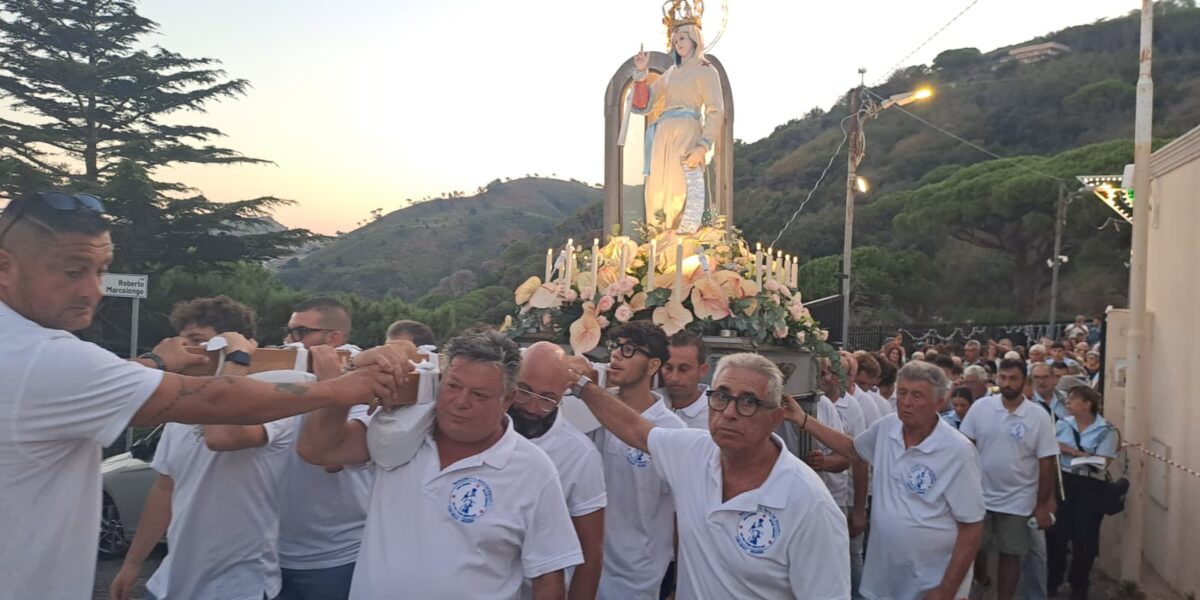
The simulacrum of the Madonna dei Bianchi was then placed on the shoulders of the bearers and crossed the streets of the village, accompanied by a large participation of faithful. Behind that procession there is an ancient story, also handed down by the historian Placido Samperi, who places the origin of the devotion in 1347. According to tradition, a farmer intent on plowing the land met Jesus in the guise of a pilgrim. He was given three loaves of bread, with orders to throw them into the nearby stream. Before he could carry out the gesture, the Madonna appeared to him, dressed in white and with a red cross on her forehead, inviting him to stop. Those three loaves represented three great goods that would fail due to equally terrible punishments destined for the city of Messina: the plague, famine and war. The Madonna asked the farmer to turn to the archbishop and invoke a general penance for the city, ensuring his prayers for the Messina people.
Tradition says that the penance was completed and that, of the three punishments announced, only the plague struck Messina. In the place of the apparition, in Curcuraci, a church dedicated to the Madonna was built, depicted with the white of her robes and the scourge, symbol of penance, in her hand. Since then, through generations, the devotion has never stopped. And even today, between prayers, songs, emotional faces and the slow pace of the bearers, the Madonna dei Bianchi returns to walk the streets of Curcuraci.