

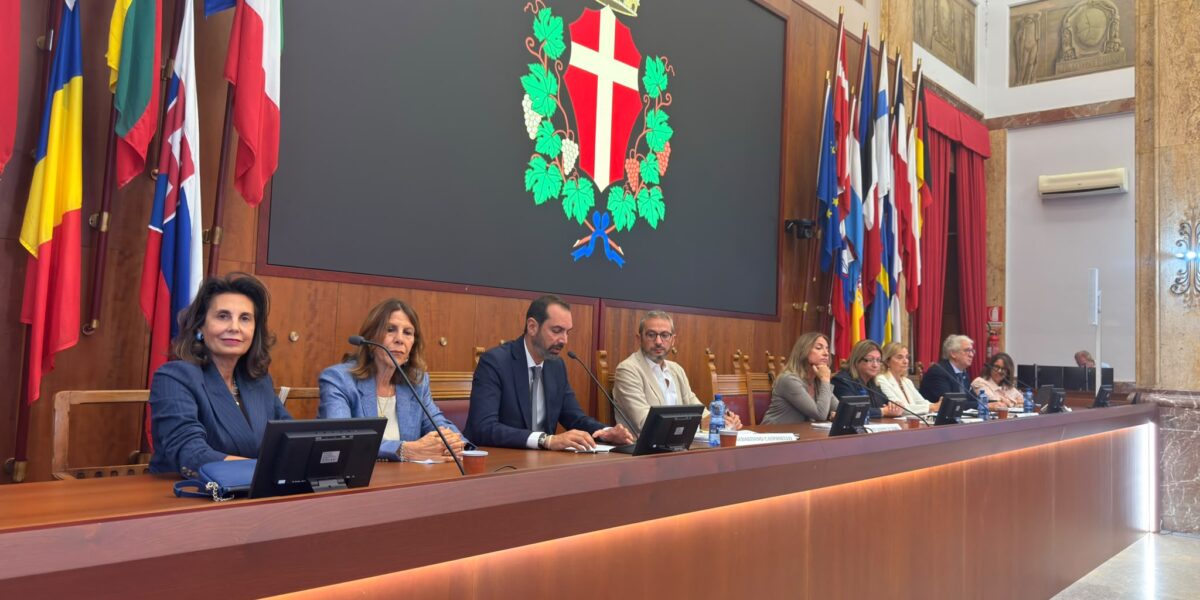
“Repair the damage, rebuild relationships, generate community”. This is the theme and conceptual core of the Center for Restorative Justice of the Court of Appeal District of Messina, presented this morning during the conference “The Center for Restorative Justice of the Municipality of Messina: institution, functions and prospects”, in the Hall of Flags of Palazzo Zanca, with the participation of the institutional authorities of the territory, including the Prefect of Messina, Cosima Di Stani.
A reality born from the collaboration between the Municipality of Messina and the Spondé ETS Association, managed in shared administration between the two bodies and built through a network that brings together institutions, judiciary, lawyers, social services, University of Messina, mediators and communities, for a justice that puts people and relationships at the center. A space in which different skills and professionalism are intertwined with a common objective: to promote paths in which the person, damage and relationships return to the centre.
“It is an important day that attests to the commitment to justice in the form of restorative justice. True justice is also this: not forgetting the crime, but having the courage to look it in the face and face it, giving the person the opportunity to return to being part of the community. I thank all the professionals and all the entities that make this path possible”. Mayor Federico Basile said this, underlining the value of a structure that fits into the policies of the municipal administration and in the construction of a territorial network dedicated to restorative justice.
For the president of the Court of Appeal of Messina, Concetta Maiore, “this is an interesting and complex topic, which brings us back to the re-educational function of punishment. Today, restorative justice is no longer a dead letter: through the path outlined by the Cartabia reform, a concrete possibility of healing between the perpetrator, the victim and the community is achieved. The Center represents a shared way of working in which the judiciary, lawyers and, above all, mediators are called to rebuild relationships of solidarity. I hope that this path can be fully implemented also through the definition of the operational protocol”.
Deputy Prosecutor Assunta Musella highlighted “the importance of being able to participate in a discussion that places the profile of restorative justice and its possible applications at the centre. It is a path of great importance, also in light of the new perspectives that the reform introduces and the attention paid to particularly delicate situations, such as those attributable to the proceedings for the so-called Red Codes”.
For the president of the Court of Messina, Olga Tarzia, “the criminal justice reform has given new importance to a perspective that already existed and which had demonstrated that it could produce important results both for the victim and for the perpetrator of the crime. With the help of a third party, the mediator, we move from a model centered only on re-education to a perspective in which reparation also finds space. Criminal justice maintains its function of ascertaining the crime, while restorative justice opens up a different and complementary perspective. It is here that the role of the mediator: a path of regeneration can arise from a deep wound, in which even the perpetrator of the crime can deal with his own experience and the consequences of his actions”.
The president of the Juvenile Court of Messina, Maria Francesca Pricoco, underlined how “in the juvenile criminal trial, restorative justice represents an opportunity for change and growth, capable of helping children to experience relationships in a more conscious and constructive way”.
The role of the University is also central. Rector Giovanna Spatari recalled that “the role of the University is already defined by the legislator. Our University has taken an active part, also following the request of councilor Calafiore, through an agreement aimed at structuring the training path and contributing to the training of mediators. With a specific addendum we will also launch a master’s degree for expert mediators and we will take care of the training of these professional figures. Today a new selection and training path opens, made possible thanks to the network and the work of all the professionals involved”.
For the president of the Supervisory Court of Messina, Francesca Arrigo, “in the execution of the sentence, among the elements that we are called to evaluate there is also the relationship that the convicted person has with the offended person. Too often the attention of the offender remains focused on his own situation, without real consideration of the person who has suffered the damage. The Center for Restorative Justice can play an important role in encouraging this reflection. Welcome, therefore, to restorative justice and welcome to the work of the Centre: the Court of Surveillance will always be open to discussion and dialogue.”
Gabriella Di Franco, director of the UIEPE of Palermo, defined the initiative as “an important opportunity that brings together all justice workers around a common cause. The community gets involved and our intervention will be concrete, through modules guided and built in close synergy with the Prosecutor’s Office and the Lawyers’ Office, to guarantee widespread information and full knowledge of the opportunities offered by restorative justice”.
The president of the Messina Bar Association, Paolo Vermiglio, highlighted that “the forensic community, with traditional responses, is not always able to give adequate answers. These new forms of justice are important, especially at a time when we are witnessing new phenomena for which we are not always prepared. The legal profession is ready to do its part in this recovery process, even when it comes to people who have to serve a sentence”.
For the president of the Order of Social Workers of the Sicilian Region, Giuseppe Ciulla, “restorative justice is based on the sense of community. In Messina there has been fruitful work by the successive administrations, first with De Luca and then with Basile, and by councilor Calafiore, who have given an extra edge to social services. This new reality allows us to build a path of common good, in which the community becomes an active part of justice”.
The program of work, moderated by the journalist Sebastiano Caspanello of the Gazzetta del Sud, continued with a first session dedicated to the path that leads from the justice reform introduced by the Cartabia law to the establishment of the Centers for Restorative Justice in the territories. Dr. attended. Claudio Ferrari, director of Office IV – Restorative Justice of the Ministry of Justice, prof. Grazia Mannozzi, full professor of criminal law at the University of Insubria, and prof. Giuseppe Di Chiara, professor of criminal procedural law at the University of Palermo.
The second session, however, proposed the experiences, restorative justice programs and the role of the University of Messina. Speakers, Dr. Maria Pia Giuffrida, expert mediator and trainer, former General Director of the DAP and scientific director of the Spondé ETS Association, with the speech “From experiences to Restorative Justice programs”. Following the speech by Professor Giuseppina Panebianco, full professor of Criminal Law at the University of Messina, dedicated to the role of the University in the initial and ongoing training of expert mediators in Restorative Justice programs and expert mediator trainers.
The central part of the seminar was dedicated to the Center for Restorative Justice of Messina, its organization and the shared administration model between the Municipality and the Spondé ETS Association. Dr. Carmela Procopio and Dr. Roberta Schneider, representatives of the Center for the Municipality of Messina, presented the Agreement for the administration of the Center; while Giuseppe Macaione, expert mediator in Restorative Justice programs and coordinator of the Centre, illustrated the functions, operations and prospects of the new structure.
To close the day, the role of the municipal administration and the Department of Social Policies, which accompanied and supported the creation of the Centre, with the support of the competent offices of the Human Services Department.
The councilor for social policies Alessandra Calafiore, one of the promoters of the project, underlined: “We strongly wanted Messina to equip itself with a Center for Restorative Justice because we believe in the value of a justice capable of looking at the person, their fragility and the relationships that a crime can break. This project was born from the desire to bring together institutions, professionals, universities, mediators and communities, building a network that does not limit itself to intervening on the damage, but which works to transform it into an opportunity for accountability, listening and reconstruction. It is an ambitious path that takes concrete shape today and that we want to grow together with the territory. Restorative justice teaches us that, even after a deep fracture, there can be a space to start again.”
The Center for Restorative Justice of Messina thus begins as a place of listening, dialogue and empowerment, in which justice meets the community and the path of repair becomes part of a broader perspective of rebuilding relationships. Repair the damage. Rebuilding relationships. Generate community. It is from here that this new experience for Messina begins. Restorative justice represents a necessary and courageous paradigm shift: a justice that is not limited to the punitive or accounting dimension of punishment, but which looks at the heart of human relationships, the recognition of the victim’s pain, the authentic responsibility of the perpetrator and, above all, the recomposition of the social fabric.