

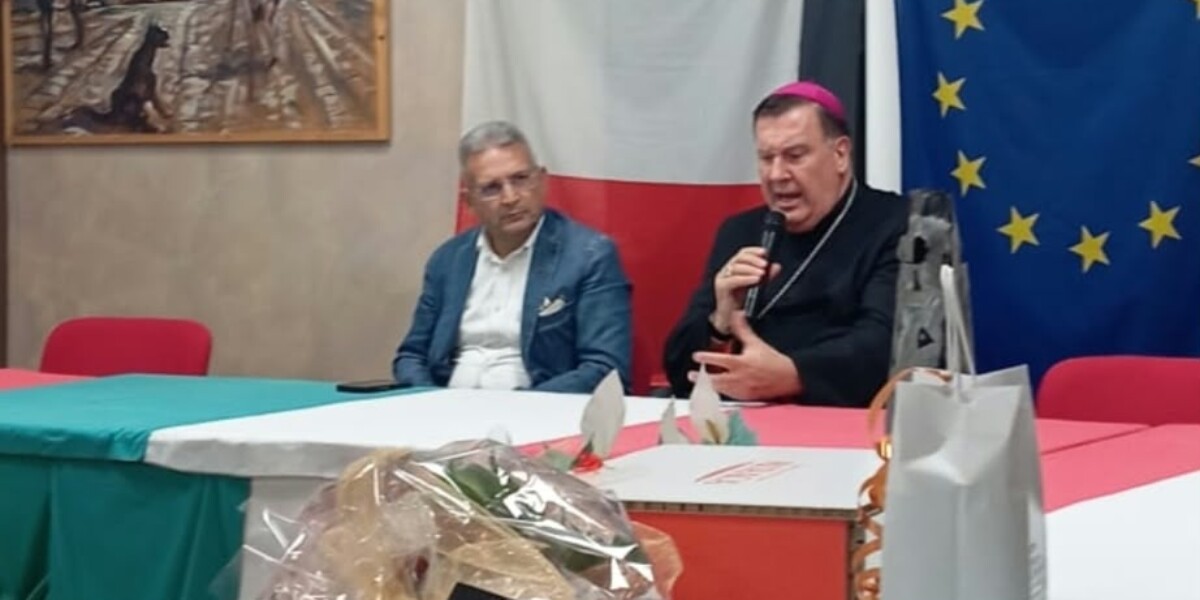
“It takes courage to do business here, to stay here.” The discussion between the archbishop of Catanzaro-Squillace, mons. Claudio Maniago, and the world of business and work met in Cicala as part of the Pastoral Visit to the forania of Gimigliano – Taverna. At his side are the mayor of the community Alessandro Falvo, the parish priest Don Sergio Polito and a representation of small entrepreneurs in the area.
An open and concrete dialogue on the problems that affect the development of the territory, starting with roads and connections. «One of the greatest plagues of this region are communications, that is, the roads», stated Maniago, recalling what he personally observed in his travels in the different areas of the diocese.
During the meeting, the Medio Savuto was also brought to the Archbishop’s attention, an infrastructure that has been awaited for decades and considered strategic for improving hinterland connections with Catanzaro. A work which, in the territory’s expectations, could contribute to reducing the isolation of internal centers and also offer better conditions for production activities.
Ferrovie della Calabria, a history that can still become the future
The topic of the Calabrian Railways also emerged in the discussion, which for generations have represented much more than a simple means of transport for the inland communities. The railway connected small towns, families, students and workers with Catanzaro, helping to keep geographically complex territories united and offering the possibility of mobility even to those who did not have their own means of transport.
An infrastructural and social heritage that can take on a new meaning today. The relaunch and full functionality of railway connections can represent one of the answers to the marginalization of internal areas, encouraging daily travel, access to services and schools and a greater connection of economic activities with the capital.
Roads and railways, therefore, not as separate issues, but as parts of the same mobility strategy for a territory that asks to be connected and not assisted.
The difficulties currently affecting connections to Catanzaro were also mentioned in the dialogue, including those linked to construction sites in the Gagliano area. Problems which, added to the critical issues of the road network, end up impacting the daily lives of families and the competitiveness of businesses.
Maniago expressed its willingness to support local demands in institutional settings: «If I can do something on the streets, tell me. I have no problems writing.”
A willingness that the Archbishop wanted to keep out of any political conflict: “I am not here to say or lash out at anyone, but only to express a serious discomfort that I have felt among the population.”
Internal areas, not territories destined for decline
Ample space was dedicated to depopulation and the future of internal areas. Maniago recalled the reflection initiated in recent years by the Italian bishops on territories that hold an important part of the cultural and social roots of the country.
The Archbishop recalled the need to overcome a vision of internal areas as a reality to be passively accompanied towards decline, to instead look at their potential and the conditions necessary to make them attractive again.
A perspective in which infrastructure, transport and work become closely connected issues. Because maintaining a business in a small town, reaching your workplace every day or allowing a young person to study without moving also means guaranteeing efficient connections and accessible services.
«You represent the liveliness of this area»
In this scenario the role of businesses becomes decisive. «You represent the liveliness of this area», Maniago said to the entrepreneurs present. “It’s clear that your presence still makes these countries livable.”
The Archbishop spoke of true “excellencies” that must be put in a position to express their potential beyond local borders. In fact, where there is work, the possibilities for families to stay and for young people to imagine their future in the land where they grew up increase.
Particularly significant was the story of an entrepreneur who explained how all three of his children chose to work in the family business: “We managed to transmit love, so it means that there is a future.”
«If there are valid opportunities – Maniago observed – you build a family, there are those who stay, there are those who have the courage to stay».
A message thus arrives from Cicala that goes beyond the boundaries of the single municipality: combating depopulation means creating jobs, guaranteeing services and restoring centrality to connections. Medio Savuto, the road network and the Calabrian railways become, in this perspective, pieces of the same challenge.
Because internal areas don’t just ask to be reached: they ask to be put in a position to produce, innovate, attract and retain energy. And an efficient transport network can once again become, as it has been in the past, one of the tools through which these territories build their future.