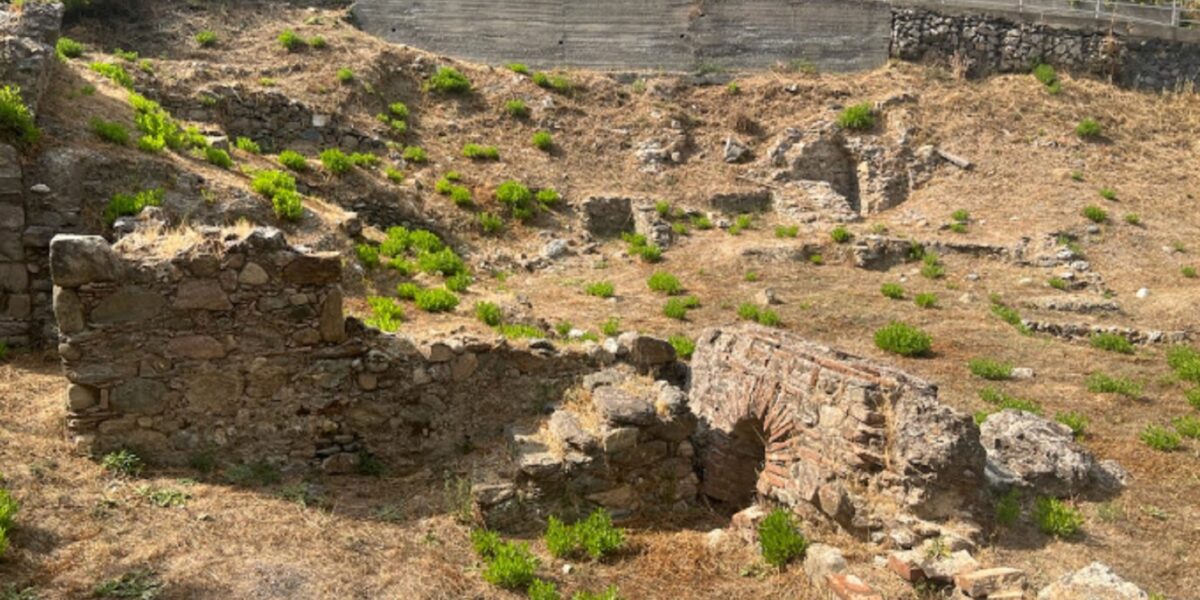
When on 11 April 1987 the master Giuseppe Lombardo spoke in the Forza d’Agrò municipal council, of which he was a member, to announce that in the hamlet of Scifì during the construction of a vineyard a piece of wall had emerged which he said was from the Roman-Byzantine era, he imagined that a machine would be set in motion to discover the origins of that site and write a new page in history.
But the skepticism of the rulers of the time immediately led him to understand that the risk of losing everything was too high. So, he purchased that land intended for vineyards, to protect it from ignorance and spite, hoping that one day what the land was hiding would emerge. Almost 40 years later, the archaeological site of Scifì still tells little, despite studies and excavation campaigns which however have not allowed full light to be shed. Lombardo hypothesized that that fragment of wall belonged to one of the buildings that made up the original monastery of the Holy Apostles Peter and Paul, then buried by a flood and rebuilt by the Normans in the 12th century on the opposite bank of the stream. Partly destroyed by a landslide and by the new route of the current road that leads to Scifì, the site was affected by a first excavation campaign in 1987, followed by other interventions in 1995, in 1997 and the last, more substantial, in 2002, which confirmed the dating indicated by Lombardo and the presence of a flood event that overwhelmed the site. The Superintendency of Cultural and Environmental Heritage of Messina hypothesized the presence of a late imperial villa or a sort of “rest station”, perhaps a mansio, along the Mylae-Tauromenium route (Milazzo-Taormina).
The identification with the Statio Tamaricium, however, remains unproven and the most prudent interpretation is that of a substantial late Roman rural complex, perhaps connected to the road network of the Valle d’Agrò, as recalled in recent months by the Topographic Analysis of a Late Roman Rural Settlement Without Continuity of Life, an interesting study conducted by Luca Casablanca of UnitelmaSapienza in Rome.
The full article is available in the print and digital editions