

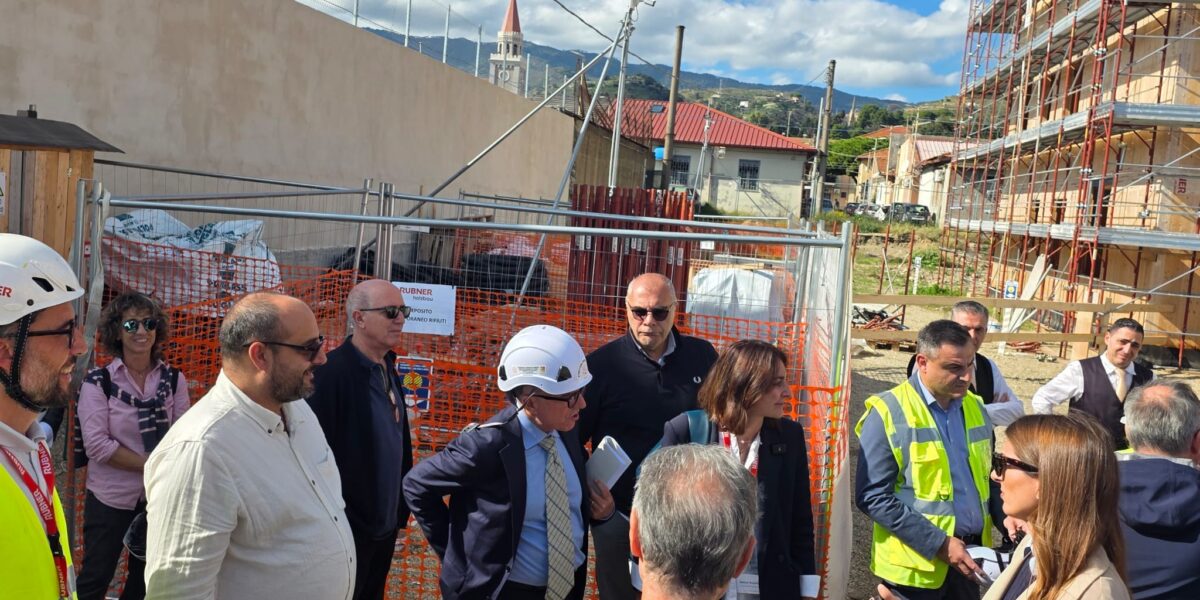
The large and attentive participation in the Open Day on Thursday 29 October promoted by the Commissioner’s Structure led by the President of the Region Renato Schifani which was held in the ATM Congress Hall and at the Fondo Saccà construction site, is testimony to how much rehabilitation has become an increasingly shared and open path to the city. Sub-Commissioner Santi Trovato introduced the works and then accompanied the professionals and event participants to the Fondo Saccà construction site where the construction of 32 green accommodations is underway. In taking stock of the important work done so far and the acceleration given to the recovery, he recalled that it was possible thanks to the derogating powers of the Commissioner’s Structure which implemented a virtuous recovery model.
In his speech in front of a room packed not only with engineers and architects but also with those who wanted to delve deeper into the various activities, the sub-Commissioner focused on the recovery numbers before and after the special law which allowed a clear change of pace and is changing Messina in a tangible way, freeing entire areas from degradation and slums.
From Camaro to the Taormina district, the areas freed from the shacks
«Redevelopment is the heritage of the entire city – explained Santi Trovato – it does not only concern families who have finally been assigned a real home, or only individual portions of territory, but it concerns everyone from the moment in which we are making entire areas livable that were not. I can cite a series of examples, from Camaro Sottomontagna where we have done a great job from 2024 onwards to demolish more than 65 shacks in over 2,800 m2, reclaim the area and make it usable for an urban park. The same goes for Salita Tremonti where we are creating another space for sport, relaxation, pedestrian paths in more than 4 thousand square meters where there were 38 shacks. And again via Macello Vecchio, handed over to the Municipality in recent weeks where instead of a shantytown of 15 shacks built close to the historic walls of Charles V, today there is a set of rain gardens and an arena for events. Not to mention the Taormina district where the division into lots and sub-lots has allowed us to date to demolish around a hundred shacks, renovate the area and make it available to the community. The liberation of via Ennio Quinto, for example, will give a turning point to the connections between the southern area and the centre. The same goes for all the other streets that had been attacked by the shacks, I’m thinking of via La Rocca, ex Lavatoio, via Bonsignore, via Appennini, via Catanoso, via Sacro Cuore di Gesù. Over 36 m2 of areas reclaimed from 2021 to today which thanks to environmental remediation we are returning to public use.”
The Camaro Amphitheater and Magnolia Park
The sub-Commissioner then recalled that at this moment, after more than 11 years, the work to complete the Camaro Amphitheater is coming into full swing, which will become a point of reference for events and demonstrations, but also for the associations that will have spaces and rooms available. The reclamation and redevelopment of Magnolia Park will also begin shortly, again after more than ten years of abandonment. Therefore not only 497 new homes delivered and others being assigned in a few years, with an average of 120 apartments assigned per year, but also the construction of homes with cutting-edge technologies and in compliance with European regulations for “green” construction which represent one of the very few cases in Italy if not the only one applied for renovation.
The request for refinancing
«We are not only talking about energy saving, seismic safety and quality but also about projects, Fund Basile and Fund Saccà, considered best practices for Invitalia and the Ministry of Infrastructure in the application of digitalisation in a public construction work – continues the sub-Commissioner – This is why for the Commissioner Structure occasions like this Open Day are important to show what we are doing and how important it is, to prevent such a virtuous path from being blocked. The refinancing will allow the whole city to free itself from the wounds of the shacks and transform the relationship with the territory. With the method adopted we are able to act in several areas at the same time and if refinanced, I’ll give another example, we will be able to continue the interventions in via Rosso da Messina, Taormina district, continue in Tirone, another project we care about very much. But environmental remediation, which is the activity that truly affects the recovery of the territory, has costs both in terms of additional time, just think of the 3 years for the cleanup of poisons in Fondo Saccà and 2 years in Fondo Basile, and in costs for the delivery of the materials found. When I say that recovery is a common heritage, I mean that all together we must defend it from slowdowns or, worse, risks of it stopping completely.”
Finally, regarding the sharing of a change that must belong to everyone, Trovato took up the criticality of the continuous abandonment of waste in the Taormina district in the newly cleared lot. The commissioner offices have requested the Municipality to reactivate the video surveillance system.
Next initiatives and technical interventions
After the Open Day, other initiatives are planned to open up to the city. Next week students from the Istituto Superiore Verona Trento will be able to visit the Fondo Basile construction site for an “in the field” lesson on all aspects relating to design and construction.
The first part of yesterday’s event was dedicated to the technical and theoretical aspects of the Fondo Saccà construction site and the regeneration model. The architects Massimo Baragli (Rup Invitalia) spoke on the Fondo Saccà construction site and Daniele Rangone (Studio Settanta7) on the urban and architectural vision of Fondo Saccà, the engineers Daniele Casagrande (University of Trento) and Marco Costanzo (Field Engineer, Würth) on aspects relating to the seismic design of wooden structures and the design of connection systems. The advantages of computational design in wooden structures were addressed by engineer Simone Rossi (Technical Director, Rubner Grandi Strutture). The delegates of the Order of Engineers of the province of Messina and the Order of Architects of the province of Messina brought greetings. Also present at the event were the implementing bodies of the Commissioner’s Structure: Invitalia and Civil Engineering.
The Open Day ended with a participatory technical visit to the construction site which gave the participants the opportunity to directly observe the design and construction solutions illustrated during the interventions and to interact with the professionals involved.