

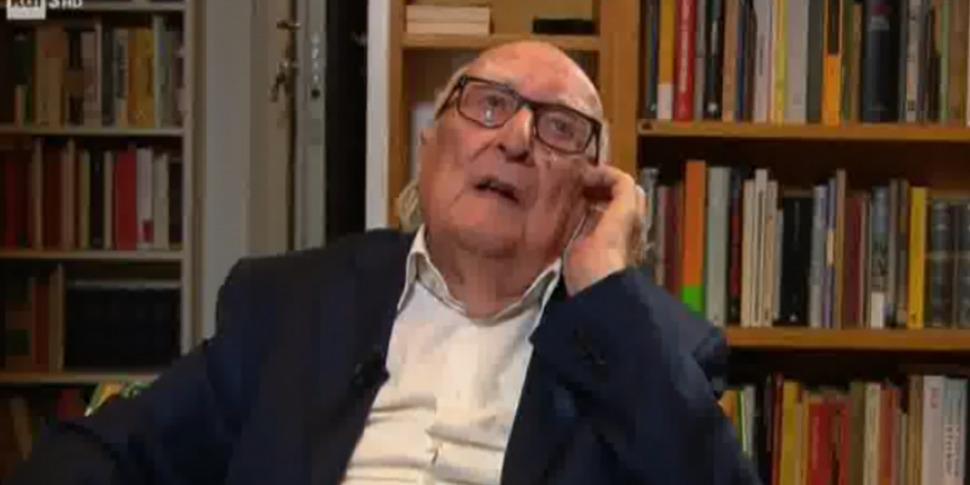
Camilleri made Sicily not just a metaphor but a great dream” recalled Gaetano Savatteri in his speech in Francesco Zippel’s docufilm which celebrates the maestro Andrea Camilleri on the hundredth year of his birth. A dream that can be read in full in the beautiful volume in words and images that Savatteri signed for «Il contastorie di Vigàta» (Rizzoli): a fair recognition for those who were masters, for those who «opened the path to a different way of writing», but not a eulogy, nor a celebration (celebrations – said Sciascia – unconsciously hide the desire and exhortation to bury people again). Perhaps at times also a memoir by Savatteri himself, journalist and writer (author, among other things, of the beautiful series «Màkari», which became a television success) who shares with Camilleri the origins and familiarity with the Agrigento area and «the taste for the surreal typical – according to Savatteri – of that province».
It is the stories that move, not just the people or the goods and for that narrative creature that was Camilleri, who made the stories grow as those who shared with him, like Savatteri, well know, periods of life, conversations, meetings, interviews, there could not be a better homage than telling a “storyteller”, starting from the end and then going back in his personal story which is also a piece of Italian history, to arrive again at the end in a circularity that includes the conclusion of an earthly existence but opens up to that resistance Camillerian which was a stigma of his life and remains steadfast through his books, editorial initiatives and his followers.
Therefore, Savatteri’s story in words and images begins from the end, when on 17 June 2019 we learn that the maestro is hospitalized at the Santo Spirito hospital in Rome and the reporter Savatteri is sent by the editorial team together with a cameraman to “prepare to possibly go live”. «Eventually», an adverb full of sadness for the journalist who has been fascinated by Camilleri’s cunti since he was a boy (“he was – he writes – the most skilled cuntista I have ever heard”). Well, that day the reporter and the cameraman were smoking in silence waiting for something that Savatteri hoped wouldn’t happen. And the smoke seems to set in motion a singular madeleine that takes him back into memories, to that day at the Greek theater in Syracuse with Camilleri-Tiresia, and again forward to the present and the office of testimony. Then, the following morning, Savatteri returns to the hospital, this time without a cameraman or for the record. But rather for the sacred one of friendship. In the name of which, while there is a sad crowd of friends outside in the courtyard, he doesn’t know how but he enters the hospital and then inside the ward without anyone stopping him. What happens in those surreal moments? Perhaps there is the absurd hope of seeing him again, the teacher, perhaps leaning against the window with a cigarette in his hand. «Hope shows strange things» writes Savatteri. But soon awareness sets in and with a sense of shame he leaves the ward imagining that the teacher “while he was thought to be on the second floor of the hospital, could be in some distant square telling his stories as he had been doing for years”.
Thus begins Savatteri’s story, where as in a kaleidoscope memories, moments, historical plots, writers, characters, testimonies, meetings, anecdotes, Savatteri’s conversations with the maestro between 1995 and 2018 emerge and mix, and two interludes with two stories by Camilleri (one on Pirandello, the other on Eduardo De Filippo) together with beautiful images, black and white historical photos and other more current ones in color made available by the archives of the Andrea Camilleri Fund. And there are many images reproduced in the volume of which Savatteri, among others by Lillo Rizzo, Angelo Pitrone, Lia Pasqualino, Aldo Alessandro, Fosco Maraini/Archivi Alinari/Gabinetto Viesseux.
The story follows the course of things, from the birth in Porto Empedocle of «Nené, son of sulfur» to his childhood and adolescence in his country where the adventure of writing was also that of sailing in the sea of imagination, while memorable figures and moments-places parade: Pirandello, Sciascia, Eduardo De Filippo, Orazio Costa, Silvio D’Amico, Vittorio Gassman, Robert Capa, Elvira Sellerio and the destination of Rome with many others meetings, which are decisive from time to time for what Andrea intends to do with his life. Even when he was seventy years old, with a solid career as a director and as a television production delegate behind him (it is enough to mention for all “dramas” that have entered the history of TV: Eduardo’s comedies and the Inspector Maigret series with Gino Cervi), he knew full success with the world of Montalbano and the Vigatese area. And behind the story of his life there is always his family, his beloved parents who followed him to Rome, his wife Rosetta, his daughters Andreina, Elisabetta and Mariolina. And the friends and the actors and the students to whom he transmitted his firm faith in dreams and in life, the humanity that every artist must put in the foreground. And the historical facts, fascism, the post-war period, the crimes of that great province that is Italy, in telling which Camilleri never abdicated the match with the world, to what Goethe defined as “productive imagination” of a world of fantasy for the truth of reality.
«We will remember Andrea Camilleri», concludes Savatteri, paraphrasing Sciascia’s intended epigraph on the white marble tombstone under which he rests in the Racalmuto cemetery.