

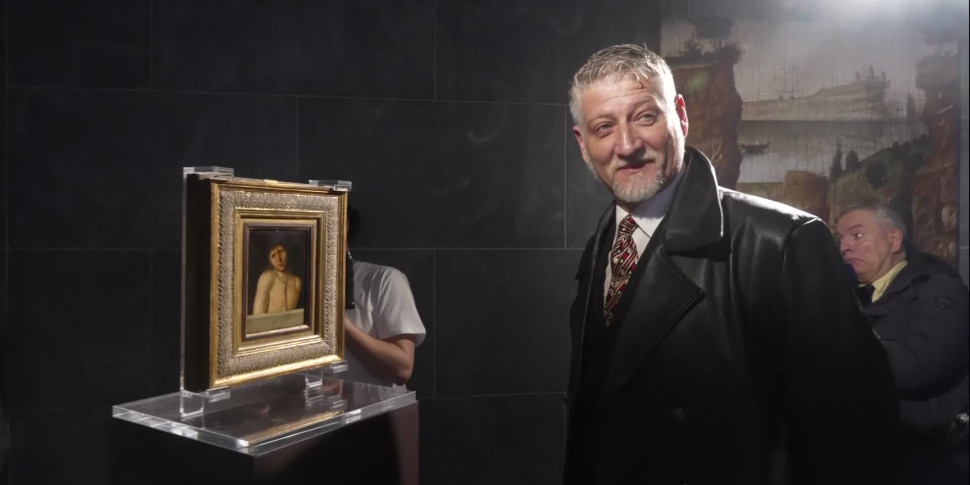
In the year in which L’Aquila celebrates the title of Italian Capital of Culture, from today the National Museum of Abruzzo (MuNDA) welcomes Antonello da Messina’s Ecce Homo into its collections. This extraordinary fifteenth-century masterpiece, recently acquired by the Ministry of Culture, finds its permanent location in the sixteenth-century Castle, returned with a new layout, a few months ago, to public use as the seat of the Museum. The opistograph panel, which bears an intense Antonellian interpretation of the Ecce Homo on the front and the penitent Saint Jerome in a Northern European landscape on the reverse, finds its permanent residence at the MuNDA, inaugurating a strategic path that confirms the centrality of the Abruzzo heritage within the National Museum System.
The arrival of the work was celebrated in the afternoon with an official ceremony in the presence of the Minister of Culture, Alessandro Giuli. Speakers included the Mayor of L’Aquila, Pierluigi Biondi, the President of the Abruzzo Region, Marco Marsilio, the Director of the Museum Federica Zalabra, the Director of the ICR Luigi Oliva and the Minister Giuli. The unveiling of the work was anticipated by a preview dedicated to the press in the presence of the Mayor Biondi, the Head of the Cultural Heritage Enhancement Department Alfonsina Russo, the General Director of Museums, Massimo Osanna, the Director of the Zalabra Museum, and the Director of the ICR Oliva.
At the end of the day, the National Museum of Abruzzo will extraordinarily open its doors to the public from 8.00 pm to 12.00 am, with the last entry allowed at 11.00 pm, offering visitors the opportunity to admire Antonello da Messina’s Ecce Homo in its new location. The painting arrives in L’Aquila after its first exhibition at the Senate of the Republic last March and following a campaign of investigations and conservation checks carried out by the ICR.
“L’Ecce Homo” by Antonello da Messina today establishes its home in L’Aquila, in its year as Italian Capital of Culture, and arrives in the sixteenth-century castle which houses the National Museum of Abruzzo. All this – declares the Minister of Culture, Alessandro Giuli – does not happen by simple coincidence, but responds to a precise will. This is a broader vision that concerns our cultural heritage: I believe it is the State’s duty to acquire great artistic testimonies to ensure their enjoyment by citizens and increasingly transform Italian beauty and culture into public capital, with a view to continuity and responsibility towards ourselves and future generations”. «The acquisition of the Ecce Homo and its permanent destination to the MuNDA – declared the Head of the Department for the valorisation of cultural heritage, Alfonsina Russo – represent a virtuous model of how ministerial protection translates into active valorisation. We are not just exhibiting a masterpiece, but we are enhancing the cultural offering of the area through a modern and accessible museum narrative. This “return home” is not a point of arrival, but rather the engine of new cultural economies, capable of attracting international audiences and strengthening the link between heritage and community in a crucial year for L’Aquila”.
«The arrival of the Ecce Homo at the National Museum of Abruzzo – comments the Director General of Museums, Massimo Osanna – represents a moment of extraordinary importance for L’Aquila and for the entire national museum system. The choice to allocate this masterpiece of art history to the Museum, recently acquired as part of the state heritage by the Ministry of Culture, testifies to a vision that recognizes the widespread heritage and quality of the cultural institutions present throughout the national territory as a fundamental resource for the cultural growth of the country. This arrival takes on a particular significance in the year in which L’Aquila is the Italian Capital of Culture and finds in the National Museum of Abruzzo, recently returned to the public, after 17 years, in the seat of the sixteenth-century Castle at the end of an important recovery and reorganization project, one of the most significant symbols of the city’s cultural renewal. In this context, Ecce Homo – he explained – not only represents the entry into public collections of a work of extraordinary importance, but contributes to strengthening the role of museums within the research and valorisation networks promoted by the national museum system, encouraging new forms of collaboration between institutions and new opportunities for dialogue between heritage and territories”. «The permanent reception of a work of this magnitude represents the scientific and managerial culmination of our rebirth – declares Mayor Biondi – This intervention is not limited to the temporary dimension of the event, but constitutes a structural element of the project to enhance the internal areas thanks to culture. It is the concrete legacy of our year as Capital, which certifies the maturity and capacity of the territory and establishes the overcoming of the challenge of reconstruction. The support of the Government and the MiC, in this ambitious community project, was decisive as they captured the spirit of the dossier and, also with this initiative, contributed to its full success”.
«Abruzzo, one of the most beautiful lands in Italy, today welcomes an extraordinary work that takes on a powerful meaning. The vision promoted by the Government and Minister Giuli clearly testifies that no land is “far away”, a constant commitment with a perspective of widespread beauty – highlights the President of the Abruzzo Region, Marco Marsilio – Our territory is increasingly central in national cultural policies, recognized as a strategic space for the valorization and growth of the Italian artistic heritage. The entire region thus places itself, with renewed authority, at the center of cultural attention, transforming itself into a precious treasure chest of world heritage, capable of preserving and enhancing art, history and identity”.
«The arrival of the Ecce Homo testifies to the remarkable work done by the National Museum of Abruzzo in recent years – underlines the director of MuNDA, Federica Zalabra – The work will be placed in room 9 dedicated to fifteenth-century production in Abruzzo. Antonello’s painting, in addition to its unquestionable pictorial quality, will allow the visitor to have a broad picture of the artistic production in Central Italy, characterized by the presence of contemporary Northern European painting.
The Ecce Homo, as desired by the Director General of Museums, was the subject of a conservative intervention carried out by the Central Institute for Restoration which returned the work to its original colours, now no longer veiled by the modern paint applied to the surface. The table was also subjected to in-depth diagnostic investigations which will allow us to study Antonello’s modus operandi, partly still unknown, to lead to a scientific publication which will be published in 2027″.
«The Central Institute for Restoration, with the General Directorate of Archaeology, Fine Arts and Landscape of the Department for the Protection of Cultural Heritage, has accepted – says Luigi Oliva, Director of the ICR – the challenge of carrying out more in-depth diagnostics and restoration of the Ecce Homo in its laboratories, as part of a tradition of studies on Antonello’s works. The intervention was carried out in a very short time to allow its exhibition at MUNDA, where visitors – he concludes – will be able to admire the rendering of the skin tones, the details and the color in a new and spectacular way, enriched by new discoveries on the extraordinary technique of the master from Messina”.