

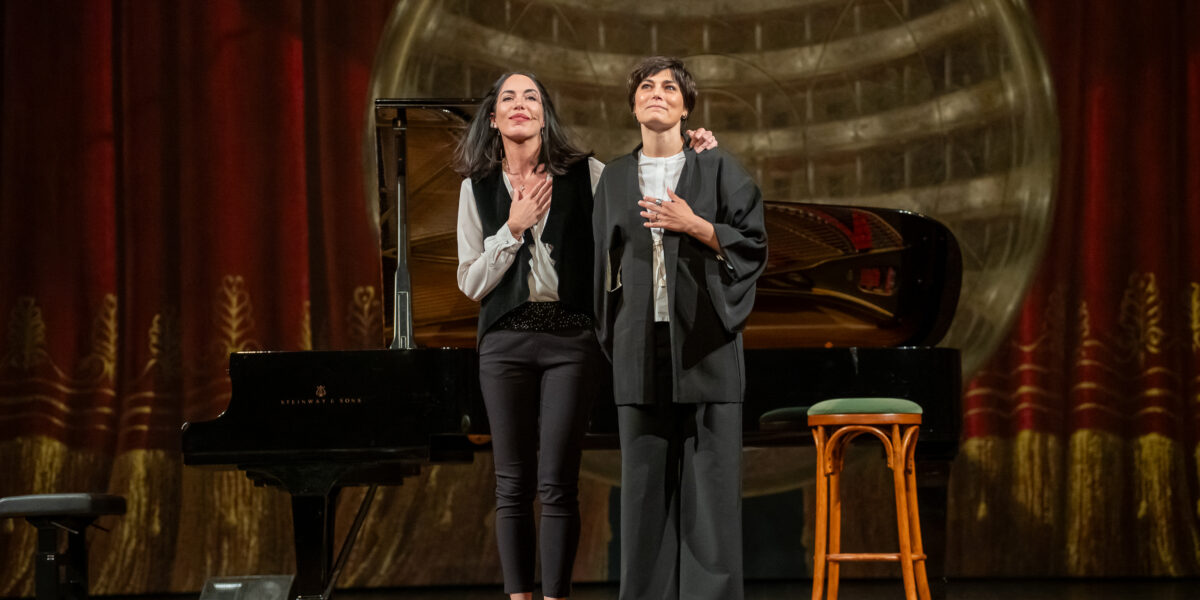
Travel and knowledge in their mutual reference at the center of “Beyond the Pillars of Hercules – Guide to the journey from Chopin to Stevenson” (Savà Produzioni Creative), Monday 10 August at 9pm at the Ancient Theater of Taormina for the 2026 edition of the Taormina Arte International Festival. A show that develops along the paths suggested by the poets who made the journey a literary genre, starring the actress Valeria Solarino, one of the most talented Italian performers, and the pianist Gloria Campaner, an internationally renowned concert performer. Words in dialogue with music, therefore, alternating the verses of authors such as Baudelaire, Whitman, Stevenson (poet of travel par excellence), Cendrars and Dickinson with the evocative compositions of musicians of the caliber of Debussy, Field and Chopin, until closing with Ulysses, the traveler par excellence, in the portraits of Homer and Dante.
“Homer is precisely the archetype of literature on travel – underlines Solarino -. A very adventurous and complex journey which is also a journey of the soul, because all the obstacles that Ulysses must overcome represent an inner journey. But the show also talks about another type of physical journey, that of the refugee in search of the promised land described by Ungaretti, which becomes a starting point for talking about the many people forced to leave their country, dreaming of Europe as the ideal landing place”.
The theme of the journey is therefore addressed from both a figurative and concrete point of view, in a process that reaches all the way back to Dante. His Ulysses is thirsty for knowledge, he is not satisfied with the return and takes to the sea again, going beyond the Pillars of Hercules “to follow virtue and knowledge”. “His verses close a circle – concludes the actress -. I love reciting authors with music because music suggests atmospheres.” “Music and poetic text find a similarity in the power of sounds and verses and in the ability of poetry to transform itself almost into a musical instrument – adds Campaner -. We move from Chopin, Berio and Richter to Glass, Debussy and Mompou, touching on minimalism and romanticism, with pieces that can stand up to the beauty of a poem, shorter and narrower than prose. We tried to find music that could also be a flight, a launch, a beauty in a few lines; precisely because, as in poetry, there was no need for too much musical development.”
Can travel still be important for us contemporaries who have the world just a click away? The journey we take with a click is not a journey. – declares Solarino -. We can delude ourselves that we are arriving, but we are still in our bedroom in front of a computer. As Stevenson said, travel is precisely the experience of the same, physical and spiritual at the same time. The danger of our contemporaneity is precisely this: deceiving ourselves that representing something is worth more than living it”. Travel is having the courage to go beyond a border or in any case believe in the existence of a beyond – adds Campaner – of a beyond that takes us out of the comfort zone. It means letting go and letting go of something to open up to something else, listening, not stopping imagining and dreaming. Even the simple gesture of traveling with the mind involves opening one’s eyes to the experience, because a true narrative of oneself or of the world happens through what can truly be told.” Can we therefore also learn something from the very idea of travel? “Of course. The journey can be done while standing still or moving physically – concludes Campaner -; the important thing is that it is always our ability to imagine that does not stop travelling”.