

Add the Gazzetta del Sud as a source
Even before words, in Palazzo Corvaja red speaks, a true material to be crossed: blood, magma, wound, lava, flesh, bright darkness. At the inauguration of Anish Kapoor’s exhibition for Taobuk, the two unpublished works on display imposed a different time on the public, slower than the explanation and more demanding of the gaze. In short, they didn’t ask to be understood immediately. And the vernissage, in the presence of Antonella Ferrara, president and artistic director of the festival, and Arturo Galansino, general director of the Palazzo Strozzi Foundation, did not follow the usual ritual of homage to the artist. In fact, Kapoor was introduced by the poetic performance of Shamma Al Bastaki, an artist from Dubai, who chose a deeper path: «I will never know how you see red and you will never know how I see it», she said. When faced with the same work, he seemed to suggest, no one really sees the same thing.
The British artist, sculptor, and architect, born in Mumbai, academic of the Royal Academy of Arts, uses materials such as granite, limestone, marble, wood and plaster to create objects with enigmatic, geometric or biomorphic shapes, covered in very colorful pigments, a clear reference to the Indian chromatic imagination. As in the two works present in Taormina, suspended in time as disturbing and powerful objects, eruptions that emerge from a dense and violent material. For Kapoor, the pigment does not serve to color, but is part of the work itself. The images do not offer answers, but confront the tragedy of our being, inviting us to accept the fragility of the human condition.
Kapoor, one of the most influential artists in contemporary science, has among other things designed a work for the Pollino National Park entitled “Earth Cinema”: an earth cinema, a “cut” dug into the earth (45 meters long) into which people can enter from both sides. Inside, a long slit allows you to “see” the extraordinary natural landscape, feeling part of it.
It is not surprising then that Kapoor has always been wary of the idea of art as a system of messages to be decoded: “The artist must not necessarily give messages, but initiate research processes”, he said, explaining trust through one of the least reassuring paths possible, with art that does not console, which forces us to remain in front of what cannot be understood at first glance, and resonates like a question with a thousand answers.
Galansino brought this tension back to the heart of the artist’s practice: overcoming the boundaries between painting, sculpture and architecture, to the point of constructing works that transform the visitor’s relationship with space and perception. «The works – he reiterated – do not stand before the visitor as frontal images; they build a perceptive field, forcing it to measure itself with depth, weight, shadow, attraction. They are like eruptions of lava: incandescent surfaces that seem to emerge from the material and transform the painting into physical space.” Kapoor, when he spoke, avoided any definitive explanation. Instead he chose doubt, almost a confession. “For many years, perhaps from the beginning, I felt very strongly that I had nothing to say as an artist,” he said. Pronounced by one of the most recognized artists on the contemporary scene, the phrase did not sound like modesty, but like a stance: art is not born from a ready-made message, but from research. The starting point was precisely a verse heard in Al Bastaki’s performance, that “intuitive madness” that Kapoor recognized as the key to the creative process. «That verse says a lot about this strange process in which we venture, of the risk that perhaps we run to be poets, poetesses».
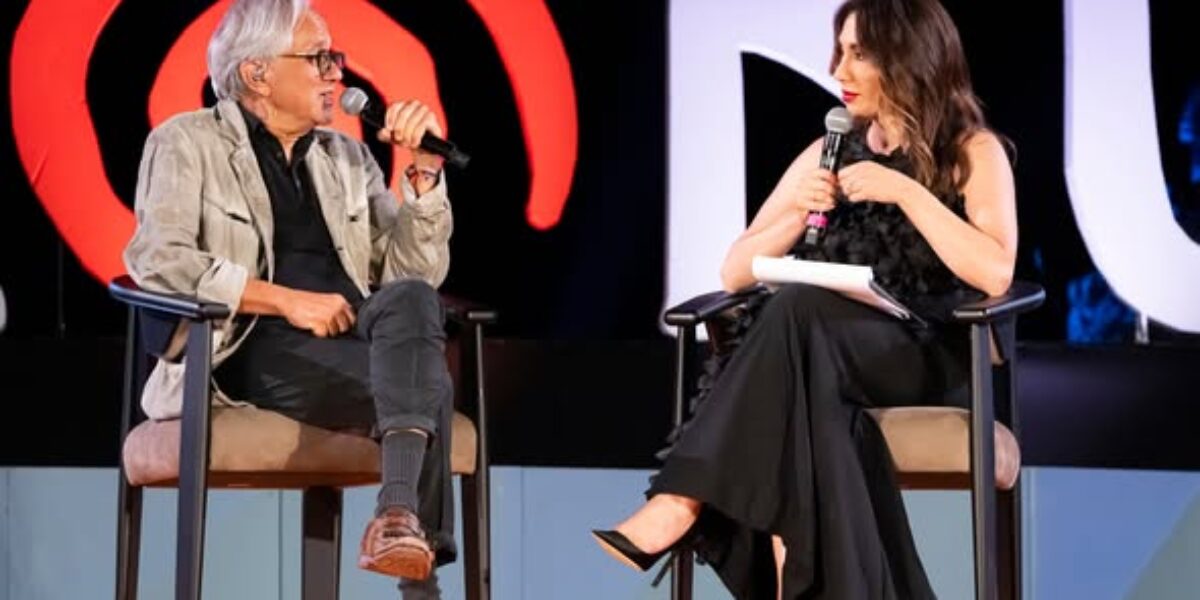
The artist, who received the Taobuk Award on the stage of the ancient theater from the president of the scientific committee Nino Rizzo Nervo and then spoke in Piazza IX Aprile together with Galansino, with the interpretation of Paolo Maria Noseda, spoke of intuition as a force that does not coincide with control: «Feeling is not here, but it is here that we find what we need, it is there that something happens», he says, touching his head first and then his belly. Intuition, for Kapoor, is not enough. Practice and play are needed, that is, the freedom to get lost, to try, to not immediately know where a gesture will lead. Then comes the judgement, the moment in which the work is observed and questioned: «There is this strange process of looking, to the point of wondering what a work can mean and what consequences it can have».
The theme of trust, the cornerstone of Taobuk, thus enters without forcing. Where to put it today? Kapoor replied clearly: «In art, in culture». And then in poetry, as a space where what does not yet have form can begin to exist. In a “very, very sad and tormented world, obsessed with money and possessions, festivals like Taobuk preserve something that belongs neither to one nor the other”. In closing, the story of the long collaboration with Galleria Continua has become the story of a choice: to spread culture everywhere, believing that the value of art does not coincide with the market but with the ability to create relationships. Perhaps this is also the most evident meeting point with the theme of Taobuk: without trust no work is born. Trust in the gesture, in the other, in the unknown. And perhaps, as Kapoor’s works suggest, also in the fact that not everything must necessarily be explained to be understood.
At Palazzo Corvaja, the Anish Kapoor exhibition, curated by Arturo Galansino, with the display of two unpublished works, goes beyond Taobuk and will remain open to visitors for free until 30 June (every day, 10am/1pm and 4pm/8pm).