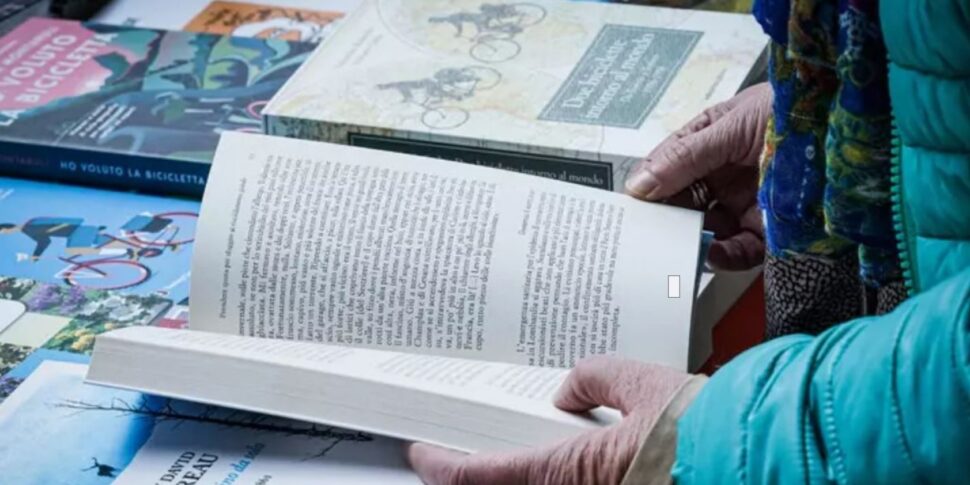
If in our part the bookstores are scarce and the libraries are neither sufficient as a library heritage nor adequate structures, we can be surprised that, in a country where little we read little, in the South-Isle territory you read even less than the center-north? The results of the statistical research, conducted by the AIE (Italian Editori Association) in the last months of 2024, were presented in Naples (hospitality of the Banco di Napoli Foundation) in the conference entitled with optimism “for a spring of reading in the South”, but certainly do not induce equally optimism in the near future. However, having called national and local institutions, private, third sector, world of schools, bookstores, gives the idea of a concrete purpose to change things.
Only a wide -ranging collaboration, in both economic and organizational terms, can give real hope. Among others, there is an interesting reason: “The data we collected indicate how the third sector, cultural volunteering, foundations – said Florindo Rubbettino, president of the Calabrian publishing house of the same name and delegate of the presidency of AIE in the South – are already active in supporting reading”, so much so that they are the only positive voices in the percentages of research. «A tool that can be strengthened with targeted support policies. Alliances are needed on concrete commitments. Between public and private, and in the public between ministries (of culture, education, businesses and Made in Italy), regions and municipalities, and in the private individual between companies (publishers and bookcases in the first place) and non -profit (from foundations to cultural associations) “.
So what are the research data that, as Innocenzo Cipolletta, president of the AIs, has the novelty of having approached the reading data to those of the infrastructures? Investigating the population from 15 years of age in the south and islands (merged Basilicata and Calabria, as well as Abruzzo and Molise) it was found that readers (of any type of book, including ebooks and audiobooks, excluding study those) are 62% of the population, well 15% less than the center-north (77%, while the national percentage is 68%). Further diversified numbers region per region: from 60% of Campania to sad 56% of Sicily, passing for 58% of Basilicata and Calabria. However, it is surprised, when we move on to the results by age, the fact that the band that reads most is between 15 and 17 years old, even 86%: as many as 24% more than the general average. Things worsen with age, to get 46% of the over 75. School therefore seems to play a role, despite insufficient and sometimes even personal school libraries. Why do you get lost on the street? The reasons are varied: books that cost too much; the non -youthful habit to read complex texts; The lack of infrastructure, with few bookstores and libraries and an insufficient number of cultural events. Note the singularity that in South-Isle you buy books in newsstands and postcolibrers for 24% (14% in the center-north). These are shopping businesses at risk, yet it has been stressed that there is no bookseller or librarian who can help the reader. Mind you, it is true that the active and attractive librarian (in extinction) plays a fundamental role, but Rubbettino clearly said how these exercises deserve help, because they often cover small municipalities, where otherwise a book would not arrive, apart from online purchases.
In his message, the Minister of Culture, Alessandro Giuli, recalled the recent decree that will support libraries and new bookstores for 34 million euros. A fundamental initiative, appreciated by the AE which, however, as Cipolletta recalled, must favor the regions that need it most, precisely those of South-Isle. Impossible to give account of all the interesting interventions, but one deserves attention: Chiara Faggiolani, professor of librarian economic of the La Sapienza University, recalled a recent research for which the life expectancy is 61 years old in Trentino against 51 in Calabria. One of the why are the social determinants, including reading which, for the WHO, is part of the well -being. New libraries mean construction of health, as has emerged in a recent conference of the Istituto Superiore di Sanità. In short, the more you read, the better you will be better.