The writer Anaïs Nin described them like this: «The Dalís made their appearance at breakfast. They were both small in stature, and they sat together. They were not remarkable in appearance, she was all moderate tones, a little faded, and he was sketched in charcoal like a child’s drawing of a Spaniard, any Spaniard, except for the incredible length of his moustache, almost in search of protection, of reassurance, and they were not open, nor confident, nor at ease.” It was 1940 and the couple Salvador and Gala Dalí had just arrived in the American refuge, sheltered from the war, the residence of the patron and publisher Caresse Crosby. Nin herself recounts how she was forced to immediately change her mind: «Before we even realized it, the whole house was working for Dalí’s well-being (…). Mrs. Dalí never raised her voice, she never seduced or fascinated. He simply took it for granted that we were all there to serve Dalí, the great indisputable genius.”
Often considered just a great self-builder of consensus, more a character than an authentic artist, the “indisputable genius” shines more than ever in the great exhibition “Dalí and Fashion”, set up in the Palazzo Reale in Milan until January 31st. Painter, sculptor, performer and much more, Dalí (1904 – 1989) had found in fashion the means to transfer his eclectic surrealism directly onto the models, to convey the movement of the transformation of bodies even more than in canvases, to demonstrate that the reality of a dress (as well as of a jewel or an accessory) is never just the known one. And much less the easily recognizable one of everyday life (too banal, let’s say it), but the other one, in movement, which sails between fantasy and idea and transforms into something real and communicative while remaining emotionally outside of “our” reality.
To demonstrate this, we find over 200 works and documents from the three largest collections of Dalí’s works in the world: the Fundació Gala-Salvador Dalí in Figueres, the Dalí Museum in St. Petersburg, Florida, and the Museo Nacional Centro de Arte Reina Sofía in Madrid, plus the historical archives of the Schiaparelli, Chanel, Dior and Rabanne fashion houses. In short, according to Montes Aguer and Laura Bartolomé, two of the architects of the exhibition (promoted by the Municipality of Milan – Culture and produced by Palazzo Reale, MondoMostre and Civita Mostre e Musei in collaboration with the Fundació Gala-Salvador Dalí, with the patronage of the Ministry of Culture, the Spanish Embassy in Italy and the National Chamber of Italian Fashion, catalog published by Skira), «this is an exhibition that invites us to discovery of Salvador Dalí from a new point of view of his cosmogony. There is no such thing as a Dalí as an artist and a Dalí as a stylist, only a total artist capable of leaving his mark wherever possible. Like the masters of the Renaissance, like Leonardo or Michelangelo.”
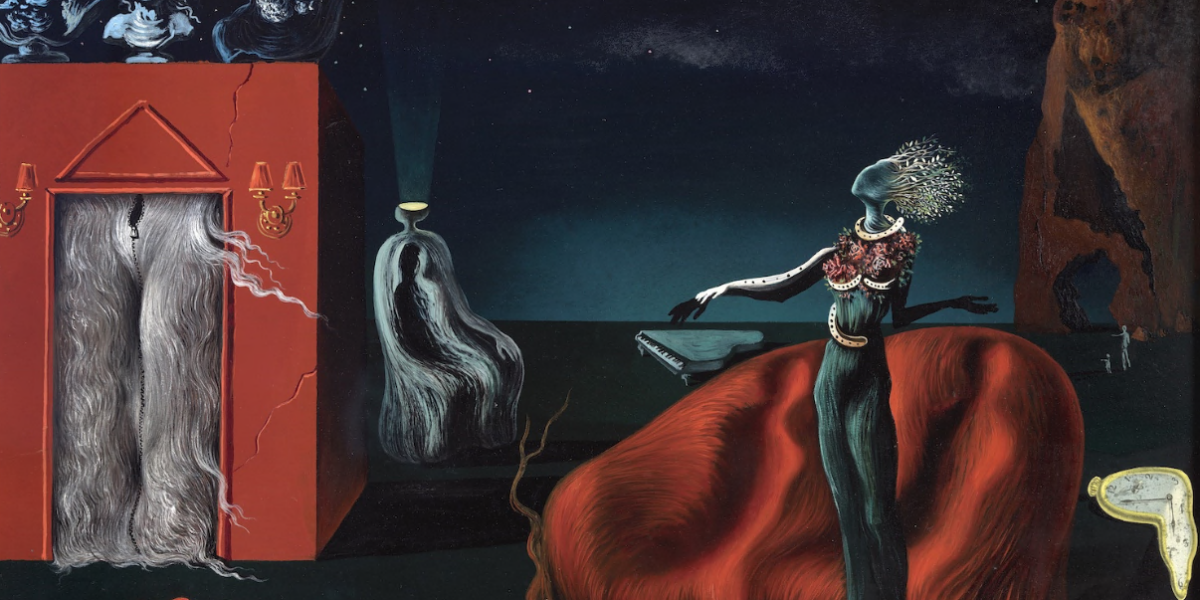
Now, if certain excessive comparisons almost seem to refer to Dalí’s self-promotion, there is no doubt that we are talking about a total artist, capable of creating historical events such as the Ball of the Century in Venice (1951) with the spectacular “Giants” designed together with Christian Dior, or of turning a shoe into a hat in cooperation with the designer Elsa Schiaparelli, or even of having the skeleton dress worn or designing costumes for the ballet “Bacchanale” (1939). But the examples of the Spanish artist’s omnivorous capacity seem to follow one another almost endlessly and the exhibition gives ample account of them with famous paintings (‘Three young surrealist women holding the skins of an orchestra in their arms’ and ‘Untitled. Couple with their heads full of clouds’ would already be enough), drawings, obviously lots of clothes, jewellery, accessories, photographs, films, all in symbiosis with each other, like a long and inexhaustible creative line, capable of transforming people and things in an uninterrupted river of inventions, all authentic subversions of every established thought.
Two famous phrases by Dalí come to mind – inevitably –. The first is: «The uniform is essential to win. Very rare in my life are the occasions in which I have degraded myself by wearing civilian clothes. I always wear Dali’s uniform.” The second is: “Like two standing sentinels, my mustache defends the entrance to my true self.” Significant, allusive, also linked to the world of psychoanalysis celebrated in artistic salons at that time, the two sentences tell us that the first impression of Anaïs Nin had its foundation, but did not ferret out a truth which instead had the complexity of a narcissistic artist for whom it was vitally necessary to go beyond, even beyond himself. With the help of his wife Gala, also a muse, of course, but above all a great maieuta, Dalì managed to characterize almost the entire last century to the point of using the rich people of the Earth as “extras” in his performances, vital and creative precursors of everything that social media today has made banal and repetitive. And he arrived before many others (I’m thinking of David Bowie, for example) at the transformations, or rather hybridisations, of gender (which perhaps had something fetishistic for him) by “using” androgynous models, such as Amanda Lear. A modernity that is still alive, enough to scandalize even André Breton who had distanced him from the “official” surrealists. Salvador Dali did not regret it. Moreover, he could not wear the common uniform of an artistic movement: his could only be the “Dalì uniform”.