

Spain goes to the vote, with a match worth much more than Moncloa. There are 38.7 million voters called to choose the new Parliament, including 1.6 million young people making their debut at the polls: a crucial pool, together with women and undecided people – estimated at 13% – courted until the last vote in a campaign based on emotion and polarisation. Pedro Sanchez is seeking a fourth term at the helm of the government, determined to stop the advance of the right and far right. Alberto Nunez Feijoo, leader of the People’s Party, favored in the polls, aims to conquer Moncloa, after the Pyrrhic victory of 2023, which was insufficient to guarantee him leadership of the executive. But, unlike three years ago, he does not shy away from the coalition with Vox, Santiago Abascal’s party, which aspires to double the consensus and is ready to present him with the bill if he has the key to governability, as almost all the findings indicate. At stake, a historic transition: the return of the far right to government for the first time since the end of Franco’s dictatorship.
The socialist prime minister arrives at the polls after a tormented legislature that was never legitimized by his opponents, due to the original sin of the amnesty granted to the Catalan independentists in exchange for the investiture. Then came the corruption accusations, which did not spare his family circle, the Ceuta migration crisis, with over 80 thousand arrivals from Morocco at the end of July, the controversies over the management of the flows resumed in the Canary Islands and two serious train accidents in nine months, the last one, at the end of October, costing the lives of 69 people. A sequence that PP and Vox have transformed into a new referendum on ‘sanchism’.
Five themes dominated the campaign: housing emergency, cost of living, immigration, corruption and railway safety. Housing itself had triggered the crisis, after the failure in Parliament of the government’s emergency package against high rents and evictions, rejected by PP, Vox and Junts, which pushed Sanchez to bring forward the elections. The prime minister relaunched, approving with allies to the left of the PSOE, a flurry of social measures, with the Chambers dissolved: from the increase in pensions and salaries of public employees to the cut in personal income tax for the self-employed, to the expansion of family leave. “My government was not perfect. I made mistakes”, he admitted, however claiming action “in the right direction” and contrasting two country models: the “red dam” with the oncoming “oil slick”. “We are called to make history. And history does not come alone: we have to give it a push”, he urged at the Caja Magica, closing the electoral campaign with a kiss to his wife Begona Gomez. Popular leader Feijoo promised “truth, decency and good management”, assuring: “This time we will not only win, but govern.” Contesting Abascal’s hard line on immigration, he visited Ceuta, the exclave in Morocco, six times. Even on the day of ‘reflection’ and electoral silence, on the eve of the vote, breaking a consolidated custom. The latest public polls indicate a stable PP, but eroded by the ascendant Vox, which has stirred up the issues of ‘remigration’ and the national priority of Spaniards in accessing homes and services. Abascal appealed to right-wing people to “vote with courage” to oust Sanchez from Moncloa.
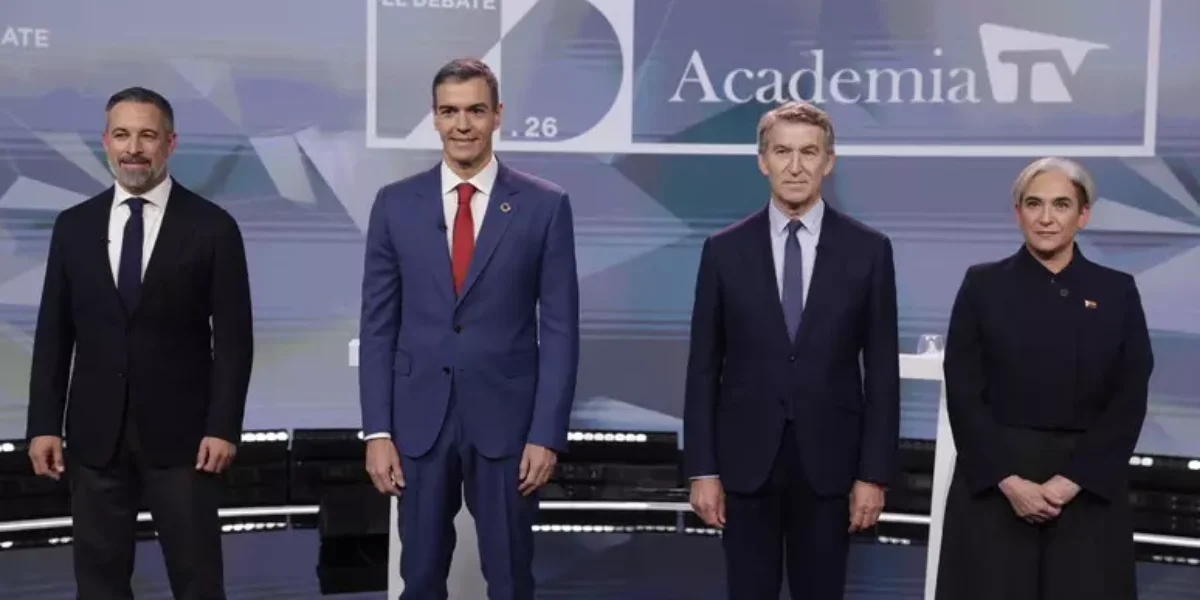
But the 112 billion cuts in public spending – the equivalent of half the annual budget – promised by Vox in Milei’s chainsaw style have frightened many and risk slowing down their progress. Together with Abascal’s denial of gender violence, evident in the lack of explicit condemnation in the television duel of the four candidates, requested by the leader of the Frente Amplio, Ada Colau. In the debate, a ‘slip’ that could alienate part of the female vote also from Feijoo, who with his index finger to his nose ordered the candidate of the alternative left “Shut up!”, attracting criticism from “machismo”https://gazzettadelsud.it/articoli/mondo/2026/11/29/elezioni-in-spagna-destre-allaiuto-della-moncloa-ma-sanchez-crede-nella-remontada-06104e34-b88e-4c74-8ca0-af5b91aad741/.”Not only will we not stay silent, we will win on Sunday”, Colau’s reply, which relaunched the defense of women’s rights and the welfare state. And it is on women’s mobilization that the resilient prime minister hopes for a remontada, on a ticket with the Frente Amplio and supported by the same eight forces that gave him their trust 3 years ago. But maybe, this time, without the help of Junts.