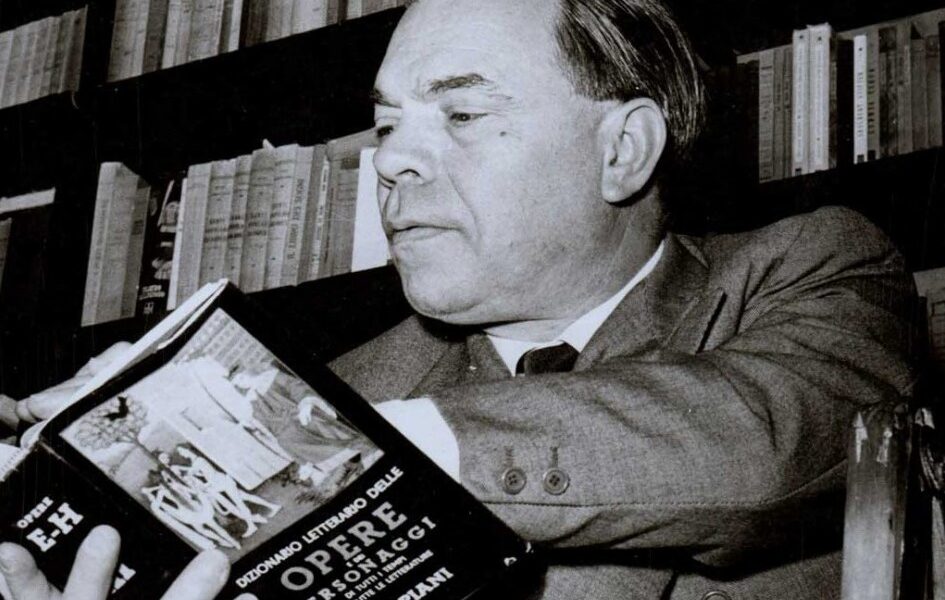
Corrado Alvaro (San Luca 15 April 1895 – Rome 11 June 1956), is defined as the most important writer of the second half of the twentieth century due to the complexity of his work. A great elzevirista, he has disseminated his articles on the third pages of the major newspapers; he was an innovative poet (the Grey-green Poems); novelist and short story writer, second only to Pirandello in short fiction (The Beloved at the Window; The Sea); diarist (Almost a Life is among the finest European logbooks); author and theater critic (Long Night of Medea is at the top of tragic texts); memoirist of the “underwater world” (the narrative trilogy with that title); and a very fine translator (of Lope de Vega, Scott, Dostoevsky and Sologub) and an intellectual and essayist of absolute importance. His journalistic activity led him to live in Paris and Berlin and to have, as a special correspondent, experiences from which travel books arise. An imposing figure, therefore, given the breadth of his cultural and inspirational horizons: for Alvaro the secret of art is to connect the microcosm of Calabria (the country of the soul which acts as a substratum to his entire creative itinerary; the high and radiating line of an entire literary and civil tradition, from the Magna Graecia roots to Gioacchino da Fiore, from Campanella to Padula) and the European reality, into which Alvaro was grafted to explore the phenomenology and pathology of the new civilization.
The full article is available in the print and digital editions