

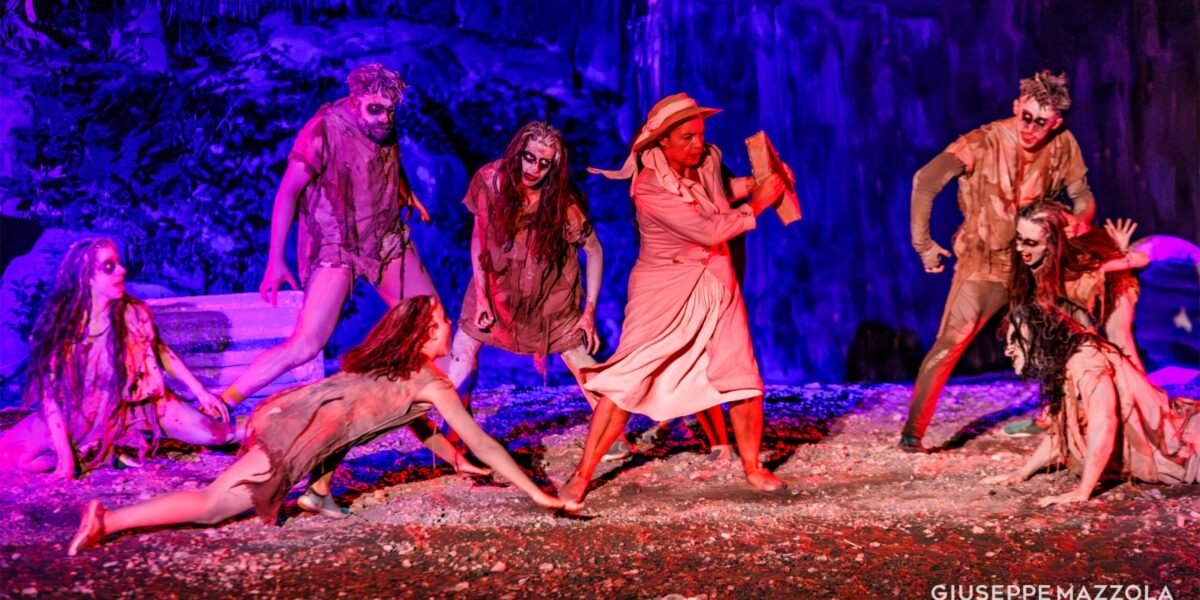
“You really feel inside a poem, in this case the Divine Comedy: and, in addition to the actors, to castNature itself is the protagonist”.
Thus Carmen Greco, journalist of the newspaper Sicilydescribed the emotion of attending theHell of Dante, the most seen among the open-air shows proposed in recent years in Sicily, adding: “It’s as if you were on the banks of the Acheron: you find Charon, Farinata degli Uberti, Ciacco, Virgilio, Dante, and a Beatrice only dreamed of: I don’t think the same suggestions could develop in a place other than the Alcantara Gorges”.
“So – he concluded -, at the end, it seems like we are going out to see those stars again, which in reality we have already admired from here. And another plusin this fiery summer, is the fact that it is nice and cool on the river banks.”
The 2026 edition ofHellproduced by Buongiorno Sicilia with the dramaturgy and direction of Giovanni Anfuso, is drawing to a close – the last performance is set for next Sunday, 6 September, at 10pm – accompanied by a genuine ovation. Also from those who, like the Palermo photographer and documentary maker Giuseppe Mazzola, wanted, as in past years, to pay homage to this Hell with the shots we propose.
“Here Nature is not scenography, but is part of the work – he said – and whoever plays in the Gorge stops being simply an actor and becomes something else: character, symbol, memory, pain, guilt, hope. Photographing them, I noticed something extraordinary: the light manages to draw a real geometry, not only of emotions, but also of human conditions. A sort of suspended state of mind, an emotion in movement, material, plastic. And here I understand the extraordinary nature of their making theatre, culture and memory”.
Among the protagonists of the work, Liliana Randi spoke about her role, which she has played since the first performance: “a tourist who, visiting the Gorges, finds herself atHell and, deluding herself that she is also Beatrice, she makes the public relive this mythical meeting”.
“I feel like Beatrice – she concluded – in that moment in love with Dante, who helps him get out of a difficult situation. impasseof tragedy when he finds himself in the dark forest. And the tourist finds herself Beatrice, almost a saint, in Heaven.”
For Luigi Nicotra, who plays Dante, “Beatrice has always been the woman desired by a childhood love”.
“They know each other – he explains -: at nine years old and they will never be together: she will marry another man and, at just 24 years old, she will die. Here, Dante writes The Divine Comedy to be able to meet Beatrice again, together with Virgil, who helps the Pope in the undertaking”.
Even in these latest performances, great applause for the actors. In addition to those already mentioned, Davide Sbrogiò (Count Ugolino), Salvo Piro (Virgil), Giovanna Mangiù (Francesca), Ivan Giambirtone (Ulysses), Luigi Nicotra (Dante), William Caruso (Farinata), Federico Fiorenza (Charon), Davide Pandolfo (Ciacco) and Peter Passalacqua (Paolo Malatesta, Diomede and Archbishop Ruggeri). Warm applause also for the infernal choir, made up of Chiara Di Giovanni, Giulia De Marzi, Alessia Linguaglossa, Marta Marino, Gaia Palmeri, Lucio Rapisarda, Francesco Rotatore, Emiliano Sgroi and Federica Zuccarello. And Gloria Trischitta, at the third edition of this show, who underlined the greater impact on the public of this year’s choreographies.
“Playing the Damned – she said – running between the stones and the river water is not as easy as being on a stage: every day is a challenge, it brings suffering. But this too is theatre: the need to expose human wounds. And this gives us strength and has made me grow a lot.”
In short, “A fantastic show, so much so that it made me want to go over the poem again” as underlined by Franco Sciacca, a Sicilian actor who came from Rome to see Hell and spoke of “A company of very good performers, in a wonderful place, perfectly used by the director Giovanni Anfuso”.
“I wasn’t distracted for a single moment – concluded Sciacca, also known for his participation in TV serials such as The young Montalbano And Vanina -, because it was so full of effects, of choreographic movements… In short, a show that makes you exclaim: Well, I saw a beautiful thing!”
As has been highlighted several times, one of the most appreciated novelties of this edition were the choreographies of Fia Distefano. Appreciations from the spectators, then, for the costumes by Riccardo Cappello, the scenic elements by Silver Ruggeri and the lights by Davide La Colla. Finally, worth mentioning are the assistant directors: Micaela De Grandi, Valentina Ferrante, Davide Pandolfo and Lucia Rotondo.